
📅 Last Updated: September 02, 2026
Quick Answer
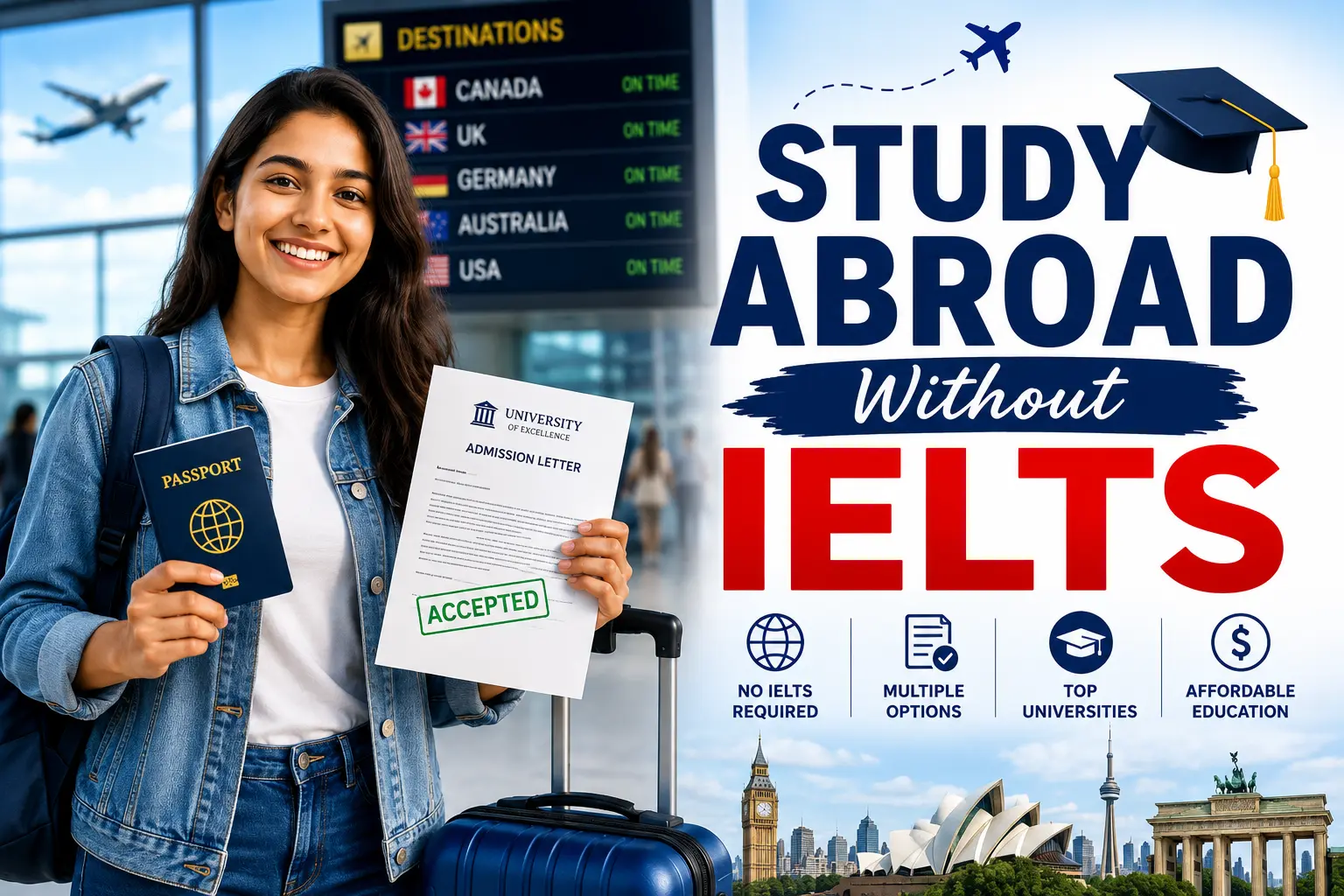
“Study abroad without IELTS” does NOT mean studying with zero English proof. It means universities are accepting alternatives like the Duolingo English Test, TOEFL, PTE, Medium of Instruction (MOI) letters, or internal interviews to assess your readiness.
Germany & Poland
Very Flexible
MOI/Interviews accepted
UK & Canada
Conditionally Flexible
Depends on Visa/School
Australia & USA
Stricter Policies
Often need alternative test
Key Rule: University admission policy ≠ Visa policy. You might get into a school with an MOI letter, but the embassy might still ask for a language test score.
👉 Use the guide below to find the best alternative route for your specific situation, budget, and destination.
📌 Quick Navigation
What “Study Abroad Without IELTS” Really Means
If you are searching for “no ielts” or “study without ielts,” here is the truth: universities rarely mean zero English proof. When a university says they accept students without IELTS, they usually mean one of these five situations:
- Alternative Tests: They accept Duolingo, TOEFL, PTE, or Cambridge exams instead.
- Conditional Waivers: You don’t need IELTS *if* your previous degree was taught in English.
- Interviews: They will assess your speaking and listening via a live video call.
- Pathway Programs: You get admission, but must complete a 3-6 month English prep course first.
- MOI Letters: You submit a document from your previous school proving English was the medium of instruction.
⚠️ The “No IELTS” Trap
I have seen students apply to a “No IELTS” university only to be asked for a recorded interview or an internal English exam weeks later. “No IELTS” often means “No standard test center required,” not “No proof needed.” Always read the admission fine print before paying application fees.
Why Universities Are Dropping Strict IELTS Requirements
The shift isn’t happening out of charity. It is driven by economics and data.
📉 Access Issues
In regions across Africa and South Asia, IELTS test centers are expensive or geographically inaccessible. A student shouldn’t lose a scholarship because the nearest test center is 500 km away.
📊 Predictive Validity
Admissions officers increasingly note that academic transcripts and interviews are stronger predictors of student success than a single standardized test score on a stressful Saturday morning.
Country-by-Country Eligibility Table
Here is the reality check for 2026. “No IELTS” policies vary wildly depending on the immigration authority, not just the university.
| Country | Waiver Conditions | Accepted Alternatives | Visa Language Nuance |
|---|---|---|---|
| 🇩🇪 Germany | Very Flexible. MOI accepted widely for private universities. | MOI Letter, Interview, Duolingo | Low visa risk. Embassy usually follows university decision. |
| 🇵🇱 Poland | Very Flexible. Interview-based admissions common. | Interview, MOI, Internal Test | Low risk. Focus is on tuition payment proof. |
| 🇬🇧 UK | Conditional. High school English scores often accepted. | MOI, High School %, PTE | Moderate risk. UKVI requires a Secure English Test (SELT) for some visas. |
| 🇨🇦 Canada | Strict. Usually requires proof unless you studied in English for 4+ years. | TOEFL, Duolingo, Pathway | High risk. SDS Visa specifically requires IELTS/TOEFL for fast processing. |
| 🇺🇸 USA | Decentralized. Varies by school. | TOEFL, Duolingo, iTEP | Moderate risk. Embassy interviews assess English spoken ability. |
| 🇦🇺 Australia | Strict. Universities rarely waive entirely. | PTE, TOEFL, Cambridge | Very High risk. Dept of Home Affairs requires “Functional English” proof. |
If you are looking for countries where an MOI letter is most effective, focus on Germany, Poland, Hungary, and Malaysia. If you are targeting Canada or Australia, assume you will need a test for the visa, even if the university waives it.
Which Route Should You Take? (Decision Flow)
Students often ask, “Should I take Duolingo or just use my MOI letter?” Here is the framework I use when advising students:
- Did you complete your last 4 years of education in English? -> Yes: MOI Letter is your cheapest option. No: Go to step 2.
- Is your budget tight and do you have stable internet at home? -> Yes: Take the Duolingo English Test. It is accepted in 4000+ schools and costs under $60. No: Go to step 3.
- Are you applying to a specific university known for interviews? -> Yes: Ask the admissions officer for an Internal Assessment/Interview instead of a test.
- Is your GPA strong but English is weak? -> Yes: Enroll in a Pathway/Prep Program. You get admitted, but you study English for the first semester.
Best Alternatives to IELTS in 2026
🟢 Duolingo English Test
Best for: Students who need speed and affordability. You take it from your bedroom. Results in 48 hours. Accepted widely in the USA, Canada, and increasingly in Europe.
🔵 TOEFL iBT
Best for: High academic rigor. If you are applying to top 50 universities or competitive research programs, TOEFL is often trusted more than Duolingo.
🟠 PTE Academic
Best for: Australia and New Zealand. The Pearson test is computer-graded, which removes human bias. Highly favored by immigration departments.
📄 MOI Letter
Best for: European universities. This is a simple certificate from your Registrar or Principal. It is not a “hack”—it is legitimate proof of education history.
Can You Get Scholarships Without IELTS?
Yes, but this is where the competition gets brutal.
Universities might waive IELTS for admission, but scholarship committees are looking for reasons to reject you because the applicant pool is so deep. If you are applying for a fully-funded scholarship, having a strong English test score (even Duolingo) acts as a tie-breaker. For more on funding, see our complete guide to scholarships for international students.
Strategic Advice
If your target is a tuition-free country (e.g., Germany), an MOI letter is often enough. If your target is a scholarship in the UK or USA, budget the $60 for Duolingo. It will pay for itself if you win $50k in funding.
Common Mistakes Students Make (And How to Avoid Them)
1. Believing You Need Zero English
This is the biggest lie on the internet. If your English is B1 level or lower, you will struggle to pass the first semester of a Bachelor’s or Master’s program. The goal is to bypass the test, not bypass the skill.
2. Ignoring the Visa Office
I cannot stress this enough: Universities decide admission. Embassies decide visas. If you are from a country with high visa rejection rates (e.g., Nigeria, Pakistan, India), a university MOI letter might not satisfy the visa officer. They might ask, “If you are serious about studying in English, why haven’t you taken a test?” Always check the visa checklist before paying tuition.
3. Using AI-Generated SOPs
Admissions officers are now running AI-detection software. An essay that says “I want to be a global citizen” without specific details will not get you a waiver. Write about a specific professor you want to learn from or a specific lab you want to join.
Improve Your Chances Without IELTS
Here’s what actually strengthens an application when you don’t have a test score:
Build Strong Academic Consistency
Universities are more willing to waive IELTS for students with good grades, strong coursework, and clear academic direction. A solid transcript reduces perceived risk. If you’re unsure how your grades translate, use our GPA guide and calculator to understand where you stand.
Write a Credible Statement of Purpose
Your SOP should sound like a real person with a real academic plan. Include why this course fits your goals, what problem you want to solve, why this country/university makes sense, and how your background connects naturally. Avoid vague statements like “I want to study abroad to achieve my dreams.”
Prepare for Interviews
Some universities conduct short interviews instead of requesting IELTS. Practice speaking clearly, explaining your academic goals, discussing your course choice, and answering naturally without memorized scripts.
Remember, the goal is not just admission but career outcomes after graduation. Explore our guide on internships for international students to plan ahead.
❓ FAQs About Studying Without IELTS
Is studying abroad without IELTS really worth it?▼
It is worth it if you choose the route strategically. If you are confident in your English but just lack the certificate, an MOI letter or Duolingo is perfect. If you are avoiding IELTS because your English is weak, you are setting yourself up for failure abroad. Also consider the long-term benefits: a strong internship or job after graduation makes the journey worthwhile, so plan with career outcomes in mind.
Do I still need English if my university waives IELTS?▼
Yes. You must be able to read textbooks, write essays, and participate in seminars. The university is waiving the paperwork, not the competency.
Which country is best to study without IELTS for Indian students?▼
Germany is the top choice for Indian students due to low tuition and high acceptance of MOI letters. Poland and Hungary are also excellent for business and medical programs.
Can I get a student visa with just an MOI letter?▼
In Germany and Poland, usually yes. In Canada or Australia, often no. You must check the specific immigration checklist for your country of origin and destination.
Is Duolingo easier than IELTS?▼
It is often considered more convenient and less stressful than IELTS because it is shorter and taken online. However, “easier” is subjective—the adaptive nature of the test can be challenging if you don’t prepare.
🌍 LearnviaHub.com – Free Educational Tools for International Students

Christian Chinonso is the founder of LearnViaHub, with 6+ years of research experience in international education, GPA systems, and study-abroad guidance for international students.Christian Chinonso is the founder of LearnViaHub, with 6+ years of research experience in international education — including GPA systems, scholarships, student financing, and study-abroad guidance — for students worldwide.