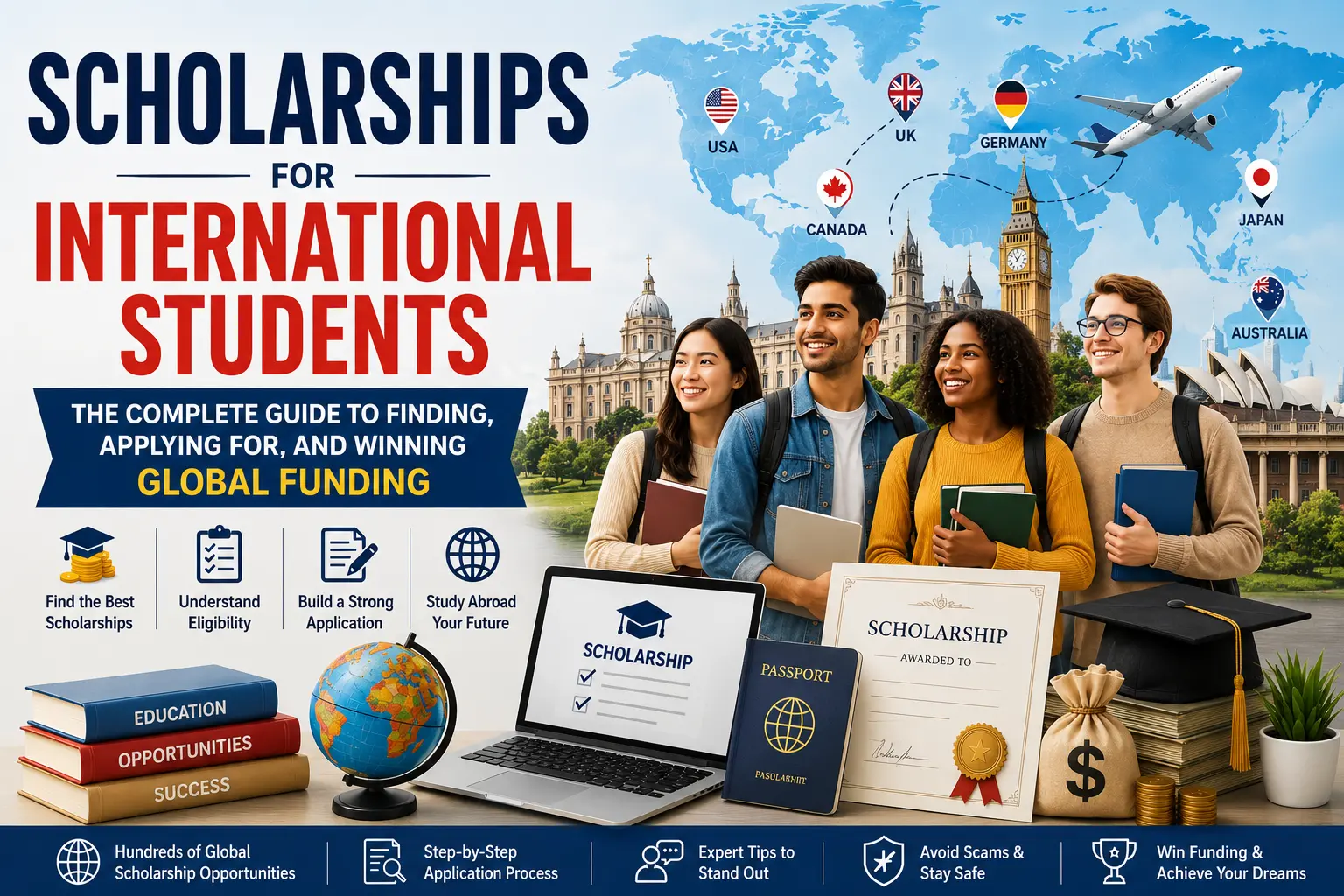
The Complete Guide to Finding, Applying for, and Winning Global Funding

Studying abroad can be one of the most rewarding investments you’ll ever make, but for many students, the cost is enough to put those plans on hold. Between tuition fees, accommodation, travel expenses, health insurance, and everyday living costs, earning a degree overseas can seem financially out of reach.

The good news is that thousands of scholarships for international students are awarded every year by governments, universities, charitable organizations, and private foundations. These international scholarships range from small tuition awards to fully funded programs that cover nearly every major expense. Yet many deserving applicants miss out, not because they aren’t qualified, but because they don’t know where to find legitimate scholarship opportunities or how to apply strategically.

Whether you’re searching for study abroad scholarships for an undergraduate degree, a master’s program, doctoral research, or a short-term exchange, understanding how the funding landscape works can make a significant difference. The right information can help you focus on opportunities that match your profile, avoid common mistakes, and submit stronger applications.

This guide brings together everything you need to know about international student scholarships, from finding trusted funding sources to building competitive applications that give you the best chance of studying abroad without unnecessary financial stress.

What Are Scholarships for International Students?

At its simplest, scholarships for international students are financial awards designed to help students from one country study in another without carrying the full burden of tuition and living expenses. These awards are part of a broader system of international education scholarships and scholarship programs created to support academic exchange, global talent development, and access to higher education.

Unlike student loans, scholarships do not require repayment because they are awarded as financial assistance rather than borrowed funds. Depending on the scholarship provider, funding may cover tuition fees, living expenses, travel costs, research, or other education-related expenses. Learn more about how scholarships differ from other forms of student financial aid on the OECD’s student support page.

How International Scholarships Differ from Domestic Scholarships

The biggest difference between international and domestic student scholarships comes down to eligibility and cost structure.

Domestic scholarships are usually limited to citizens or permanent residents of a country and often align with national education funding systems. International scholarships, on the other hand, are designed specifically for students studying outside their home country. This means they often cover additional costs like visas, travel, health insurance, and higher international tuition fees.

In many cases, educational grants for international students are also more competitive because they attract applicants from a global pool rather than a single country.

Who Qualifies as an International Student?

An international student is typically anyone studying in a country where they do not hold citizenship or permanent residency. For example, a student from Nigeria studying in Canada, the UK, or Germany would be classified as an international student.

Although specific definitions vary slightly between countries and institutions, the UNESCO Institute for Statistics defines internationally mobile students as individuals who cross a national border to pursue education outside their country of origin. You can read UNESCO’s official definition here.

This classification matters because it determines access to academic scholarships and funding opportunities specifically reserved for non-resident applicants. Some programs are open globally, while others are restricted to certain regions, countries, or academic fields.

Common Types of Scholarships for International Students

Understanding the structure of funding is key to identifying the right opportunities. Most scholarship programs fall into one or more of the following categories:

1. Merit Scholarships

These are awarded based on academic performance, test scores, leadership achievements, or extracurricular excellence. Strong grades and a competitive profile are usually required, but some programs also consider talent in sports, arts, or research.

2. Need-Based Scholarships

These focus on financial circumstances rather than academic results alone. Students from low-income backgrounds are often prioritized, especially in programs aimed at improving global access to education.

3. Government Scholarships

Government-funded scholarship programs are often fully funded, covering tuition fees, living expenses, travel costs, and health insurance. For example, Australia’s dfat.gov.au support students from developing countries to undertake undergraduate and postgraduate study while fostering long-term international partnerships.

4. University Scholarships

Individual universities frequently offer international student scholarships to attract talented applicants. These may be partial or full awards and are often tied to specific degree programs or faculties.

5. Private Scholarships

Corporations, foundations, and private donors also provide funding. These scholarships may focus on leadership, innovation, entrepreneurship, or specific career paths.

6. NGO Scholarships

Non-governmental organizations support students from disadvantaged backgrounds or specific regions, often focusing on social impact, development, or community leadership.

Common Myths About International Scholarships

One of the biggest misconceptions is that scholarships are only for students with perfect grades. While academic excellence helps, many scholarship opportunities also value leadership, community involvement, personal stories, and long-term goals.

International organizations such as UNESCO and the OECD also highlight the important role scholarships and grants play in improving access to higher education worldwide.

Why Scholarships for International Students Have Become More Competitive

Winning scholarships for international students today is more challenging than it was a decade ago, and the reasons go far beyond just “more applicants.” The entire global education landscape has shifted, and funding has not kept pace with demand.

One of the biggest drivers is rising tuition costs. Universities in popular study destinations like the UK, Canada, the US, and Australia have steadily increased fees for international students. As costs rise, more students actively search for international scholarships and study abroad scholarships, creating heavier pressure on the same pool of funding. According to the OECD’s Education at a Glance reports, the cost of higher education and patterns of international student mobility continue to shape demand for financial support worldwide

At the same time, the number of applicants has grown rapidly. Improved access to information, online application portals, and global awareness means students from nearly every region are now competing for the same international student scholarships and scholarship opportunities. What used to be a regional competition has become truly global. UNESCO Institute for Statistics data shows that millions of students now pursue tertiary education outside their home countries, reflecting the steady growth of international student mobility.

Funding itself has not expanded at the same rate. Many scholarship programs, especially government and university-funded ones, have fixed budgets. When more students apply but funding stays the same, acceptance rates naturally drop.

Economic conditions also play a major role. Inflation, reduced public spending in some countries, and shifting government priorities have made it harder for institutions to expand educational grants. In addition, currency fluctuations can dramatically increase the real cost of studying abroad for families, pushing even more applicants into the scholarship pool.

Beyond the financial pressures, selection committees have also become more selective in how they evaluate candidates.

Strong grades are still important, but they are no longer enough. Committees now look for a combination of academic ability and personal impact. They want students who can show leadership, community involvement, clear career direction, and the ability to contribute to their field or home country after graduation.

In many cases, two applicants with similar academic performance will be distinguished by how clearly they communicate their goals, how authentic their personal story is, and how well they align with the mission of the scholarship provider. This is why academic scholarships increasingly favor well-rounded applicants rather than purely high-achieving students.

Types of Scholarships Available Around the World

When students start searching for international funding opportunities, one of the first surprises is just how many different types of scholarships exist. Not all scholarships are built the same, and understanding the structure behind them helps you quickly identify which ones are worth your time, and which ones won’t realistically support your study goals.

Fully Funded Scholarships

Fully funded scholarships are the most competitive and the most sought after. These awards are designed to remove almost every financial barrier associated with studying abroad.

Fully funded package include

  • Full tuition coverage
  • Monthly living allowance
  • Round-trip flights
  • Health insurance
  • Accommodation support (in some cases)
  • Research or academic project funding

Some programs also include additional benefits like internship placement, language training, or mentorship opportunities. Because they cover nearly everything, fully funded scholarships attract thousands of applicants globally, making selection extremely competitive.

Partially Funded Scholarships

Partially funded scholarships cover only a portion of study costs. This could be a percentage of tuition fees or a fixed monetary award that helps reduce overall expenses.

While they don’t eliminate financial pressure completely, they are far more accessible than fully funded options. Many students combine partial scholarships with personal savings, part-time work, or external funding.

Tuition Waivers

A tuition waiver removes part or all of your tuition fees but does not cover living costs. These are common in public universities and are often awarded based on academic merit or financial need.

Research Scholarships

Research scholarships are designed for postgraduate students, especially those pursuing master’s by research or PhD programs. They often fund specific academic projects and may include stipends for living expenses, depending on the institution or research grant provider.

Exchange Scholarships

Exchange programs allow students to study abroad for a semester or academic year while paying tuition to their home institution. These programs are often supported by partner universities or government agreements.

Athletic Scholarships

Athletic scholarships reward students with outstanding sports performance. They are especially common in countries like the United States, where universities recruit athletes for competitive sports programs while supporting their education financially.

Leadership Scholarships

These scholarships focus on students who demonstrate leadership potential, community involvement, or social impact. Academic performance is important, but personal achievements and initiative often carry equal weight.

Country-Specific Scholarships

Some governments design funding programs exclusively for students from specific regions or developing countries. These international funding opportunities are often part of diplomatic, cultural exchange, or development initiatives.

Program-Specific Scholarships

These scholarships are tied to particular fields of study such as engineering, public health, business, or environmental science. They are often funded by universities, industry partners, or research institutions looking to develop talent in specific areas.

Best Scholarships for International Students

When people search for the best scholarships for international students, they’re usually expecting a long list of opportunities. But in reality, the strongest approach is not knowing more scholarships, but understanding how the top ones are structured and what makes them competitive. The most successful applicants focus on categories rather than random scholarship listings, because it helps them target the right opportunities faster.

Below are some of the top international scholarships, grouped by source and purpose.

Government Scholarships

Government-funded programs are among the most prestigious and competitive international scholarships available. They are designed to promote cultural exchange, academic development, and diplomatic relations.

Examples

Fulbright (USA)

Administered by the U.S. government, the Fulbright Foreign Student Program is one of the world’s most prestigious international scholarship programs, supporting graduate students, researchers, and young professionals from more than 160 countries.

  • Coverage: Tuition, living expenses, travel, health insurance
  • Eligibility: Graduate students, researchers, professionals
  • Best candidates: Strong academic records, leadership experience, clear research or career goals

Chevening Scholarship (UK)

Funded by the UK government, the Chevening Scholarship offers fully funded master’s degrees to future leaders from around the world. The program emphasizes leadership potential, professional achievement, and the ability to contribute to your home country after graduation.

  • Coverage: Full tuition, monthly stipend, flights, visa costs
  • Eligibility: Master’s degree applicants with leadership potential
  • Best candidates: Mid-career professionals with impact-focused goals

Australia Awards

The Australia Awards Scholarships are funded by the Australian Government to help students from eligible developing countries pursue undergraduate or postgraduate studies at participating Australian universities.

  • Coverage: Full tuition, living allowance, travel, establishment costs
  • Eligibility: Students from developing countries
  • Best candidates: Applicants aligned with development goals of home countries

DAAD (Germany)

The German Academic Exchange Service (DAAD) is one of the world’s largest scholarship organizations, offering funding for master’s students, PhD candidates, researchers, and academics.

  • Coverage: Tuition (often free), stipend, insurance, travel support
  • Eligibility: Postgraduate students and researchers
  • Best candidates: Strong academic or research background

Erasmus+ (EU)

The Erasmus+ Programme is funded by the European Union and supports students pursuing exchange studies, joint master’s degrees, internships, and academic mobility across Europe and partner countries worldwide.

  • Coverage: Tuition, mobility allowance, travel support
  • Eligibility: Students studying within European partner institutions
  • Best candidates: Students in exchange or joint-degree programs

MEXT (Japan)

The MEXT Scholarship, sponsored by Japan’s Ministry of Education, Culture, Sports, Science and Technology, provides fully funded opportunities for undergraduate, master’s, doctoral, and research students to study at Japanese universities.

  • Coverage: Tuition, monthly stipend, airfare
  • Eligibility: Undergraduate and postgraduate students
  • Best candidates: Academically strong students with interest in Japan

University Scholarships

Top universities offer some of the most competitive scholarship opportunities, often tied directly to admission.

Examples

  • Oxford University Scholarships
  • University of Cambridge Funding
  • Yale University Financial Aid
  • Stanford University Scholarships
  • University of Toronto Awards
  • ETH Zurich Excellence Scholarships

Coverage

  • Full or partial tuition
  • In some cases, living stipends or research funding

Eligibility

  • Admission into the university
  • Outstanding academic performance
  • Strong personal statement and references

Best Candidates

  • High-achieving students with clear academic direction
  • Applicants with leadership, research, or innovation potential

International Organizations & Foundations

These scholarships are funded by global institutions focused on development, leadership, and education access.

Examples

  • Commonwealth Scholarships
  • Coverage: Full tuition, travel, living expenses
  • Eligibility: Citizens of Commonwealth countries
  • Best candidates: Students with leadership potential and development focus

World Bank Scholarships (JJ/WBGSP)

  • Coverage: Tuition, travel, living allowance
  • Eligibility: Development-related master’s programs
  • Best candidates: Professionals working in public or development sectors

Rotary Foundation Scholarships

  • Coverage: Partial or full funding depending on district
  • Eligibility: Graduate-level students with service background
  • Best candidates: Community-focused applicants with leadership experience

What Makes These Scholarships Competitive

Across all categories, the most successful applicants share similar traits. Strong grades matter, but they are not the only deciding factor. Selection committees often prioritize

  • Leadership and initiative
  • Clear academic or career direction
  • Community or social impact
  • Research potential (for postgraduate applicants)
  • Alignment with scholarship goals

This is why the top international scholarships are not just academic rewards, they are strategic investments in future leaders, researchers, and professionals.

Countries Offering the Most Scholarship Opportunities

When students look for international funding opportunities, one of the most important decisions they make is choosing the right study destination. Different countries don’t just offer different education systems, they also fund international students in very different ways. Some rely heavily on government scholarships, others on university-based funding, and some combine both with generous research and development grants.

United States (USA)

The USA offers a wide range of international student scholarships, but competition is intense. Students can explore study options, visa information, and education resources through EducationUSA, the U.S. Department of State’s official network for international students. Most funding comes from
  • Universities (merit-based and need-based aid)
  • Private foundations
  • Government programs like Fulbright
Key features:
  • Strong emphasis on leadership and academic excellence
  • Many fully funded graduate scholarships
  • Need-based aid available at top universities
The US system is decentralized, meaning each university sets its own funding rules.

United Kingdom (UK)

The UK is known for structured, highly competitive scholarships such as Chevening. Students considering British universities can find official guidance on studying, scholarships, and student visas through Study UK, the British Council’s official international education portal. Funding sources:
  • Government scholarships
  • University scholarships (Oxford, Cambridge, etc.)
Key features:
  • Focus on leadership and career impact
  • Most awards are for postgraduate study
  • Strong emphasis on personal statement quality

Canada

Canada offers a balanced mix of affordability and funding support. The EduCanada portal, managed by the Government of Canada, provides official information on studying in Canada, scholarships, and admission requirements for international students. Funding sources:
  • University scholarships
  • Government-funded research grants
Key features:
  • Strong research funding for postgraduate students
  • Increasing availability of partial scholarships
  • Competitive but slightly less centralized than the UK/US

Germany

Germany is one of the most attractive destinations for study abroad scholarships. Prospective students can explore universities, scholarships, and admission guidance through Study in Germany, the country’s official higher education portal. Funding sources:
  • DAAD scholarships
  • Low or no tuition at public universities
Key features:
  • Many programs already have free tuition
  • Strong research-focused funding
  • High support for international students in STEM fields

Australia

Australia offers generous government-backed funding for students from developing countries. The Australian Government’s official Study Australia website provides comprehensive information on universities, scholarships, student visas, and living in Australia. Funding sources:
  • Australia Awards
  • University scholarships
Key features:
  • Fully funded programs available
  • Strong development-focused selection criteria
  • Competitive but well-structured application system

Netherlands

The Netherlands provides a growing number of English-taught programs with scholarships. Students can compare universities and funding options through Study in NL, the official platform managed by Nuffic. Key features:
  • Holland Scholarship program
  • University-based merit funding
  • Strong focus on internationalization

Sweden

Sweden offers high-quality education but limited funding. The country’s official Study in Sweden portal explains scholarship options, university admissions, and student life for international applicants. Key features:
  • Swedish Institute Scholarships
  • Competitive, fully funded master’s programs
  • Strong preference for leadership and sustainability focus

France

France offers relatively affordable education with selective scholarships. International applicants can explore universities, scholarships, and visa guidance through Campus France, the French government’s official higher education agency. Key features:
  • Eiffel Excellence Scholarship Program
  • Government and university co-funded awards
  • Strong emphasis on academic excellence

Japan

Japan provides structured government scholarships such as MEXT. Students can learn about Japanese universities, scholarships, and admissions through Study in Japan, the official portal supported by Japan’s Ministry of Education. Key features:
  • Fully funded programs (tuition, stipend, travel)
  • Strong academic and research focus
  • Cultural exchange priority

South Korea

South Korea is expanding its international scholarship system. The official Study in Korea portal provides information on government scholarships, universities, admissions, and visa procedures. Key features:
  • Korean Government Scholarship Program (KGSP)
  • Strong support for language and integration
  • Focus on global talent development

China

China has rapidly expanded its scholarship offerings. Students can explore official scholarship information and university admissions through Study in China, the government’s official international education portal. Key features:
  • Chinese Government Scholarship (CGS)
  • University-specific funding
  • Strong focus on international enrollment growth

Key Differences in Global Scholarship Systems

While these countries all offer international scholarships, their systems differ in structure:
  • US & Canada: Decentralized university-based funding
  • UK & Australia: Centralized government scholarships + elite university awards
  • Germany & France: Strong state-supported education systems
  • Asia (Japan, China, South Korea): Government-driven internationalization strategies
  • Nordic countries (Sweden, Netherlands): Limited but highly competitive merit-based funding
In practice, this means your chances depend less on the country itself and more on how well your profile matches its funding philosophy.

Scholarship Eligibility Requirements

Most students start their search for international student funding by assuming there’s a single checklist that automatically determines who gets accepted and who doesn’t. In reality, scholarship eligibility is rarely based on one factor alone. Instead, selection committees look at a combination of academic strength, personal impact, and long-term potential.

Academic Requirements

Academic performance is usually the first filter. Many academic funding programs set minimum GPA or grade thresholds, especially for competitive scholarships. However, meeting the minimum requirement doesn’t guarantee selection. It simply qualifies you for consideration. Top scholarships often compare applicants far beyond grades alone.

Language Requirements

For English-speaking destinations, proof of language ability is often required through tests like IELTS or TOEFL. Some countries also require local language proficiency, especially for undergraduate or integrated programs. Strong language scores improve your chances, but they are usually part of a broader evaluation rather than the deciding factor.

Leadership Experience

Leadership is one of the most overlooked but powerful parts of scholarship eligibility. Committees want students who have taken initiative, whether in school, community projects, student organizations, or workplace settings. Leadership doesn’t mean holding a formal title. It can also include organizing events, leading small teams, or starting initiatives.

Volunteer Work and Community Service

Many scholarship providers value applicants who show commitment to community development. Volunteer experience signals responsibility, empathy, and long-term engagement beyond academics. This is especially important for government-funded programs that aim to develop future change-makers.

Research Experience

For postgraduate applicants, research experience can be a major advantage. Publications, academic projects, or research assistant roles demonstrate analytical ability and academic seriousness. In many cases, strong research potential can outweigh slightly lower grades.

Professional Achievements

Work experience, internships, and industry achievements also strengthen applications, especially for master’s-level scholarships. Applicants who can show real-world impact in their field often stand out more than purely academic candidates.

Extracurricular Activities

Sports, arts, clubs, competitions, and creative pursuits all contribute to a well-rounded profile. These activities help committees understand your personality, discipline, and time management skills.

Financial Need

Some scholarships prioritize students who demonstrate genuine financial need. This is especially common in need-based international student funding programs and development-focused awards.

Portfolio Requirements

Certain fields such as design, architecture, film, and engineering, require portfolios. A strong portfolio can significantly influence selection decisions because it provides direct evidence of skill and creativity

Recommendation Letters

Strong references from teachers, professors, or employers add credibility to your application. A detailed recommendation can reinforce your academic ability, character, and achievements.

Interview Performance

Some scholarships include interviews as a final stage. This is where communication skills, clarity of goals, and confidence are evaluated. Many qualified candidates are rejected at this stage due to poor preparation.

Why Average Students Still Win Scholarships

One of the biggest misconceptions about scholarship eligibility is that only top-performing students win. In reality, many “average” students succeed every year because selection is not purely academic. Scholarship committees often look for
  • Clear goals and direction
  • Consistency in effort and involvement
  • Personal growth and resilience
  • Strong storytelling in applications
  • Alignment with scholarship values
A student with average grades but strong leadership, community impact, and a compelling personal statement can outperform a high-achieving student with a weak or generic application. This is why understanding academic funding goes beyond grades. Scholarships reward potential, not perfection and applicants who present their story strategically often have a much higher chance of success than they expect.

How to Find Legitimate Scholarships

Finding real scholarship opportunities is often where many students struggle, not because they don’t exist, but because they’re scattered across different platforms, institutions, and official channels. Professionals don’t rely on random social media posts or unverified lists of “latest scholarships.” Instead, they follow a structured search strategy that focuses on credible sources. If you understand where legitimate funding is published, you’ll waste less time and significantly reduce the risk of falling for scams while searching for scholarships abroad.

University Websites

The first and most reliable place to find scholarships is directly on university websites. Most institutions publish funding opportunities under sections like Financial Aid, Admissions, or International Students. For example, universities such as Oxford, Stanford, and the University of Toronto maintain dedicated scholarship pages that are updated every admission cycle. These listings are always up to date because universities manage their own funding cycles. Many of the most competitive scholarship opportunities are never advertised anywhere else.

Government Portals

Government-funded scholarships are usually announced through official education or foreign affairs websites. Programs such as Chevening, Australia Awards, DAAD, and the Fulbright Foreign Student Program publish eligibility requirements, deadlines, and application procedures directly on their official portals. Always verify that you are on a .gov or officially recognized domain before applying.

Embassies

Embassies often publish latest scholarships available through bilateral education agreements and government exchange programs. For example, U.S. embassies frequently direct applicants to EducationUSA, while British embassies often promote Study UK and Chevening opportunities for eligible applicants. Embassy announcements are highly trustworthy because they come directly from government representatives.

Official Scholarship Databases

Several respected scholarship databases compile verified funding opportunities from universities, governments, and international organizations. Platforms such as ScholarshipPortal, Campus France, Study in Germany, and Study in Sweden allow students to search scholarships by country, study level, and academic discipline.

Even when using these databases, it’s good practice to complete your application through the scholarship provider’s official website.

NGOs and Nonprofit Organizations

Non-governmental organizations play a significant role in supporting international education. Organizations such as the Rotary Foundation and the Mastercard Foundation Scholars Program provide scholarships that focus on leadership, social impact, and educational access for students from underserved communities.

These opportunities are often less publicized than government scholarships but can offer equally generous funding.

Professional Organizations

Many professional associations invest in the next generation of experts through scholarships and educational grants. Organizations such as the Institute of Electrical and Electronics Engineers (IEEE) and the Association of Chartered Certified Accountants (ACCA) regularly promote scholarships, bursaries, and educational support for students pursuing careers in their respective fields.

Because these awards target specific professions, competition is often lower than for general scholarship programs.

Employer Scholarships

Many multinational employers support employees who want to continue their education. Companies such as Google, Microsoft, and Amazon have offered scholarship or tuition assistance initiatives for eligible employees or students in selected programs.

If you’re already employed, it’s also worth checking your company’s human resources department, as many organizations provide education benefits that aren’t widely advertised.

Foundation Grants

Private foundations remain an important source of scholarship opportunities worldwide. Organizations such as the Wellcome Trust, the Ford Foundation, and the Gates Foundation support education, research, and leadership development through grants and fellowship programs.

Many foundation awards are highly competitive, but they often provide substantial financial support for students whose goals align with the foundation’s mission.

How to Avoid Scholarship Scams

As scholarships abroad become more competitive, scams have also increased. A legitimate scholarship will never
  • Ask for large upfront payments to apply
  • Guarantee acceptance without evaluation
  • Use unofficial email domains
  • Pressure you to “apply immediately” without documentation
  • Avoid transparent eligibility criteria
Always verify the source. If a scholarship is real, it will be traceable to a university, government agency, or recognized organization. A simple rule: if it sounds too easy or too guaranteed, it usually isn’t real.

Step-by-Step Scholarship Application Process

Applying for scholarships abroad can feel overwhelming at first, especially when different programs have different requirements. But once you understand the system, it becomes a repeatable process rather than guesswork. Most successful applicants follow a structured approach instead of applying randomly to every available listing of latest scholarships. Here’s how the process actually works in practice. 1. Research Everything starts with research. At this stage, you’re not applying, you’re gathering information on available scholarship opportunities, eligible countries, study levels, and funding types. Focus on understanding:
  • Which countries match your budget and academic goals
  • Which universities offer strong funding packages
  • Which programs align with your field of study
2. Shortlisting After research, narrow your options. Don’t apply everywhere. Instead, choose scholarships where your profile realistically matches the requirements. A strong shortlist usually includes a mix of
  • Fully funded programs
  • Partial funding options
  • University-specific scholarships
3. Checking Deadlines Scholarships run on strict timelines. Missing a deadline usually means waiting another year. Create a simple tracking system that includes
  • Application opening date
  • Deadline
  • Required documents
  • Interview dates (if applicable)
4. Preparing Documents Most scholarship opportunities require similar documents:
  • Academic transcripts
  • Certificates
  • Passport
  • CV or resume
  • Proof of language proficiency
Start early, some documents take weeks to obtain. 5. Writing Essays and Personal Statements This is where many applications succeed or fail. Scholarship essays are not just summaries of your achievements, they are arguments for why you deserve funding. Strong essays usually
  • Tell a clear personal story
  • Connect goals to the scholarship mission
  • Show impact, not just ambition
  • Avoid generic statements
6. Submitting Applications Before submitting, double-check everything:
  • Spelling and formatting
  • Required attachments
  • Word limits
  • Official submission portals
Small mistakes can disqualify otherwise strong applications. 7. Tracking Results After submission, keep track of application status. Some programs update candidates by email, while others require logging into portals. Stay organized so you don’t miss interview invitations or follow-up requests. 8. Accepting Offers If you receive multiple offers, compare them carefully. Consider
  • Funding coverage
  • Living conditions
  • Program quality
  • Long-term career impact
  • Don’t rush this decision.
9. Visa Preparation Once you accept a scholarship, the final step is securing a student visa. Scholarship award letters often simplify this process, but you still need to prepare
  • Financial documentation (if required)
  • Medical exams (if applicable)
  • Embassy interviews
  • Proof of admission and funding

Documents You’ll Need for Scholarship Applications

Most scholarship opportunities fail not because students are unqualified, but because their documents are incomplete, rushed, or poorly prepared. Whether you’re applying for international student funding or competitive government awards, the documentation stage is where seriousness is measured. While requirements vary by program, most applications for scholarships abroad rely on a core set of documents. Passport

Your passport is the foundation of any international application. It confirms your identity and nationality, and in many cases, it must be valid for at least 6–12 months beyond your intended travel date. Once you’ve accepted a scholarship, you’ll also use it to complete your student visa application through the immigration authority of your destination country, such as U.S. Travel Docs or UK Visas and Immigration.

Without a valid passport, you cannot proceed with most latest scholarships applications.

Academic Transcripts Transcripts show your academic history in detail, including courses taken and grades earned. Scholarship committees use them to assess consistency, performance trends, and academic readiness. Degree Certificates These are official proof that you have completed a previous level of education. For undergraduate scholarships, this may be secondary school certificates; for postgraduate funding, bachelor’s or master’s certificates are required. CV (Curriculum Vitae) A CV summarizes your academic background, skills, work experience, leadership roles, and achievements. A strong CV for international student funding is clear, structured, and tailored to the scholarship you are applying for, not a generic job resume. Recommendation Letters These letters come from teachers, professors, or employers who can vouch for your academic ability and character. Strong references can significantly strengthen your application, especially when grades alone are not enough. Statement of Purpose (SOP) The SOP explains your academic journey, goals, and motivation for applying. It connects your past experiences to your future ambitions and shows why you are a strong fit for the program. Personal Statement While similar to an SOP, a personal statement is often more story-driven. It focuses on your background, challenges, achievements, and personal growth. Many scholarship opportunities use it to understand your personality beyond academics. Research Proposal Required mainly for postgraduate and PhD applicants, a research proposal outlines your intended study topic, objectives, methodology, and expected outcomes. It shows whether your project is feasible and academically relevant. English Language Test Results

Most universities require proof of English proficiency through internationally recognized exams such as IELTS, TOEFL iBT, PTE Academic, or the Duolingo English Test. These scores help universities assess whether you can successfully study in an English-speaking academic environment.

Always check your university’s admission requirements, as many institutions accept multiple English proficiency tests or may waive the requirement under certain conditions.

Portfolio For creative or technical fields such as design, architecture, engineering, or media, a portfolio is essential. It provides direct evidence of your skills and practical abilities. Financial Documents Some scholarships require proof of financial need, such as bank statements or income documentation. These help verify eligibility for need-based international student funding programs.

How to Write a Scholarship Essay That Gets Noticed

A strong scholarship essay is often the deciding factor in scholarship opportunities, especially when applicants have similar grades and qualifications. Selection committees read hundreds, sometimes thousands of essays, and the ones that stand out are not the most complicated, but the most clear, honest, and focused. If you want to compete for international student funding, your essay has to do more than list achievements. It needs to show personality, direction, and real impact.

Storytelling: Turning Experience into Meaning

The best scholarship essays don’t start with achievements, they start with moments. Instead of saying:
I have always been passionate about education.
A stronger approach is:
describing a specific experience that shaped your interest in education.
Storytelling makes your application memorable. It helps reviewers connect emotionally with your journey, especially in competitive scholarships abroad programs where technical qualifications alone are not enough.

Authenticity: Avoiding Generic Writing

One of the fastest ways to lose attention is sounding like everyone else. Phrases like “I am a hardworking student” or “I want to make a difference in the world” are overused and add little value. Authenticity means:
  • Writing in your own voice
  • Being specific about your journey
  • Avoiding exaggerated claims
Committees can easily detect generic writing, especially in latest scholarships applications where competition is global.

Leadership Examples That Actually Matter

Leadership is not just about titles. It’s about action. Instead of saying:
I was a class representative.
Explain what you actually did:
  • What problem did you solve?
  • Who did you help?
  • What changed because of your action?
This kind of detail makes your scholarship opportunities application more credible and impactful.

Showing Real Impact

Impact is one of the most important factors in modern scholarship selection. It answers one question: What difference have you made so far? This could be:
  • Community projects
  • Academic contributions
  • Volunteer work
  • Workplace improvements
Even small actions matter if they show responsibility and initiative.

Career Goals: Clarity Over Complexity

Scholarship providers want to understand your direction. Your goals don’t need to be overly ambitious, they need to be realistic and connected to your past experiences. A strong essay clearly shows:
  • Where you are now
  • Where you want to go
  • How the scholarship fits into that path
This is especially important for international student funding, where long-term impact is often a key evaluation factor.

Common Mistakes That Hurt Applications

Many strong candidates lose opportunities due to avoidable errors:
  • Writing too generally without specific examples
  • Repeating CV content instead of expanding on it
  • Ignoring essay prompts
  • Using overly complex language
  • Focusing on achievements instead of growth

Weak vs Strong Example

**Weak:**
> “I am a dedicated student who wants to study abroad to improve my career.”
**Strong:**
> “After volunteering at a local tutoring center, I realized how limited access to education resources was affecting students in my community. This experience shaped my decision to pursue educational policy and develop solutions that improve access to learning materials.”
The difference is clarity, detail, and purpose.

Recommendation Letters That Actually Help

Recommendation letters are one of those parts of scholarship opportunities that students often underestimate, yet they can quietly influence decisions more than grades or even essays in some cases. A strong letter adds credibility to your application by showing that someone else, usually an educator or employer has observed your abilities over time. For competitive international student funding, a well-written recommendation can confirm your strengths in a way your CV or personal statement cannot.

Who Should Write Your Recommendation Letters?

The best referees are people who know you well academically or professionally, not necessarily the most senior or “important” person available. Good options include:
  • Teachers or professors who taught you core subjects
  • Academic supervisors or project mentors
  • Employers or internship supervisors
  • Research advisors (for postgraduate applicants)
  • What matters most is familiarity with your work, not title or prestige.
Mistake students make is choosing someone based only on status. A famous name with a vague letter is far less effective than a detailed letter from someone who actually understands your performance.

What Admissions Officers Expect

When reviewing recommendation letters for scholarships abroad, committees look for more than general praise. They want specific evidence. A strong letter usually includes:
  • Context of how the recommender knows you
  • Specific academic or professional examples
  • Personal traits backed by real situations
  • Comparison to other students or peers
  • Clear support for your scholarship application
The most effective letters don’t just say you are “excellent” they explain *why* and *how*.

Common Mistakes Professors Make

Even well-meaning recommenders can weaken your application without realizing it. Some of the most common issues include:
  • Writing generic or copy-paste letters
  • Using vague praise without examples
  • Focusing only on grades instead of character or growth
  • Submitting short, underdeveloped letters
  • Missing the scholarship’s specific purpose or values
In latest scholarships, where competition is high, these weak letters can quietly push strong candidates out of consideration.

How Students Should Request Recommendation Letters

How you ask for a recommendation can directly affect the quality of the letter you receive. A good approach includes:
  • Asking early (at least 2–4 weeks before deadlines)
  • Choosing someone familiar with your work
  • Providing your CV and achievements
  • Sharing details about the scholarship and its goals
  • Reminding them of specific projects or experiences you worked on
You are not writing the letter yourself, but you should make it easy for the recommender to write something detailed and accurate.

Scholarships Without IELTS

For many students searching for scholarship opportunities, English language tests like IELTS often feel like a major barrier. The good news is that not every university or program requires it. In fact, a growing number of international student funding options now accept alternative proof of English proficiency, and some completely waive language tests under certain conditions.

Countries Where Many Universities Accept IELTS Alternatives

Several study destinations are flexible when it comes to English requirements, especially for students applying through structured latest scholarships programs. Many universities in countries such as Germany, Canada, the United Kingdom, the Netherlands, Sweden, China, and Malaysia accept alternative evidence of English proficiency or waive language tests for eligible applicants. National study portals such as Study in Germany, Study in Holland, and Study in Sweden explain how English language requirements vary by institution.

Each country sets its own rules, but adaptability is often based on your previous education or alternative documentation.

Universities That Offer IELTS Waivers

Many universities around the world waive IELTS if students meet specific academic conditions. For example, the University of Bristol, University of Birmingham, University of Adelaide, and University of Saskatchewan publish detailed English language policies that recognize alternative qualifications or waive IELTS for eligible applicants.

Common examples include:

  • Universities where instruction was previously in English
  • Institutions with internal English assessments
  • Schools offering conditional admission

In many cases, top universities may still require proof of proficiency, but they allow alternatives instead of strictly requiring IELTS.

Medium of Instruction (MOI) Certificates

One of the most widely accepted alternatives is the Medium of Instruction (MOI) certificate. This document is issued by your previous school or university and confirms that:
  • Your previous degree was taught in English
  • You used English for lectures, assignments, and exams
MOI certificates are commonly accepted for international student funding, especially at universities that are familiar with global applicants. However, not all institutions accept MOI alone, so it’s important to verify requirements carefully.

Other Accepted English Tests

Many universities now accept alternative tests besides IELTS. These commonly include TOEFL iBT, the Duolingo English Test, PTE Academic, and Cambridge English Qualifications. Universities typically list all accepted English proficiency tests and minimum score requirements on their admissions pages.

Some institutions even conduct their own internal English assessments during the admission process.

These alternatives are especially useful for students targeting scholarships abroad who want faster, more flexible testing options.

Scholarships for Students with Low GPA

A low GPA doesn’t automatically close the door to scholarship opportunities. While grades are important for many international student funding programs, they are not the only factor scholarship committees evaluate. In fact, a significant number of scholarships abroad are designed specifically to recognize potential in areas beyond academic performance. What matters is how you reposition your profile when academic results are not your strongest advantage.

Leadership Scholarships

Leadership-based scholarships are one of the most realistic pathways for students with lower academic performance. These programs focus on:
  • Initiative and responsibility
  • Ability to influence or guide others
  • Problem-solving in real situations
Even without top grades, students who have led school clubs, community projects, or small organizations often stand out in latest scholarships evaluations.

Need-Based Funding

Many scholarship opportunities are awarded based on financial need rather than academic excellence. These programs aim to increase access to education for students who might otherwise be unable to afford it. Selection committees typically consider:
  • Household income
  • Personal financial background
  • Access to educational resources
In these cases, a lower GPA is not a major disadvantage if financial need is clearly demonstrated.

Community Impact

Community involvement can significantly strengthen a weak academic profile. Scholarship providers value students who actively contribute to society, especially in development-focused programs. Examples include:
  • Volunteering
  • Local initiatives
  • Mentorship programs
  • Social awareness campaigns
Strong community impact can often outweigh average grades in international student funding decisions.

Sports Scholarships

Athletic ability is another major pathway. Many institutions offer sports-based scholarships abroad, especially in countries like the United States and Canada. Performance in sports carries more weight than academic results, provided minimum admission requirements are met.

Creative Portfolios

For students in creative fields, portfolios can completely shift evaluation outcomes. Programs in design, arts, media, architecture, and film often prioritize skill over GPA. A strong portfolio demonstrates:
  • Technical ability
  • Creativity
  • Consistency of work
  • Personal style and originality
In some scholarship opportunities, this becomes the primary selection factor.

Professional Experience

Work experience can also compensate for lower academic results, especially for postgraduate applicants. Relevant experience shows:
  • Practical knowledge of the field
  • Responsibility and discipline
  • Real-world application of skills
Many international student funding programs value experienced candidates who bring practical insight into academic environments.

Scholarship Interviews

For many scholarship opportunities, especially competitive international student funding programs, the interview stage is where final decisions are made. At this point, your grades, essays, and documents have already done most of the work. The interview is about clarity, confidence, and consistency. A strong interview doesn’t require perfect answers, it requires clear thinking and alignment with everything you’ve already submitted for scholarships abroad.

Common Scholarship Interview Questions

While questions vary by program, most interviews follow a predictable pattern. You can expect questions like:
  • Tell us about yourself
  • Why do you want this scholarship?
  • Why did you choose this course or university?
  • What are your long-term career goals?
  • How will you contribute to your home country after your studies?
  • What challenges have you overcome?
  • Why should we choose you over other candidates?
These questions are designed to test motivation, direction, and authenticity, not memorized responses.

How to Prepare Effectively

Good preparation is not about scripting answers word-for-word. It’s about understanding your own story clearly. Focus on:
  • Your academic and personal journey
  • Your motivation for studying abroad
  • Your future goals and how they connect
  • Key experiences you can confidently explain
Practice speaking your answers out loud. Many latest scholarships interviews are conducted under time pressure, so clarity matters more than complexity.

Common Mistakes Students Make

Many strong candidates lose scholarship opportunities at the interview stage due to avoidable errors:
  • Giving memorized or robotic answers
  • Speaking without structure or clarity
  • Not understanding their own application details
  • Over-explaining instead of being direct
  • Showing uncertainty about goals
Another major mistake is inconsistency, when interview answers don’t match the essay or CV submitted earlier.

Virtual Interview Tips

Most modern international student funding interviews are conducted online. This adds a technical layer to your preparation. To perform well:
  • Test your internet connection beforehand
  • Use a quiet, well-lit environment
  • Dress professionally, even at home
  • Maintain eye contact with the camera
  • Keep notes nearby, but don’t read from them
Small technical issues can distract from strong answers, so preparation matters.

Professional Etiquette

How you present yourself often matters as much as what you say. Good etiquette includes:
  • Joining on time (or early)
  • Greeting the panel respectfully
  • Listening carefully before answering
  • Avoiding interruptions
  • Thanking the interviewers at the end
Scholarship panels are not just assessing knowledge, they are evaluating professionalism and maturity.

Can You Combine Multiple Scholarships?

The answer is yes, but not always. Whether you can combine, or stack, multiple awards depends on the rules of each scholarship provider, the university’s funding policies, and the type of financial support you receive. These rules can help you maximize your international student funding without accidentally violating scholarship conditions.

What Does It Mean to Stack Scholarships?

Stacking scholarships simply means using two or more funding awards to cover your educational expenses. For example, a student might receive:
  • A university scholarship that covers 50% of tuition
  • An external foundation scholarship for living expenses
  • A small grant to help pay for books or research costs
When permitted, this approach can significantly reduce your out-of-pocket expenses and make studying abroad much more affordable.

Understanding University Scholarship Policies

Every university has its own policy on combining scholarships.

Some institutions allow students to hold multiple awards as long as the total funding does not exceed the cost of attendance, while others may reduce institutional aid if additional funding is received. For example, universities such as Stanford University, Yale University, and the University of Toronto publish detailed financial aid and scholarship policies explaining how external awards may affect institutional funding.

Before accepting any offer, carefully review your university’s scholarship terms or contact its financial aid office for clarification.

Combining External Scholarships

External scholarships, from charities, nonprofit organizations, professional associations, or private foundations are often easier to combine with university funding.

For example, a student may receive:

  • A university tuition scholarship
  • A Rotary Foundation scholarship to help cover living expenses
  • A research or conference travel grant from another organization

However, some scholarship providers require applicants to disclose all other financial support before accepting additional awards.

Government Scholarship Restrictions

Government-funded scholarships usually have stricter rules.

Many prestigious government programs require recipients to accept only one major government-funded award at a time. For example, programs such as Chevening and Australia Awards clearly outline funding conditions and recipient responsibilities, including restrictions that may apply to holding overlapping government scholarships.

If you receive a fully funded award that already covers tuition, living expenses, travel, and health insurance, you may not be permitted to accept another major government-funded scholarship simultaneously.

Financial Aid Coordination

Universities often coordinate all sources of financial aid to prevent duplicate funding. If your combined scholarships exceed your educational costs, the university may:
  • Reduce institutional funding
  • Replace part of one award with another
  • Adjust your financial aid package
This process is known as financial aid coordination, and it helps ensure that scholarship funds are distributed according to each provider’s policies.

How to Avoid Funding Conflicts

Before accepting multiple awards:
  • Read the terms and conditions of every scholarship carefully.
  • Inform each scholarship provider about other funding you have received if required.
  • Contact your university’s financial aid office if you’re unsure whether awards can be combined.
  • Keep written confirmation of any approvals related to multiple funding sources.
Being transparent from the beginning can prevent unexpected funding reductions or scholarship cancellations later.

Scholarships vs. Grants vs. Fellowships vs. Assistantships vs. Student Loans: What’s the Difference?

If you’re planning to study abroad, you’ll quickly come across several funding terms that sound similar but serve very different purposes. Scholarships, educational grants, fellowships, assistantships, student loans, and employer sponsorships all help finance higher education, but they differ in how they’re awarded, what they cover, and whether you need to repay them.

Scholarships

Scholarships are the most widely recognized form of international student funding. They reward students based on academic achievement, leadership, athletic ability, artistic talent, financial need, or a combination of factors. Many governments and universities publish official scholarship information through national education portals, such as EducationUSA and the British Council’s Study UK platform, helping international students explore legitimate funding opportunities.

One of their biggest advantages is that they do not have to be repaid. Depending on the program, a scholarship may cover only part of your tuition or provide comprehensive funding that includes accommodation, travel, health insurance, and monthly living expenses.

Educational Grants

Educational grants are similar to scholarships because they are also non-repayable. However, grants are more commonly awarded based on financial need, government initiatives, research priorities, or specific social and economic objectives. Government agencies and public education authorities, such as the U.S. Federal Student Aid office and EduCanada, explain how grant programs support eligible students alongside other forms of financial assistance.

For example, some governments offer grants to encourage students from underrepresented communities or to support studies in high-demand fields such as healthcare, education, or environmental science.

Fellowships

Fellowships are generally intended for postgraduate students, researchers, academics, and professionals. Prestigious organizations such as the Fulbright Program, the Alexander von Humboldt Foundation, and the Commonwealth Scholarship Commission demonstrate how fellowships often combine financial support with research, academic collaboration, and professional development. Rather than simply paying tuition, fellowships often support:
  • Independent research
  • Professional development
  • Academic projects
  • International collaboration
Many fellowships include generous stipends, travel funding, and research allowances, making them particularly attractive for master’s and PhD candidates.

Assistantships

Graduate assistantships combine financial support with work experience. Universities with strong graduate research programs—such as the Massachusetts Institute of Technology (MIT) and the University of Michigan Rackham Graduate School explain how teaching and research assistantships provide tuition support, stipends, and valuable academic experience.

Students typically work as:

  • Teaching Assistants (TAs)
  • Research Assistants (RAs)
  • Laboratory Assistants

In return, universities may provide tuition waivers, monthly stipends, or both.

Student Loans

Unlike scholarships and grants, student loans must eventually be repaid, usually with interest.

Loans can help cover educational costs when other funding isn’t available, but they also create long-term financial obligations. Before borrowing, review official guidance from your country’s education or financial aid authority. For example, the U.S. Federal Student Aid website provides detailed information on loan types, repayment plans, and borrower responsibilities.

Before accepting any loan, carefully review:

  • Interest rates
  • Repayment terms
  • Grace periods
  • Total borrowing costs

Employer Sponsorship

Some employers invest in their employees’ education by paying part or all of their tuition. Employer sponsorship is particularly common for:
  • MBA programs
  • Executive education
  • Professional certifications
  • Industry-specific postgraduate degrees
In exchange, employees may be required to remain with the company for a specified period after completing their studies.

Which Funding Option Is Best?

There isn’t a single “best” funding source. The right option depends on your academic level, financial circumstances, career goals, and eligibility. In general:
  • Prioritize scholarships and educational grants because they don’t require repayment.
  • Consider fellowships if you’re pursuing research or advanced academic work.
  • Explore assistantships if you’re applying for master’s or PhD programs and are comfortable combining study with teaching or research.
  • Use employer sponsorship if your education aligns with your current career.
  • Treat student loans as a backup option after exhausting non-repayable funding opportunities.

FAQ

Can international students apply for multiple scholarships?

Yes. In fact, applying for multiple scholarship opportunities is one of the smartest strategies. Relying on a single application significantly reduces your chances of receiving funding.

Which countries offer the most scholarships?

Countries with some of the largest numbers of international scholarships include, United States, United Kingdom, Canada, Germany, Australia, France, Netherlands, Sweden, Japan, South Korea, and China. These countries offer funding through governments, universities, research institutions, and private organizations.

Can I get scholarships with low grades?

Yes. Although many scholarships consider academic performance, it’s not the only selection criterion.

Are scholarships taxable?

It depends on the country and the type of scholarship. In many countries, scholarship funds used for tuition and required educational expenses are tax-exempt, while payments intended for living expenses or other allowances may be taxable under local laws.

Can scholarships cover family expenses?

Most scholarships are designed to support the student only. Fully funded programs typically cover tuition, living expenses, health insurance, and travel for the recipient, but they rarely pay for spouses, children, or other family members.

Can transfer students apply for scholarships?

Yes. Many universities and scholarship providers accept transfer students, although eligibility varies by institution and program.

Can working professionals apply?

Absolutely, many master’s scholarships, executive education programs, and leadership-focused awards actively encourage applications from professionals with relevant work experience.

What happens if my visa is delayed?

A visa delay doesn’t automatically mean you’ll lose your scholarship. Many universities and scholarship providers understand that visa processing times are outside a student’s control. Depending on the situation, they may:
  • Extend enrollment deadlines
  • Allow deferred admission
  • Offer a later start date

Can scholarships be renewed?

Yes, many scholarships are renewable, but renewal usually depends on meeting specific conditions. Common renewal requirements include:
  • Maintaining a minimum GPA
  • Making satisfactory academic progress
  • Remaining enrolled full-time
  • Following scholarship regulations
Review the renewal policy carefully so you know what’s expected throughout your studies.

What if I lose my scholarship?

Losing a scholarship doesn’t always mean your education has to end. Depending on the circumstances, you may be able to:
  • Appeal the decision
  • Apply for other funding opportunities
  • Seek emergency financial assistance
  • Qualify for university grants or assistantships
  • Cover remaining costs through alternative funding sources

Building a Long-Term Scholarship Strategy

Many students approach scholarships with a last-minute mindset. They search a few weeks before university applications are due, submit one or two applications, and hope for the best. When they don’t receive funding, they often conclude that scholarships are simply too competitive or weren’t meant for them. In reality, students who consistently win scholarships for international students rarely rely on a single application or a single opportunity. They treat scholarship hunting as an ongoing project, one that starts months, and sometimes years, before they plan to study abroad. If you adopt the same mindset, you’ll not only find more scholarship opportunities but also submit stronger applications over time.
CASEY FROST

Leave a Comment