
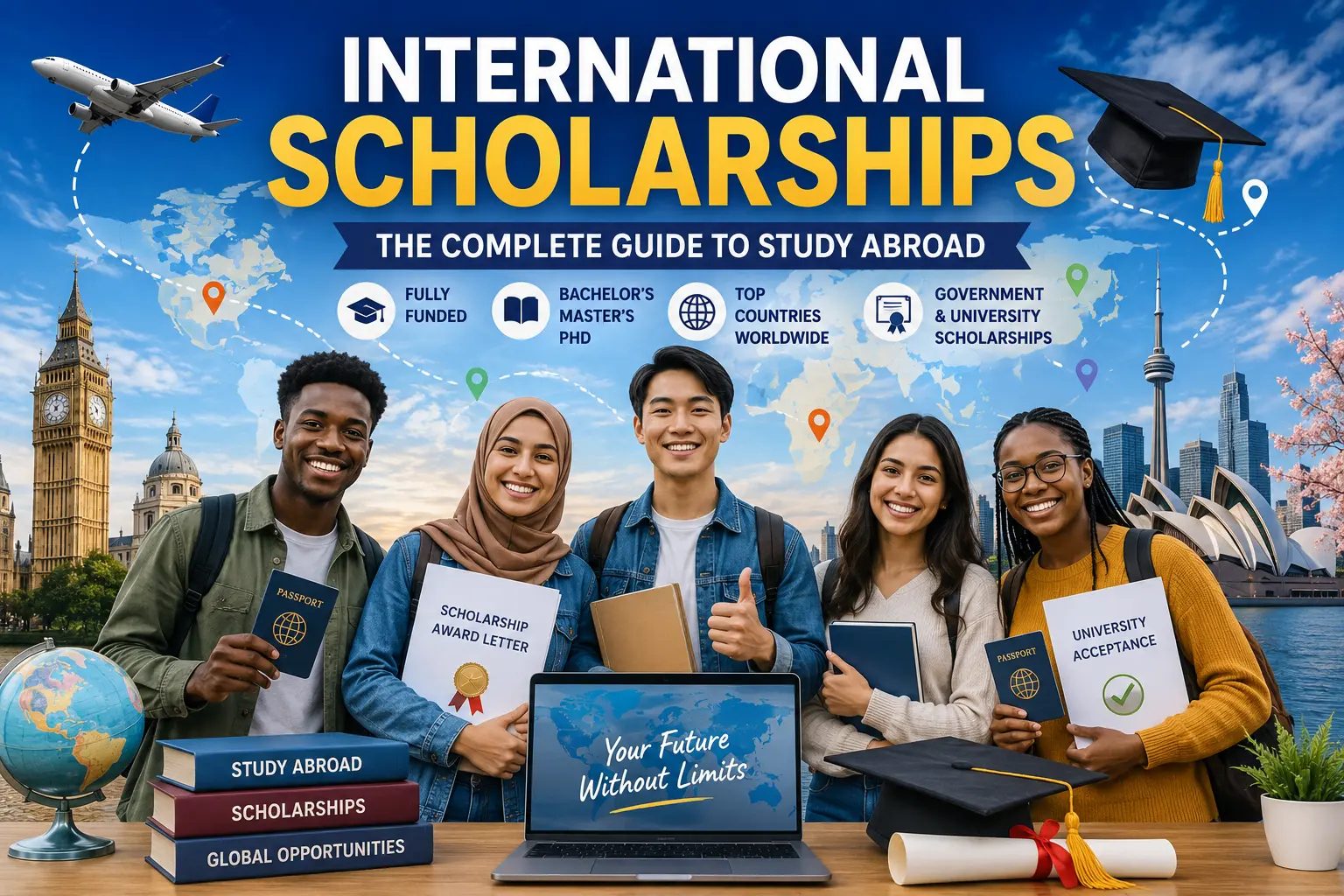
Pursuing higher education abroad is an exciting goal, but for many students, the cost of tuition, accommodation, travel, and living expenses can make it seem out of reach. Fortunately, international scholarships provide a pathway to study at leading universities without bearing the full financial burden.
From fully funded international scholarships and government-sponsored programs to university awards and private foundation grants, thousands of opportunities are available each year for undergraduate, master’s, PhD, and exchange students.
This guide explains how international scholarships work, who can apply, where to find legitimate opportunities, and how to submit stronger applications. Whether you’re searching for international scholarships for African students, scholarships to study abroad, master’s scholarships for international students, or scholarships without IELTS, you’ll find practical advice, trusted resources, and proven strategies to help you identify the right funding opportunities and improve your chances of studying abroad.
This page is a curated shortlist of the top fully funded picks.
For the full handbook covering every country, deadline, and FAQ, visit our
Complete International Student Scholarship Handbook →
What Are International Scholarships?
International scholarships are financial awards that help students study in a country other than their own. Depending on the program, it cover tuition fees, living expenses, accommodation, health insurance, travel costs, research funding, or a combination of these. Some scholarships are fully funded, while others provide partial financial assistance to reduce the overall cost of studying abroad.
Unlike student loans, scholarships generally do not need to be repaid, provided recipients meet the program’s academic and participation requirements. They are awarded based on various criteria, including academic excellence, financial need, leadership potential, research achievements, community service, athletic or artistic talent, or a commitment to contributing to a specific field or region after graduation.
Definition
International scholarships are funding opportunities offered by governments, universities, organizations, foundations, or private companies to support eligible students pursuing education outside their home country. Their primary goal is to make quality education more accessible while promoting academic collaboration, cultural exchange, innovation, and global leadership.
> International scholarships are financial awards that help students study abroad by covering some or all education-related costs, such as tuition, living expenses, travel, and insurance. They are funded by governments, universities, organizations, foundations, and private companies, and unlike loans, they typically do not require repayment.
How International Scholarships Work
Most scholarship programs begin with an application process in which students submit documents such as academic transcripts, a personal statement, recommendation letters, proof of language proficiency, and, in some cases, a research proposal or portfolio. Applications are then evaluated against the scholarship’s selection criteria.
Successful applicants receive funding according to the scholarship’s terms. While some programs pay tuition fees directly to the university, others also provide monthly stipends, accommodation support, airfare, or health insurance. Scholarships require recipients to maintain satisfactory academic performance throughout their studies to continue receiving financial support.
Who Provides International Scholarships?
International scholarships are funded by a wide range of organizations, each with different objectives and eligibility requirements.
- Governments: National governments fund scholarship programs to attract global talent, strengthen diplomatic relationships, and develop future leaders.
- Universities: Many universities offer merit-based, need-based, and department-specific scholarships to recruit outstanding international students.
- Non-Governmental Organizations (NGOs):** NGOs support students whose education aligns with social development, humanitarian, environmental, or community-focused goals.
- International Organizations: Organizations operating across multiple countries provide scholarships to promote international cooperation, research, and sustainable development.
- Foundations: Charitable and philanthropic foundations invest in education by funding students with exceptional academic potential, leadership qualities, or a commitment to creating positive social impact.
- Private Companies: Some businesses sponsor scholarships to develop future professionals in industries facing talent shortages or to support students pursuing careers related to their fields.
Types of International Scholarships
International scholarships are available in several forms, each designed to support different types of students and educational goals. Some programs provide comprehensive financial support, while others focus on recognizing academic excellence, addressing financial need, or encouraging study in specific fields. Understanding these scholarship types will help you identify opportunities that best match your qualifications and career aspirations.
Fully Funded International Scholarships
Fully funded international scholarships cover nearly all major study-related expenses, including tuition fees, accommodation, living expenses, health insurance, and round-trip airfare. These scholarships are highly competitive and are commonly offered by governments, universities, and international organizations to attract talented students from around the world.
Partial Scholarships
Partial scholarships cover only certain costs, such as tuition fees, accommodation, or living expenses. Although recipients are responsible for the remaining costs, these awards can substantially reduce the financial burden of studying abroad and may sometimes be combined with other funding sources.
Merit-Based Scholarships
Merit-based scholarships are awarded to students with outstanding academic performance, leadership experience, research achievements, or exceptional extracurricular involvement. Financial need is usually not the primary consideration, making these scholarships ideal for high-achieving applicants.
Need-Based Scholarships
Need-based scholarships support students who face financial challenges but demonstrate the potential to succeed academically. Applicants are often required to provide evidence of their financial circumstances alongside their academic records.
Subject-Specific Scholarships
Subject-specific scholarships are intended for students pursuing particular fields of study, such as engineering, medicine, agriculture, computer science, education, or environmental science. Many funding providers use these scholarships to develop expertise in areas that are important to national or global development.
Country-Specific Scholarships
Country-specific scholarships are available only to applicants from selected countries or regions. Many international scholarships for African students, for example, are designed to improve access to quality education and help develop future professionals and leaders in developing countries.
Research Scholarships
Research scholarships primarily support postgraduate students pursuing master’s by research or PhD degrees. In addition to covering tuition, they often include research funding, monthly stipends, and financial support for conferences, fieldwork, or laboratory expenses.
Athletic and Artistic Scholarships
Students with exceptional abilities in sports, music, visual arts, performing arts, or other creative disciplines may qualify for athletic or artistic scholarships. These awards recognize talent while encouraging recipients to contribute to university life through competitions, performances, exhibitions, or other creative activities.
Who Can Apply for International Scholarships?
Almost anyone can apply for international scholarships, but eligibility depends on factors such as your academic level, nationality, chosen destination, field of study, and the specific requirements of each scholarship program. While some scholarships are open to applicants worldwide, others are restricted to students from certain countries, disciplines, or career backgrounds.
High School Students
Many scholarship programs support high school graduates pursuing a bachelor’s degree abroad. These undergraduate international scholarships may be offered by governments, universities, or private organizations and often consider academic performance, leadership, volunteer work, and extracurricular achievements.
Undergraduate Students
Students already enrolled in a bachelor’s program can apply for scholarships to complete their degree, transfer to another institution, or participate in exchange and study abroad programs. Eligibility varies depending on the scholarship provider and academic institution.
Master’s Applicants
Graduates seeking postgraduate education have access to a wide range of master’s scholarships for international students. These scholarships often evaluate academic excellence, relevant work experience, leadership potential, and clear career objectives.
PhD Applicants
Doctoral scholarships are primarily research-focused and typically support candidates with strong academic records, research experience, and a well-developed research proposal. Many include tuition waivers, research funding, and a monthly stipend.
Professionals
Some international scholarships are designed for working professionals who want to develop advanced skills, gain international experience, or prepare for leadership roles in their industries. Relevant work experience is often an important eligibility requirement.
Researchers
Researchers will qualify for fellowships and grants that support collaborative research, academic exchanges, laboratory work, or specialized training at institutions abroad. These opportunities are especially common in science, technology, health, and social science fields.
Mid-Career Fellowships
Professionals with several years of experience can apply for mid-career fellowship programs that focus on leadership development, public policy, education, sustainable development, and other specialized fields. These programs often combine academic study with professional networking and practical experience.
Common Misconceptions
Students believe they need perfect grades or exceptional wealth to qualify for international scholarships, but this is not always true. While academic performance is important, many scholarship providers also value leadership, community involvement, research potential, professional achievements, and financial need.
Likewise, not every scholarship requires standardized English tests or years of work experience, making it worthwhile to carefully review each program’s eligibility criteria rather than assuming you do not qualify.
Fully Funded International Scholarships Worth Applying For
If your goal is to study abroad without worrying about tuition fees or living expenses, fully funded international scholarships are the best place to start. These scholarships typically cover tuition, accommodation, a monthly stipend, health insurance, and travel costs. Although highly competitive, they are available to students from many countries and across different academic levels.
Government International Scholarships
Government-funded scholarships are among the most prestigious because they are backed by national governments and often aim to develop future leaders, researchers, and professionals.
- Chevening Scholarships (United Kingdom): For one-year master’s degrees. Covers tuition, living expenses, airfare, and other essential costs. Ideal for professionals with leadership potential. Applications are submitted through the official Chevening scholarship portal.
- Fulbright Program (United States): Supports master’s, PhD, research, and teaching opportunities. Funding varies by country but commonly includes tuition, living expenses, and travel. Best suited for academically strong students and researchers.
- Australia Awards Scholarships (Australia): Open to applicants from eligible developing countries for undergraduate and postgraduate study. The scholarship covers tuition, return airfare, living expenses, and health insurance.
- DAAD Scholarships (Germany): Primarily for master’s and PhD students. Many programs include tuition support, monthly stipends, travel allowances, and research funding, making them popular among students from developing countries.
- MEXT Scholarships (Japan): Offered by the Japanese government for undergraduate, master’s, PhD, and research students. The scholarship generally includes tuition, a monthly allowance, and international travel.
- Erasmus Mundus Joint Master’s Scholarships (Europe): Supports selected joint master’s programs offered by multiple European universities. Students receive tuition coverage, a living allowance, and travel support while studying in more than one country.
- Chinese Government Scholarship (China): Available for bachelor’s, master’s, PhD, and language studies. It commonly covers tuition, accommodation, medical insurance, and a monthly stipend.
- Türkiye Scholarships (Türkiye): One of the few government scholarships that funds bachelor’s, master’s, and PhD studies. Benefits include tuition, accommodation, monthly stipends, airfare, and Turkish language training.
- Manaaki New Zealand Scholarships (New Zealand): Designed primarily for students from developing countries pursuing undergraduate and postgraduate studies, with funding that includes tuition, travel, and living expenses.
- Swedish Institute Scholarships (Sweden): Available for eligible international master’s students. The scholarship covers tuition, monthly living expenses, and travel grants for selected countries. Applications are managed through the Swedish Institute’s official scholarship portal.
University Scholarships
Leading universities also offer generous scholarships to attract outstanding international students. Unlike government scholarships, which usually allow you to choose from multiple institutions within a country, university scholarships are tied to a specific institution and may be funded by the university, alumni, donors, or endowment funds.
Well-known examples include scholarship programs offered by the University of Oxford, University of Cambridge, Harvard University, Yale University, Stanford University, University of Toronto, ETH Zurich, University of Melbourne, and the National University of Singapore. Funding varies by program and may cover full tuition, living expenses, research costs, or a combination of these. Always review the scholarship section on the university’s official admissions website for the latest eligibility requirements and deadlines.
Scholarships from International Organizations
Several international organizations provide scholarships to promote education, research, and sustainable development across borders.
He’s the respected programs
- World Bank Scholarships, which support graduate studies in development-related fields for professionals from eligible countries.
- Commonwealth Scholarships, offering fully funded master’s and PhD opportunities to students from Commonwealth nations.
- Joint Japan/World Bank Graduate Scholarship Program, designed for professionals pursuing master’s degrees related to economic and social development.
- Islamic Development Bank (IsDB) Scholarships, supporting undergraduate, master’s, PhD, and postdoctoral studies for students from member countries and Muslim communities.
- Mastercard Foundation Scholars Program, which provides comprehensive financial support and leadership development for academically talented students, particularly from Africa, through partner universities around the world.
Instead of applying to dozens of scholarships, focus on programs that closely match your academic background, career goals, and eligibility. Well-targeted applications are often far more successful than submitting the same materials to every scholarship you find.
International Scholarships for African Students
African students have access to a growing number of international scholarships designed to expand access to quality higher education and develop future leaders. Many of these opportunities prioritize applicants from developing countries because they aim to strengthen skills, research capacity, innovation, and economic development in regions where access to higher education funding may be limited.
Beyond global scholarship programs, there are also regional and Pan-African initiatives that support students pursuing undergraduate, master’s, PhD, and professional development programs both within Africa and abroad.
Most recognized international scholarships for African students include:
- Mastercard Foundation Scholars Program – Supports academically talented students with financial need through partner universities in Africa, North America, and other regions. In addition to covering education costs, the program emphasizes leadership development and community impact. Scholarship details are available on the Mastercard Foundation Scholars Program official website.
- Commonwealth Scholarships – Available to eligible citizens of Commonwealth countries for master’s and PhD studies in the United Kingdom, with funding covering tuition, travel, and living expenses.
- DAAD Scholarships – Germany’s flagship scholarship program offers numerous postgraduate and research funding opportunities for African students, particularly in development-related fields.
- Erasmus Mundus Joint Master’s Scholarships – Enables students to study in multiple European countries through fully funded joint master’s programs offered by partner universities.
- Islamic Development Bank (IsDB) Scholarship Programme – Provides funding for undergraduate, master’s, PhD, and postdoctoral studies, with a strong focus on science, technology, medicine, and sustainable development for eligible applicants from member countries.
- African Union Scholarships – Through various initiatives and partnerships, the African Union supports postgraduate education, research, and capacity building in priority sectors that contribute to Africa’s long-term development.
Undergraduate International Scholarships
Pursuing a bachelor’s degree abroad can be expensive, but a wide range of undergraduate international scholarships helps reduce or even eliminate the cost. Depending on the program, scholarships may cover tuition fees, accommodation, living expenses, travel costs, or a combination of these. The key is identifying opportunities that match your academic background, financial circumstances, and study destination.
Full Bachelor’s Funding
Fully funded undergraduate scholarships provide the most comprehensive financial support, covering tuition, accommodation, monthly living expenses, health insurance, and airfare. Programs such as Türkiye Scholarships, the Chinese Government Scholarship, and selected Australia Awards Scholarships offer full funding to eligible international students, although available degree levels vary by country and program.
Exchange Scholarships
Exchange scholarships allow students to study at a partner university abroad for one semester or an academic year while remaining enrolled at their home institution. Programs like Erasmus+ in Europe provide funding for tuition, travel, and living expenses, making international study more affordable without completing an entire degree overseas.
First-Year Scholarships
Many universities automatically consider outstanding international applicants for first-year scholarships based on academic achievement, leadership, or extracurricular involvement. Some awards require a separate application, while others are granted alongside an admission offer. Reviewing the scholarship section of your chosen university’s official admissions website is essential to avoid missing opportunities.
Transfer Scholarships
Students transferring from one university to another may also qualify for scholarships. These awards typically recognize strong academic performance at the previous institution and are offered by universities seeking to attract talented transfer students. Eligibility requirements differ significantly between institutions, so early planning is important.
Best Scholarship Programs for Undergraduate Students
Scholarship programs for bachelor’s students include:
- Türkiye Scholarships for fully funded undergraduate study in Türkiye.
- Chinese Government Scholarship for eligible students studying at participating universities in China.
- Mastercard Foundation Scholars Program, which supports academically talented students with financial need through partner universities in Africa and abroad.
- Australia Awards Scholarships, available for selected undergraduate programs in eligible countries.
- * University-funded scholarships offered by institutions such as the University of Melbourne, National University of Singapore, and many other leading universities worldwide.
Master’s Scholarships for International Students
A master’s degree abroad can open doors to specialized knowledge, international career opportunities, and advanced research. Fortunately, many master’s scholarships for international students provide full or partial funding, making postgraduate education more accessible across a wide range of disciplines.
Coursework Master’s Scholarships
Coursework-based master’s programs focus on structured learning through lectures, assignments, and examinations. Scholarships for these programs are commonly offered by governments, universities, and international organizations, with many covering tuition fees and living expenses.
Research Master’s Scholarships
Research master’s scholarships are designed for students pursuing independent research under academic supervision. In addition to tuition support, these scholarships may include research grants, laboratory funding, conference allowances, and monthly stipends.
MBA Scholarships
Business schools worldwide offer scholarships for outstanding MBA candidates based on academic achievement, leadership potential, professional experience, and entrepreneurial impact. While many MBA scholarships are partial awards, several institutions and organizations provide fully funded opportunities for exceptional applicants.
STEM Funding
Students studying science, technology, engineering, and mathematics (STEM) often have access to generous scholarship opportunities because these fields are considered critical to innovation and economic development. Many governments actively invest in STEM education to address workforce shortages and support research.
Humanities Funding
Scholarships are equally available for students in fields such as education, law, social sciences, arts, languages, history, and public policy. Although funding may be more competitive than in some STEM disciplines, numerous universities and foundations continue to support high-achieving humanities students.
Best Scholarships for Master’s Students
Master’s scholarship programs:
- Chevening Scholarships (United Kingdom)
- Erasmus Mundus Joint Master’s Scholarships (Europe)
- DAAD Scholarships (Germany)
- Swedish Institute Scholarships (Sweden)
- Fulbright Foreign Student Program (United States)
- Australia Awards Scholarships (Australia)
- Joint Japan/World Bank Graduate Scholarship Program
- Commonwealth Master’s Scholarships
These programs are highly competitive, but they offer comprehensive funding and valuable international networking opportunities.
PhD Scholarships Around the World
Unlike undergraduate and many master’s scholarships, PhD scholarships are often linked directly to research projects, academic departments, or faculty supervisors. Funding is typically provided in exchange for research, teaching, or other academic responsibilities, making doctoral education financially accessible at many universities.
Research Assistantships
Research assistantships provide financial support in return for assisting professors with research projects. Responsibilities may include data collection, laboratory work, field research, literature reviews, or publishing academic papers. These positions usually include a monthly salary or stipend alongside tuition support.
Teaching Assistantships
Teaching assistantships allow doctoral students to assist with undergraduate courses by leading tutorials, grading assignments, supervising laboratory sessions, or providing academic support. In return, students often receive tuition waivers and a living stipend.
Stipends
Most fully funded PhD programs provide a monthly stipend to cover essential living expenses. The amount varies by country, university, and funding source but is intended to allow students to focus on their research without seeking full-time employment.
Tuition Waivers
Many universities waive tuition fees for funded PhD candidates, either automatically through admission or as part of a scholarship or assistantship package. This significantly reduces the overall cost of doctoral study.
Why PhD Funding Is Different
Undergraduate scholarships primarily reward academic potential and help students access higher education. PhD funding, however, is often viewed as an investment in research and knowledge creation. Universities, governments, and research organizations fund doctoral candidates because their work contributes to scientific discoveries, innovation, policy development, and academic advancement. As a result, applicants are usually evaluated on their research experience, publications, academic achievements, and the strength of their proposed research rather than grades alone.
Scholarships Without IELTS
Yes, many universities and scholarship providers accept alternative proof of English proficiency instead of IELTS, although the requirements vary by institution and scholarship program. This provides greater adaptability for students who meet English language requirements through other recognized qualifications or prior education.
Accepted alternatives:
Medium of Instruction (MOI) Certificate
Many universities accept a Medium of Instruction (MOI) certificate, which confirms that your previous education was taught entirely in English. This option is particularly common for applicants from countries where English is widely used in higher education. However, acceptance depends on the university and is not guaranteed for every scholarship.
TOEFL
The Test of English as a Foreign Language (TOEFL) is one of the most widely recognized alternatives to IELTS. Many universities and scholarship providers accept TOEFL scores for admission and scholarship applications.
Duolingo English Test
The Duolingo English Test (DET) has become increasingly popular because it is affordable, fully online, and accepted by thousands of universities worldwide. Some scholarship programs also recognize it, but applicants should always confirm acceptance before applying.
Pearson Test of English (PTE)
The Pearson Test of English (PTE Academic) is accepted by many universities in countries such as Australia, the United Kingdom, Canada, and New Zealand. It offers another reliable pathway for demonstrating English proficiency.
Cambridge English Qualifications
Several universities accept Cambridge English qualifications, including C1 Advanced and C2 Proficiency, as evidence of English language ability. These certificates are particularly common among institutions in Europe.
English-Language Degree Exemptions
Universities waive English language test requirements for applicants who previously completed a degree in English-speaking countries or at institutions where English was the official language of instruction. Policies vary widely, so applicants should review the admission requirements carefully.
Important Limitations
Although many scholarships are advertised as scholarships without IELTS, this does not mean they have no English language requirements. Some universities may still require another approved language test, an interview, or additional documentation. Scholarship eligibility and university admission requirements may also differ, so always verify both before submitting your application.
Best Countries Offering International Scholarships
Countries invest heavily in attracting talented international students through generous scholarship programs. Your ideal destination should depend on your academic goals, preferred language of instruction, career plans, and the availability of funding in your field of study.
Canada
Canada offers numerous government, provincial, and university scholarships for undergraduate, master’s, and PhD students. It is especially attractive for its high-quality education, research opportunities, and favorable post-graduation work pathways.
United Kingdom
The United Kingdom is home to globally recognized scholarship programs such as Chevening Scholarships and Commonwealth Scholarships, alongside generous funding from many universities for international students.
Germany
Germany is a leading destination for affordable higher education, with many public universities charging low or no tuition fees. DAAD Scholarships further support international master’s and PhD students with living expenses and research funding.
Australia
Australia provides a wide range of government and university scholarships, including Australia Awards Scholarships, making it a popular choice for students from developing countries.
United States
The United States offers thousands of scholarships through universities, private foundations, and organizations. While government-funded opportunities are more limited than in some countries, many institutions provide substantial financial aid to outstanding international students.
Netherlands
The Netherlands attracts international students through English-taught programs and scholarship opportunities offered by universities and government-supported initiatives, particularly for master’s studies.
Sweden
Sweden offers fully funded opportunities through the Swedish Institute Scholarships and university-specific awards, especially for master’s students with leadership potential.
Finland
Finland has become an increasingly popular study destination thanks to its high-quality education system and scholarship programs that reduce or fully cover tuition fees for international students.
Japan
Japan’s MEXT Scholarships provide comprehensive funding for undergraduate, master’s, PhD, and research students while encouraging international academic exchange.
China
China offers one of the largest scholarship portfolios through the Chinese Government Scholarship, funding bachelor’s, master’s, doctoral, and language programs at participating universities.
South Korea
South Korea provides generous funding through programs such as the Global Korea Scholarship (GKS), covering tuition, living expenses, airfare, and language training for international students.
Ireland
Ireland offers government-funded and university-based scholarships, particularly for postgraduate students in research, innovation, science, technology, and business, making it an increasingly attractive destination for international education.
How to Find Legitimate International Scholarships
Finding legitimate international scholarships starts with using trusted and authoritative sources. Relying on verified information not only helps you discover genuine funding opportunities but also protects you from scams and misleading offers.
Government Scholarship Portals
Many countries publish official scholarship opportunities through government education or foreign affairs websites. These portals provide accurate information on eligibility, funding, deadlines, and application procedures for government-sponsored scholarships.
University Websites
If you have already chosen a university, visit its official admissions or financial aid page. Universities regularly update scholarship opportunities, application requirements, and important deadlines directly on their websites.
Official Scholarship Databases
Reputable scholarship providers maintain official databases where applicants can search for available funding by country, degree level, or field of study. Always verify that the website belongs to the scholarship provider before submitting personal information.
Embassies
Embassies and consulates often promote scholarship opportunities offered by their governments. They can also provide reliable guidance on eligibility requirements, study visas, and educational partnerships.
International Organizations
Organizations such as the World Bank, Commonwealth Scholarship Commission, DAAD, and Islamic Development Bank (IsDB) publish scholarship information through their official websites, making them trusted sources for international applicants.
Avoid Common Scholarship Scams
Be cautious of websites or individuals that promise guaranteed scholarships, request upfront application fees, or ask for sensitive financial information before confirming eligibility. Likewise, verify scholarship announcements shared on social media against the official scholarship provider’s website, as misinformation and fake opportunities are increasingly common.
International Scholarship Application Guide
1. Choose your study destination by considering your preferred country, university, program, budget, and long-term career goals before searching for funding opportunities.
2. Identify eligible scholarships that match your academic level, nationality, field of study, and admission requirements instead of applying indiscriminately.
3. Check the eligibility criteria carefully, including academic qualifications, language requirements, required work experience, application deadlines, and supporting documents.
4. Prepare all required documents, such as your passport, academic transcripts, certificates, CV, recommendation letters, Statement of Purpose (SOP), language test results, and a research proposal if the program requires one.
5. Submit your application well before the deadline, allowing enough time to review your documents, correct errors, and resolve any technical issues with the application portal.
6. Prepare thoroughly for scholarship interviews by understanding the scholarship’s objectives, reviewing your application, and practicing clear, confident answers about your academic goals and future plans.
How to Write a Scholarship-Winning Personal Statement
A strong personal statement does more than list achievements, it tells a clear, authentic story about who you are, what has shaped your ambitions, and why you deserve the scholarship. Scholarship reviewers look for applicants with academic potential, leadership qualities, a clear sense of purpose, and the ability to make a meaningful contribution to their communities or profession.
Rather than simply listing awards, explain how your experiences influenced your goals, demonstrate the impact of your work through measurable examples, connect your career plans to the scholarship’s mission, and highlight meaningful community involvement. Avoid common mistakes such as writing a generic essay, exaggerating achievements, repeating your CV, or failing to tailor your statement to the specific scholarship
Scholarship Interview Tips
If you’re invited to an interview, it usually means you’ve already impressed the selection committee on paper. The interview is your opportunity to demonstrate confidence, motivation, and alignment with the scholarship’s objectives.
Questions include:
- Tell us about yourself.
- Why did you choose this program or university?
- Why do you deserve this scholarship?
- What are your long-term career goals?
- How will your education benefit your community or country?
Answer each question with specific examples, keep your responses structured, and clearly explain your future plans. Avoid memorized answers, speaking negatively about others, or giving vague responses. For virtual interviews, test your internet connection, camera, microphone, lighting, and background beforehand, dress professionally, and maintain eye contact by looking at the camera rather than the screen.
Documents That Make Scholarship Applications Stronger
A competitive scholarship application is supported by evidence of both academic ability and personal achievements. Before applying, make sure your application includes as many of the following as possible:
- ✔️ Strong academic transcripts
- ✔️ Leadership experience
- ✔️ Volunteer or community service activities
- ✔️ Research experience
- ✔️ Academic or personal projects
- ✔️ Internships or professional experience
- ✔️ Awards and honors
- ✔️ Professional or academic certifications
- ✔️ Research publications (if applicable)
- ✔️ Portfolio for creative or design-related programs
Common Reasons Scholarship Applications Get Rejected
Many scholarship applications are unsuccessful because applicants overlook basic requirements rather than lacking potential.
- Ignoring eligibility requirements: Apply only to scholarships you genuinely qualify for.
- Late applications: Submit several days before the deadline to avoid technical issues.
- Weak essays or personal statements: Tailor every application to the scholarship’s objectives.
- Generic Statement of Purpose (SOP): Personalize your goals instead of reusing the same essay.
- Poor recommendation letters: Choose referees who know your abilities and achievements well.
- Incomplete documents: Double-check every required document before submission.
- Low GPA without context: Strengthen your application with leadership, research, or professional achievements where possible.
- Limited leadership experience: Participate in student organizations, volunteering, or community projects before applying.
- No clear career vision: Explain how the scholarship will help you create long-term impact in your field or community.
Scholarship Timeline (12-Month Planning Guide)
Preparing early gives you enough time to improve your academic profile, gather quality recommendation letters, write stronger essays, and avoid last-minute mistakes that often weaken scholarship applications.
Months Before Intake Action
12–10 months Research countries, universities, and scholarship opportunities.
10–8 months Check eligibility requirements and prepare for language tests if needed.
8–6 months Request transcripts, recommendation letters, and update your CV.
6–4 months Write and refine your Statement of Purpose and scholarship essays.
4–2 months Complete applications, review documents carefully, and submit before deadlines.
2–0 months Prepare for scholarship interviews, monitor application updates, and organize visa documents if selected.
Starting your preparation at least a year in advance allows you to apply for more scholarships, produce stronger application materials, and respond quickly to any additional requests from scholarship providers.
Frequently Asked Questions
Can I get a fully funded international scholarship with average grades?
Yes, although competition is stronger. Fully funded international scholarships consider more than academic performance.
Can I apply without work experience?
Yes. Most undergraduate scholarships do not require work experience, and many master’s scholarships accept recent graduates. However, some leadership-focused programs, such as Chevening Scholarships, require relevant professional experience, so always check the eligibility criteria before applying.
Which countries give the most scholarships?
Countries such as the United Kingdom, Germany, United States, Australia, Canada, China, Japan, and Sweden offer a large number of government and university-funded scholarships for international students across different academic levels.
Can I apply for multiple scholarships?
Yes. In fact, applying for multiple scholarships is recommended to increase your chances of success.
Can I work while studying?
In many countries, international students are permitted to work part-time while studying, provided they meet the conditions of their student visa.
Can scholarships cover family members?
Scholarships cover only the recipient’s educational expenses.
Are scholarships taxable?
It depends on the country and the type of scholarship. In many cases, scholarships used for tuition and required educational expenses are not taxable.
Can I study abroad for free?
Yes. By securing a fully funded scholarship or enrolling in countries where public universities charge little or no tuition.
Do scholarships guarantee a student visa?
No. Receiving a scholarship does not automatically guarantee visa approval. You must still satisfy the immigration requirements of your destination country, including submitting the required documents and meeting all visa conditions, even if your studies are fully funded.
Common Myths About International Scholarships
Misconceptions about international scholarships often discourage qualified students from applying. Understanding the facts can help you focus on opportunities that genuinely match your profile.
I Need Perfect Grades.
Excellent grades can strengthen your application, but they are not the only factor scholarship committees consider.
Scholarships Are Only for Science Students.
Although STEM fields receive significant funding, students studying business, education, law, social sciences, arts, humanities, public policy, and many other disciplines also have access to a wide range of scholarship opportunities.
Older Students Cannot Apply.
Age is not a universal eligibility requirement. Many scholarships welcome mature students, working professionals, and researchers, especially for master’s, PhD, and fellowship programs.
IELTS Is Always Mandatory.
This is one of the most common myths. Many universities and scholarship providers accept alternatives such as TOEFL, PTE Academic, the Duolingo English Test, Cambridge English qualifications, or a Medium of Instruction (MOI) certificate. Some institutions also waive English language tests for applicants who completed previous studies in English, although requirements vary by university and scholarship program.

Christian Chinonso is the founder of LearnViaHub, with 6+ years of research experience in international education, GPA systems, and study-abroad guidance for international students.Christian Chinonso is the founder of LearnViaHub, with 6+ years of research experience in international education — including GPA systems, scholarships, student financing, and study-abroad guidance — for students worldwide.