
Quick Answer
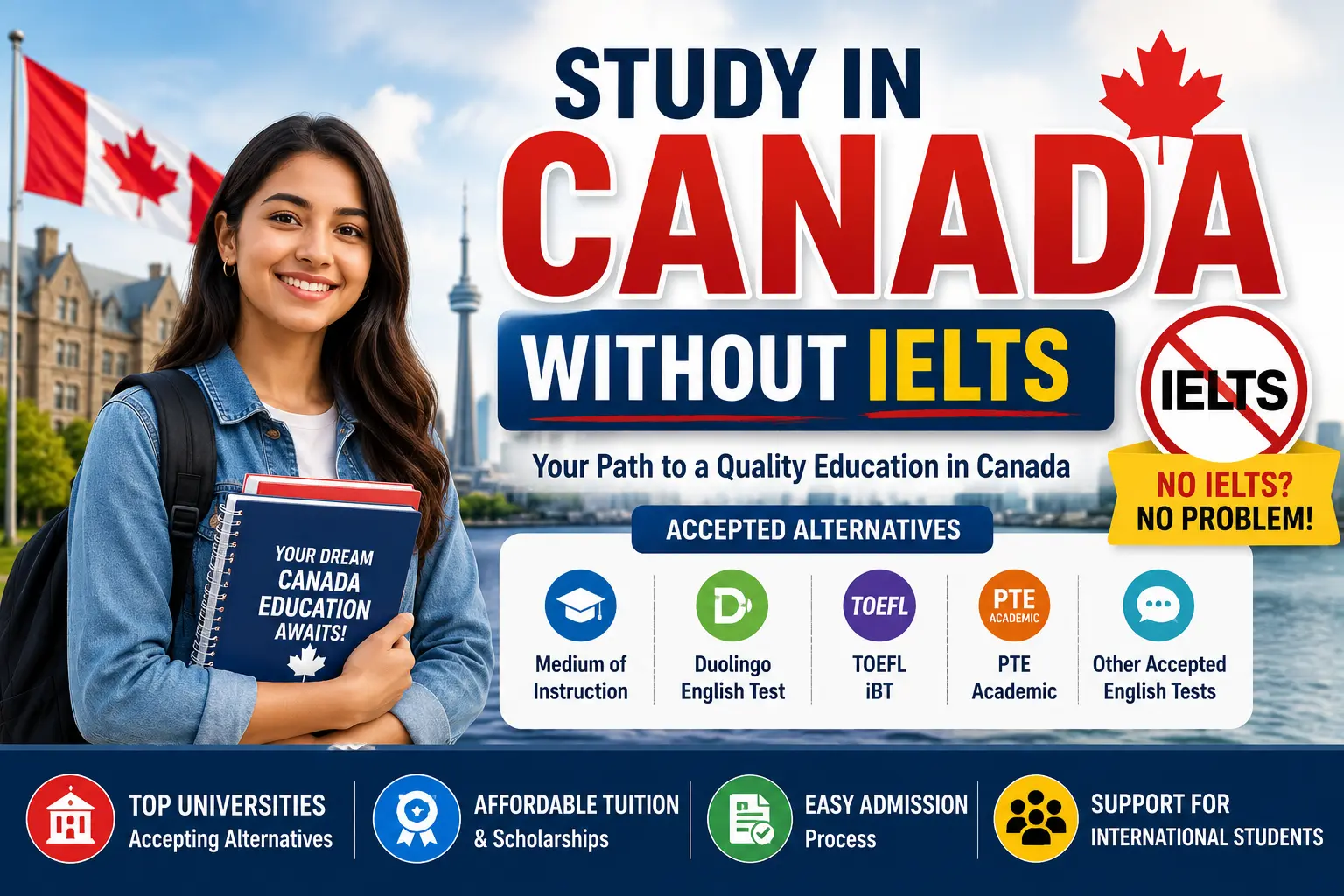
Yes — you can study in Canada without an IELTS score. 15 Canadian universities and colleges publicly accept alternatives: TOEFL iBT, PTE Academic, Duolingo English Test, CAEL, Cambridge English, a Medium of Instruction (MOI) certificate, or an approved pathway programme. The critical distinction: admission and study permit are two separate processes.
A university can admit you without IELTS and IRCC can still refuse your study permit on financial or credibility grounds. Canada is stricter than Germany or Poland at the visa stage — plan for a test even if the university waives it.
The 2024–2025 policy changes matter: SDS was discontinued in November 2024, most applicants now need a Provincial Attestation Letter (PAL), and the financial proof minimum rose to CAD $22,895 for a single applicant as of September 2025. Read the study permit section below before you pay any tuition deposit.
Where this page sits in the cluster: This is the country-specific spoke. For the hub covering all IELTS alternatives and country comparisons, see Study Abroad Without IELTS (Complete Guide). For funding, see Scholarships for International Students.
Study in Canada Without IELTS at a Glance
| Detail | Information |
|---|---|
| Biggest pitfall | University admission ≠ study permit approval. IRCC can refuse even with a valid LOA. |
| Best waiver route | MOI certificate — free, from your previous school’s registrar |
| Best alternative test | Duolingo English Test — under $60, at-home, results in 48 hours |
| Institutions listed | 15 universities and colleges with direct links to English-requirement pages |
| Financial proof minimum | CAD $22,895 (single applicant, as of September 1, 2025) |
| Key 2024 policy change | Student Direct Stream (SDS) discontinued November 8, 2024 |
| PAL requirement | Most applicants need a Provincial Attestation Letter; master’s and PhD at public DLIs exempt as of January 1, 2026 |
Admission vs Permit
Alternatives
15 Institutions
Cheapest
Colleges
By Level
By Country
How to Apply
Study Permit
Mistakes
FAQs
Can You Study in Canada Without IELTS?
The short answer: Yes. Canadian universities and colleges set their own English language requirements, and most accept at least one alternative to IELTS — TOEFL iBT, PTE Academic, Duolingo English Test, CAEL, Cambridge English, an MOI certificate, or completion of an approved pathway programme.
The important caveat: Admission without IELTS does not automatically mean a study permit will be approved. These are two separate processes governed by two separate bodies. We cover both below.
IELTS is widely accepted in Canada, but it is not the only route. Because each institution sets its own policy, the accepted alternatives vary by university, faculty, and even individual programme. That is why the practical question is not “does Canada accept alternatives?” — the answer is yes — but “does the specific programme I want accept the specific evidence I have?”
Why Canadian Universities Accept Alternatives
Canadian universities have the authority to decide how applicants demonstrate English proficiency. Many recognise that a student who completed a full degree taught in English, or who scores well on an equally recognised standardised test, can succeed in an English-speaking academic environment without an IELTS score. The government’s own education portal, EduCanada, confirms that each university sets its own admission requirements.
University Admission vs. Study Permit — Two Separate Processes
This is the single most common source of confusion for international students applying to Canada, and the one that costs the most applicants a cycle.
| Aspect | University Admission | Canadian Study Permit |
|---|---|---|
| Who decides | The university or college | Immigration, Refugees and Citizenship Canada (IRCC) |
| What is assessed | Academic qualifications, English proficiency, programme fit | Admission letter, financial capacity, study intent, immigration history |
| Language testing | Set by the university; multiple alternatives accepted | No universal IELTS requirement; overall eligibility is assessed |
| Outcome | Offer of admission (LOA) | Study permit or refusal |
A student can be admitted to a Canadian university without IELTS and still be refused a study permit on financial or credibility grounds. Conversely, a strong study permit applicant with weak academic documents can still be refused admission. Neither process guarantees the other.
IELTS Alternatives Accepted by Canadian Universities
These are the seven main alternatives. Acceptance is described as a general pattern, not a guarantee — always confirm on the specific programme page.
| Alternative | What it is | Pattern of acceptance |
|---|---|---|
| TOEFL iBT | US-origin standardized test, taken at test centres | Accepted by almost every Canadian university; typically listed alongside IELTS on admission pages |
| PTE Academic | Computer-scored test; results in ~48 hours | Accepted by most universities; slightly narrower than TOEFL |
| Duolingo English Test | Online, at-home, ~$65, results in 48 hours | Growing acceptance; more common at colleges and non-research universities |
| CAEL | Canadian Academic English Language test; designed for Canadian academic settings | Accepted by a narrower set of institutions, mostly Canadian-focused |
| Cambridge English | C1 Advanced or C2 Proficiency certificates; do not expire | Accepted by many universities, particularly for graduate programmes |
| MOI certificate | Letter from your previous institution confirming English was the language of instruction and examination | Varies widely — accepted by some universities, refused by others. Always confirm with the specific programme |
| Pathway programme | English-language preparation course offered by the university or a partner | Accepted by institutions that run them; completion leads to direct entry without a test |
Note on CELPIP: The Canadian English Language Proficiency Index Program is primarily used for immigration and citizenship applications, not university admission. Very few institutions list it as an acceptable admission test.
15 Universities and Colleges That Accept Students Without IELTS
The table below lists 15 institutions that publicly accept an IELTS alternative for at least some applicants. The waiver status column uses a defined three-level scale — check the meaning before assuming you qualify.
Waiver status key:
✅ Yes — waivers available for qualifying applicants (usually those with prior English-medium education)
⚠️ Case-by-case — waivers sometimes granted; requires direct confirmation with the admissions office
❌ Test required — an IELTS alternative is accepted, but a standardized test is required for admission
| Institution | Province | Waiver Status | Accepted Alternatives | Official Page |
|---|---|---|---|---|
| University of Winnipeg | Manitoba | ✅ Yes | MOI, TOEFL, Duolingo, CAEL, Pathway | uwinnipeg.ca ↗ |
| Brock University | Ontario | ⚠️ Case-by-case | TOEFL, PTE Academic, Duolingo, CAEL, Pathway | brocku.ca ↗ |
| Memorial University of Newfoundland | Newfoundland and Labrador | ✅ Yes | MOI, TOEFL, Duolingo, Cambridge English | mun.ca ↗ |
| University of Regina | Saskatchewan | ✅ Yes | TOEFL, PTE Academic, Duolingo, CAEL, ESL Pathway | uregina.ca ↗ |
| University of Saskatchewan | Saskatchewan | ⚠️ Case-by-case | TOEFL, PTE Academic, Duolingo, Pathway | usask.ca ↗ |
| Concordia University | Quebec | ⚠️ Case-by-case | TOEFL, Duolingo, PTE Academic, Cambridge English | concordia.ca ↗ |
| Carleton University | Ontario | ⚠️ Case-by-case | TOEFL, PTE Academic, Duolingo, CAEL | carleton.ca ↗ |
| University of Prince Edward Island | Prince Edward Island | ✅ Yes | MOI, TOEFL, Duolingo, Pathway | upei.ca ↗ |
| Cambrian College | Ontario | ✅ Yes | Duolingo, TOEFL, PTE Academic, MOI (selected programmes) | cambriancollege.ca ↗ |
| Seneca Polytechnic | Ontario | ⚠️ Case-by-case | TOEFL, Duolingo, PTE Academic, CAEL, Cambridge | senecapolytechnic.ca ↗ |
| George Brown College | Ontario | ⚠️ Case-by-case | Duolingo, TOEFL, PTE Academic, EAP Pathway | georgebrown.ca ↗ |
| Centennial College | Ontario | ⚠️ Case-by-case | Duolingo, TOEFL, PTE Academic, ELL/EAP Pathway | centennialcollege.ca ↗ |
| Saskatchewan Polytechnic | Saskatchewan | ⚠️ Case-by-case | TOEFL, PTE Academic, Duolingo, ILAC Pathway | saskpolytech.ca ↗ |
| Fanshawe College | Ontario | ✅ Yes | TOEFL, PTE Academic, Duolingo, Pathway | fanshawec.ca ↗ |
| NorQuest College | Alberta | ✅ Yes | MOI, TOEFL, Duolingo, PTE Academic, Pathway | norquest.ca ↗ |
Waiver status and accepted alternatives were last checked in September 2026. Institutions update their English language policies each admission cycle — always confirm on the specific programme page before applying.
Cheapest Universities Without IELTS
Several Canadian institutions offer relatively low international tuition alongside IELTS alternatives. The tuition ranges below are approximate annual figures for international students and vary by programme — confirm current fees on the institution’s website.
| Institution | Province | Approx. International Tuition | Scholarship Types |
|---|---|---|---|
| Memorial University of Newfoundland | Newfoundland and Labrador | CAD $11,000–$20,000 | Entrance, merit, graduate scholarships |
| University of Prince Edward Island | Prince Edward Island | CAD $16,000–$23,000 | International entrance awards |
| University of Winnipeg | Manitoba | CAD $16,000–$20,000 | Entrance awards, President’s Scholarships |
| Cambrian College | Ontario | CAD $15,000–$19,000 | Entrance scholarships |
| Fanshawe College | Ontario | CAD $16,000–$21,000 | International student awards |
| NorQuest College | Alberta | CAD $17,000–$22,000 | International entrance scholarships |
| University of Regina | Saskatchewan | CAD $18,000–$25,000 | International entrance scholarships |
| University of Saskatchewan | Saskatchewan | CAD $22,000–$35,000 | Guaranteed entrance & merit scholarships |
Tuition ranges are indicative for the 2026–27 cycle and vary by programme. Verify on each institution’s fee page.
Look Beyond Tuition
A lower tuition figure does not always mean a lower total cost. Rent, food, transportation, and health insurance vary significantly between provinces. A university with tuition $2,000 higher in a cheaper city can cost you less overall than a nominally cheaper university in Toronto or Vancouver. Before deciding, estimate total annual spend, not just tuition. Many institutions also offer renewable entrance awards and on-campus employment — applying early improves your chances of receiving them.
Colleges vs. Universities — Which to Choose?
If your goal is practical skills, faster completion, or lower tuition, Canadian public colleges are a strong alternative to universities. Many accept IELTS alternatives on similar terms.
| Feature | Colleges | Universities |
|---|---|---|
| Focus | Career-oriented, practical | Academic and research-based |
| Credentials | Diplomas, advanced diplomas, certificates, graduate certificates | Bachelor’s, master’s, PhD |
| Duration | 1–3 years (most programmes) | 3–4+ years |
| Tuition | Often more affordable | Generally higher |
| Learning style | Hands-on, industry experience embedded | Theory, research, academic specialization |
| Outcome | Quick entry into the workforce | Professional careers, research, further study |
Graduate Certificates — an Underused Route
If you already hold a bachelor’s degree, a one-year graduate certificate can be an efficient way to build specialized skills in business, IT, healthcare, engineering, or project management — at lower cost than a second degree. Many colleges accept IELTS alternatives for these programmes, making them a practical option for students who want Canadian credentials quickly.
Applying by Study Level
Requirements differ by degree level. This is what changes between undergraduate, master’s, and PhD applications when you are applying without IELTS.
| Level | Waiver likelihood | What matters most | Notes |
|---|---|---|---|
| Undergraduate | Moderate | Secondary school grades, transcripts | Waivers less common at research-intensive universities; more common at colleges and non-research universities |
| Master’s (coursework) | Moderate | Bachelor’s degree, GPA, SOP, references | Waiver accepted for applicants with a prior English-medium degree |
| Master’s (research) | Higher | Research proposal, supervisor availability | Supervisor support often matters more than the language test; a supervisor who wants you can advocate for a waiver |
| PhD | Higher | Research output, publications, thesis, proposal | Most programmes require prior contact with a potential supervisor; funding usually comes with the position |
Country-Specific Considerations
Your country of education affects which English-proficiency route is most practical. Four patterns are worth knowing.
🇳🇬 Nigerian applicants
Nigeria is one of the strongest source markets for the MOI route. English is the medium of instruction throughout Nigeria’s higher education system, and a properly issued MOI certificate is often sufficient for admission at Canadian institutions that accept MOI (Winnipeg, Memorial, UPEI, NorQuest). Nigerian applicants also frequently rank well in IRCC’s study permit assessment when financial documentation and a coherent study plan are provided. The two most common reasons for Nigerian permit refusals are incomplete financial documentation and generic SOPs — both of which are avoidable. Budget for a Duolingo English Test (~$65) as a backup in case a specific programme refuses MOI.
🇮🇳 Indian applicants
India sends more students to Canada than any other country, and the MOI route is less consistently accepted for Indian undergraduate degrees. Most Indian applicants use TOEFL, PTE Academic, Duolingo, or an approved pathway programme. Because the competition is deep, a strong test score matters for both admission and scholarship consideration. The Provincial Attestation Letter (PAL) requirement is critical for Indian applicants — it was introduced in 2024 and most applicants now need one, though master’s and PhD students at public DLIs are exempt as of January 1, 2026.
🇵🇰 Pakistani and South Asian applicants
The MOI route is inconsistent for Pakistani, Bangladeshi, and Nepali education systems. Expect to need a recognised test (Duolingo, PTE Academic, or TOEFL) or an approved pathway programme. Duolingo is the fastest and cheapest option and is accepted at a growing number of Canadian colleges and non-research universities. For research master’s and PhD applicants, supervisor support can sometimes override the language test requirement.
African applicants from other countries
Applicants from Ghana, Kenya, Uganda, and South Africa are frequently represented among students admitted without IELTS, because English is the medium of instruction in these countries’ higher education systems. A properly issued MOI certificate is often sufficient for admission — though individual universities still evaluate documents on a case-by-case basis. Universities may verify transcripts, certificates, and MOI letters directly with your previous institution, so submit authentic documents and ensure all information matches your application.
How to Apply Without IELTS — Step by Step
The process is straightforward once you know which pathway applies to you. Work through these steps in order.
Step 1: Identify Institutions That Accept Your Chosen Route
Start with the table above, then check the English language requirements page for the specific programme you want. Look for a section titled “English language requirements,” “English proficiency,” or “Admission requirements.” If the page only lists IELTS, email admissions and ask whether an alternative is accepted — many accept alternatives that are not listed online.
Step 2: Confirm Whether You Qualify for a Waiver
Before registering for any test, check whether you qualify for an exemption. Many universities waive English-language testing for applicants who completed a full degree in an English-medium institution. Confirming this first can save you the cost of a test you don’t need.
Step 3: Prepare Your Academic Documents
- Academic transcripts (certified, translated if needed)
- Degree or diploma certificates
- Valid passport
- Statement of Purpose
- Letters of recommendation (usually 2–3)
- CV or résumé for postgraduate programmes
- Financial documents, if requested
Step 4: Obtain a Medium of Instruction (MOI) Certificate
If your previous education was taught in English, request an official MOI certificate from your school or university. Contact the Registrar’s office (for a university degree) or the Principal’s office (for secondary school). Turnaround is typically 3–15 working days.
Ask for three things specifically:
- An official reference number and date of issue
- The original signature of the Registrar or Principal — not a photocopy
- A clear statement that the medium of instruction and examination was English
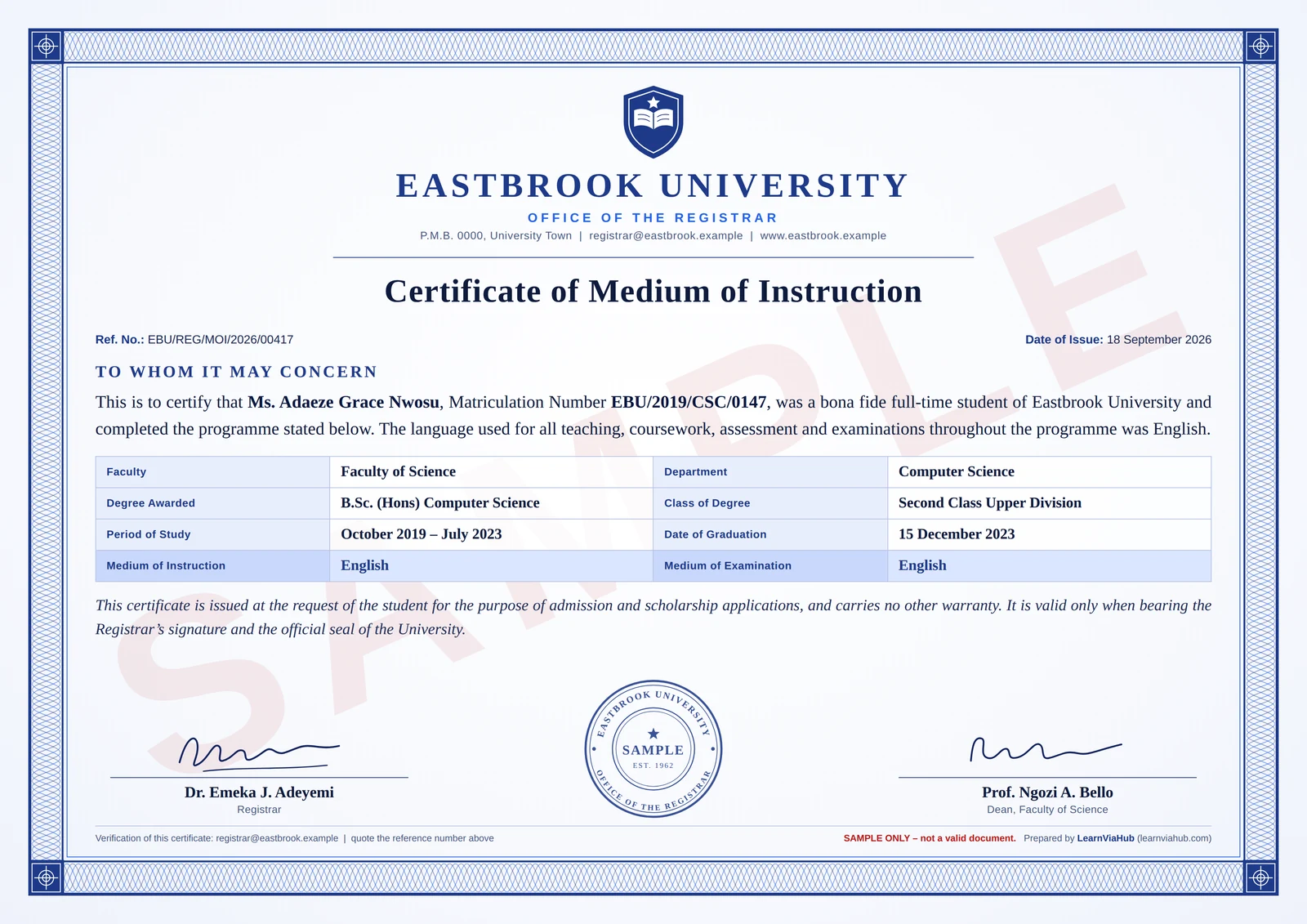
Some receiving universities verify the certificate by contacting the issuing institution and quoting the reference number. Ensure the contact details on the letter are current.
Step 5: Submit Your Applications
Complete the online application for each institution, upload all required documents, and pay the application fee. Keep confirmation emails and payment receipts for reference. Apply well before the deadline — institutions with rolling admissions may still close competitive programmes early.
Step 6: Accept Your Offer of Admission
If you receive a Letter of Acceptance (LOA), review it carefully, meet any outstanding conditions, and follow the institution’s instructions to accept before the stated deadline. You’ll need the LOA for your study permit application.
Step 7: Apply for Your Study Permit
Submit your study permit application through Immigration, Refugees and Citizenship Canada (IRCC). Prepare your Letter of Acceptance, financial documents, passport, and any additional documents requested. Full detail on the permit process is below.
Getting a Canadian Study Permit Without IELTS
Yes — you can obtain a Canadian study permit without an IELTS score. IRCC does not require IELTS as a universal condition. Instead, officers assess your overall eligibility: admission to a Designated Learning Institution (DLI), financial capacity, study plan, and immigration history.
2024–2025 Policy Changes You Need to Know
⚠️ The study permit landscape has changed significantly since 2024. Verify each item below on IRCC’s official site before applying.
- Student Direct Stream (SDS) discontinued — the fast-track SDS route for select countries (including India, Nigeria, China, and the Philippines) ended on November 8, 2024, at 2:00 p.m. EST. All applicants now use the regular study permit process.
- Provincial Attestation Letter (PAL) required — most study permit applicants must include a PAL issued by the province or territory where they will study. As of January 1, 2026, master’s and doctoral degree students at public designated learning institutions no longer need to submit a PAL.
- Study permit caps — the federal government introduced caps on the number of study permits issued to international students. The 2025 cap was set at 437,000 permits (a 10% reduction from 2024), and the 2026–2028 Immigration Levels Plan targets 155,000 new student arrivals in 2026. Master’s and doctoral students at public institutions are exempt from the cap.
- Higher financial proof requirement — as of September 1, 2025, a single study permit applicant must show a minimum of CAD $22,895 (up from $20,635). The figure increases with accompanying family members.
Proof of Financial Support
Financial capacity is one of the most important parts of your study permit application. Depending on your circumstances, acceptable evidence may include:
- Recent bank statements (past 4 months)
- Proof of tuition payment
- Scholarship or sponsorship letters
- Guaranteed Investment Certificate (GIC), where applicable
- Proof of income from parents or sponsors
Demonstrate You Are a Genuine Student
IRCC expects applicants to show that education is their primary purpose for coming to Canada. Your Statement of Purpose, academic background, and programme choice should align logically. A visa officer reviewing your file should be able to understand, within a few minutes, why this specific programme, at this specific institution, at this point in your career, makes sense. A vague or generic SOP is one of the most common reasons for refusal.
Four Mistakes That Cost Applications
1. Assuming an MOI certificate works everywhere
The most common assumption is that because one university accepts an MOI certificate, they all do. They don’t. Some universities accept it for all programmes; others accept it only for non-competitive entry; still others refuse it entirely and require a standardized test.
Fix: Confirm with the specific programme — not the university’s general admissions page — that an MOI certificate is accepted for your intake.
2. Submitting an incomplete MOI certificate
A letter that is not on official letterhead, does not carry a seal, or omits the reference number can be rejected even when the underlying fact is true. Universities have seen enough forged documents to be strict about format.
Fix: Use the sample above as your reference. If your institution’s standard MOI letter doesn’t include these elements, ask them to produce one that does — most will.
3. Treating admission and study permit as one process
A student can be admitted without IELTS and still be refused a study permit on financial or credibility grounds. Many applicants stop preparing once they have the admission letter and then discover the permit process has its own requirements — PAL, proof of funds, study plan.
Fix: Prepare both in parallel. Start gathering financial documents and drafting your SOP as soon as you submit university applications.
4. Ignoring the 2024–2025 policy changes
The SDS discontinuation, PAL requirement, and higher financial proof thresholds all took effect within the last 18 months. Many guides online — and some university pages — still reference the old SDS route. Relying on outdated information leads to incomplete applications and refusals.
Fix: Always check IRCC’s official site for current requirements before submitting your application. Policy can change with little notice.
Frequently Asked Questions
Can I study in Canada without IELTS?
▼
Which universities accept students without IELTS in Canada?
▼
Do I need IELTS to study in Canada? (Is IELTS required for a study permit in Canada?)
▼
Can I get a Canadian study permit without IELTS?
▼
Is the Duolingo English Test accepted in Canada?
▼
Can I do a PhD in Canada without IELTS?
▼
Can I study nursing in Canada without IELTS?
▼
How long is an MOI certificate valid?
▼
Can diploma students apply without IELTS?
▼
Does Canada require IELTS after graduation?
▼
Is IELTS required for scholarships in Canada?
▼
Related LearnViaHub Resources
Study Abroad Without IELTS (Complete Guide)
The hub page — 7 IELTS alternatives compared across every major study destination, with country-by-country rules.
Scholarships for International Students
Complete guide to fully funded scholarships, eligibility, and funding routes for international applicants.
GPA Guide and Calculator
Understand how your grades translate to international systems — useful for waiver applications.
Scholarship Essay Guide
Write a statement of purpose that satisfies admissions offices and scholarship committees.
References
- Immigration, Refugees and Citizenship Canada (IRCC) — Study permit requirements
- EduCanada — Official Canadian education portal
- ETS — TOEFL iBT
- Pearson — PTE Academic
- Duolingo — Duolingo English Test
- CAEL — Canadian Academic English Language test
- Cambridge English — C1 Advanced and C2 Proficiency

Christian Chinonso is the founder of LearnViaHub, with 6+ years of research experience in international education — including GPA systems, scholarships, student financing, and study-abroad guidance — for students worldwide.