
📅 Last Updated August 2026
👨💻 Reviewed By LearnViaHub Editorial Team
⏱️ Reading Time Approximately 12–15 minutes
🎓 Applies To F‑1 international students in the United States planning an internship before or after graduation.
🔄 Update Frequency Reviewed annually and whenever USCIS or ICE changes F‑1 work authorization rules.
📚 Sources Reviewed U.S. Citizenship and Immigration Services (USCIS), U.S. Immigration and Customs Enforcement (ICE), Study in the States, and the USCIS Policy Manual.
If you are an F‑1 student in the United States, CPT and OPT are the two main ways to legally intern or work. Understanding the difference is critical because choosing the wrong one — or using too much full‑time CPT — can affect your future OPT eligibility.
What Is OPT?
12‑Month CPT Rule
CPT vs. OPT Decision Matrix
Common Mistakes
Application Process
FAQ
Quick Answer
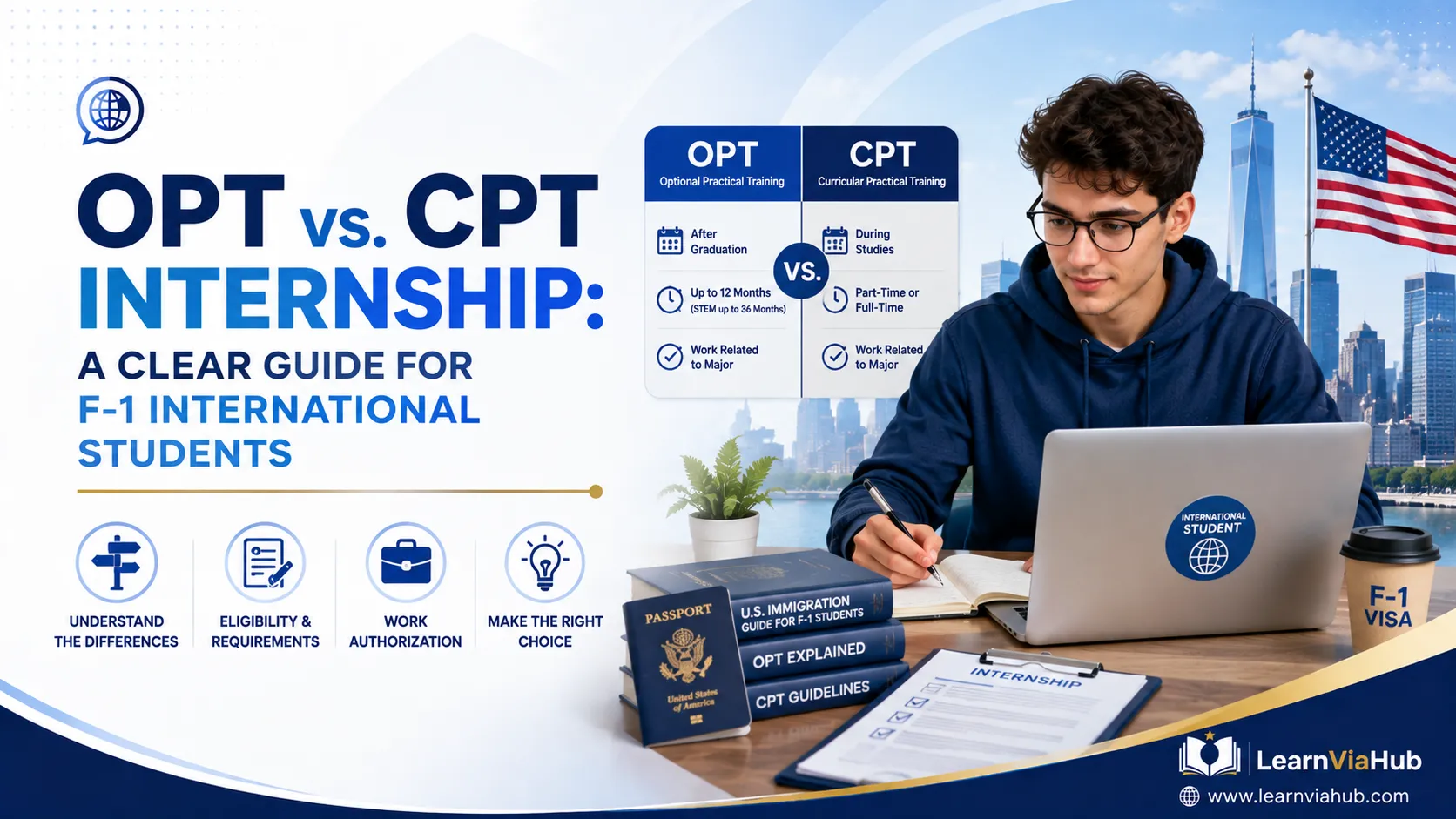
What is the difference between CPT and OPT? CPT is Curricular Practical Training used before graduation for internships that are required by or integral to your academic programme. OPT is Optional Practical Training that can be used before or after graduation and gives you broader flexibility to work in your field of study.
Does CPT affect OPT eligibility? Yes. If you complete 12 months of full‑time CPT at the same degree level, you become ineligible for OPT at that level. Part‑time CPT does not have the same effect.
Which should you choose? If you are still studying and the internship is part of your curriculum, CPT is usually the correct choice. If you are graduating or want broader post‑study work, OPT is generally the better path. For a full country‑level overview, see our internships for international students pillar page.
What if the internship is remote or unpaid? The same CPT/OPT rules apply if you are physically in the U.S., even if the employer is abroad or the role is remote. See our Remote Internships for International Students and Paid vs Unpaid Internships Legality guides.
What Is CPT?
Curricular Practical Training is F‑1 work authorization for an internship, practicum, or work experience that is directly required by your degree programme or counts as an integral part of your curriculum. CPT is not a visa category; it is a school‑authorised employment benefit recorded on your Form I‑20.
CPT Eligibility
- You must be in valid F‑1 status and enrolled full‑time.
- The internship must be required by your programme or an integral part of your curriculum.
- You must receive academic credit, or the work experience must be formally linked to your course of study.
- You must apply through your Designated School Official (DSO) and receive CPT authorization on your I‑20 before starting work.
Part‑Time vs. Full‑Time CPT
CPT authorization is issued as either part‑time or full‑time.
- Part‑time CPT: 20 hours or fewer per week. Part‑time CPT does not count toward the 12‑month full‑time CPT threshold and does not affect OPT eligibility.
- Full‑time CPT: More than 20 hours per week. If you accumulate 12 months (365 or more days) of full‑time CPT, you lose OPT eligibility at the same degree level.
CPT Approval Process
- Confirm with your academic department that the internship qualifies for CPT.
- Obtain a written internship offer with a detailed job description.
- Submit your university’s CPT application form and required documents to your DSO.
- Your DSO verifies your eligibility and issues a new I‑20 with CPT authorization.
- Begin work only after the CPT start date listed on your I‑20.
What Is OPT?
Optional Practical Training is temporary employment authorization that allows F‑1 students to work in their major field of study. Unlike CPT, OPT requires a formal application to USCIS and the issuance of an Employment Authorization Document (EAD) before you can start work.
Pre‑Completion OPT vs. Post‑Completion OPT
| Feature | Pre‑Completion OPT | Post‑Completion OPT |
|---|---|---|
| Timing | Before graduation, while still enrolled | After completing your degree |
| Duration | Counts against the 12‑month standard OPT total | Up to 12 months standard |
| Work hours | Can be part‑time or full‑time | Generally full‑time |
| Unemployment limit | No unemployment limit | 90 days; 150 total if STEM extension is approved |
Standard OPT Duration
Standard post‑completion OPT provides up to 12 months of work authorization per educational level. Any pre‑completion OPT used will reduce the post‑completion OPT time available.
STEM OPT Extension
If your degree is in a STEM‑eligible field, you may qualify for a 24‑month STEM OPT extension, allowing up to 36 total months of OPT at the same educational level. The employer must participate in E‑Verify, and you must meet stricter reporting and training requirements.
Unemployment Limits During OPT
During post‑completion OPT, you are allowed up to 90 days of unemployment. If you receive a STEM OPT extension, you gain an additional 60 days, for a total of up to 150 days across the entire post‑completion OPT and STEM OPT period.
Important details:
- Pre‑completion OPT does not have unemployment limits, but any pre‑completion OPT time reduces the total post‑completion OPT available.
- Unemployment during the cap‑gap automatic extension counts toward the 90‑ or 150‑day maximum.
- Every day, including weekends and holidays, counts toward the unemployment limit.
- Non‑qualifying volunteer positions do not stop unemployment accrual.
- If you exceed the unemployment limit, your SEVIS record may be terminated, and you may not be eligible for reinstatement.
The 12‑Month Full‑Time CPT Rule
This is one of the most important F‑1 rules to understand before accepting an internship.
Rule: If you complete 12 months or more of full‑time CPT at the same educational level, you become ineligible for OPT at that level. This threshold is based on 365 days of full‑time CPT. Part‑time CPT does not count toward this limit.
Worked Example
Example 1 — Safe use:
You complete 6 months of full‑time CPT during your Master’s programme. You still have 12 months of OPT available after graduation because you did not reach the 12‑month full‑time CPT threshold.
Example 2 — OPT loss:
You complete 13 months of full‑time CPT during the same Master’s programme. Because you crossed the 12‑month full‑time limit, you are no longer eligible for OPT at the Master’s level.
Example 3 — Part‑time protection:
You complete 15 months of part‑time CPT. Because part‑time CPT does not count toward the 12‑month full‑time threshold, your OPT eligibility remains intact.
Higher Educational Level Reset
The 12‑month full‑time CPT rule applies at the same educational level. If you later enrol in a higher degree level — for example, progressing from a Bachelor’s to a Master’s — you become eligible for a new 12 months of OPT, and the CPT limit resets.
CPT vs. OPT Decision Matrix
Use this table to decide which authorization fits your situation.
| Situation | Best Choice | Reason |
|---|---|---|
| Your programme requires an internship for credit | CPT | Curricular integration requirement fits CPT. |
| You are still studying and want flexible part‑time work | CPT or Pre‑Completion OPT | CPT is simpler if the role is curricular; OPT may be used if CPT is not available. |
| You are graduating soon and want to stay in the U.S. to work | Post‑Completion OPT | OPT is the standard post‑graduation work benefit. |
| You have a STEM degree and want extended U.S. work experience | Post‑Completion OPT + STEM Extension | STEM extension adds 24 months. |
| You are concerned about losing future OPT | CPT part‑time or limited full‑time CPT | Stay below 12 months of full‑time CPT. |
Common Mistakes Students Make
- Starting CPT before the authorized I‑20 date.
- Not tracking full‑time CPT months and accidentally crossing the 12‑month OPT elimination threshold.
- Using CPT for an internship that is not actually curricular or integrated into the degree.
- Confusing part‑time and full‑time CPT definitions.
- Applying for OPT too late, not accounting for USCIS processing delays.
- Assuming pre‑completion OPT does not reduce post‑completion OPT — it does, since all standard OPT is capped at 12 months per level.
- Failing to maintain F‑1 status while waiting for OPT approval.
- Not reporting OPT employment or unemployment days within the required timeframes.
- Assuming an unpaid or remote internship does not require CPT/OPT — it still does if you are physically in the U.S. See our remote internships guide and paid vs unpaid legality guide.
Application Process
CPT Application Steps
- Obtain a written internship offer that matches your academic programme.
- Confirm with your academic advisor that the internship qualifies for CPT.
- Submit your university’s CPT request form and required documents to your DSO.
- Receive a new I‑20 with CPT authorization.
- Start work on or after the authorized CPT start date.
OPT Application Steps
- Request an OPT recommendation from your DSO.
- Receive a new I‑20 showing the OPT recommendation.
- File Form I‑765, Application for Employment Authorization, with USCIS within the required window.
- Pay the USCIS filing fee and retain your receipt notice.
- Wait for USCIS processing and receive your EAD card.
- Begin work only after the EAD start date and when you have the physical card.
Planning tip: USCIS processing for OPT commonly takes several months. Many university advisors recommend applying 3–5 months before your intended start date. Check current USCIS processing times and filing fees before submitting, because these change regularly.
Frequently Asked Questions
What is the difference between OPT and CPT? ▼
Can I do CPT after graduation? ▼
Does CPT affect OPT eligibility? ▼
How many months of CPT can I do? ▼
What is pre‑completion OPT? ▼
How long does OPT application processing take? ▼
Can I use CPT and OPT at the same time? ▼
Official Sources & Further Reading
- Study in the States — Working in the United States
- USCIS — Form I‑765
- USCIS — Students and Exchange Visitors
- ICE — Practical Training
Editorial Disclaimer
This guide is published by LearnViaHub for educational and informational purposes only. U.S. immigration rules are complex and subject to change. Always confirm with your Designated School Official and official USCIS/ICE guidance before applying for CPT or OPT.

Christian Chinonso is the founder of LearnViaHub, with 6+ years of research experience in international education, GPA systems, and study-abroad guidance for international students.Christian Chinonso is the founder of LearnViaHub, with 6+ years of research experience in international education — including GPA systems, scholarships, student financing, and study-abroad guidance — for students worldwide.