
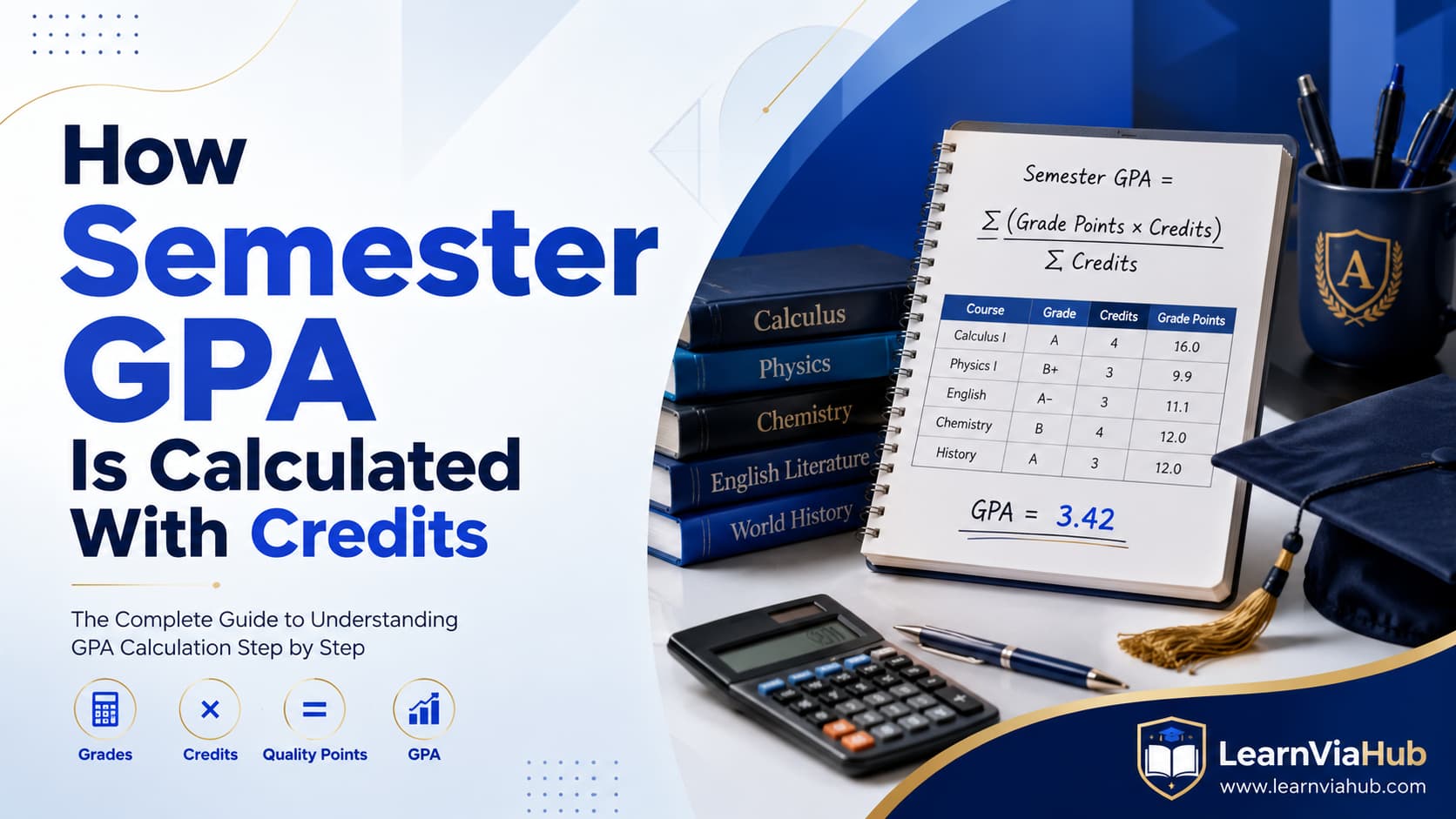
Learning how semester GPA is calculated with credits is the quickest way to take control of your academic standing. Your semester GPA is the weighted average of your letter grades for one term, where every course’s credit hours determine how much it counts. Use our free calculator below to see your own semester GPA instantly, then keep reading to master the formula, see a real‑world example, and understand exactly which courses count and which don’t.
Quick Answer
This is how semester GPA is calculated. Semester GPA = Total Grade Points ÷ Total Credit Hours Attempted
Grade Points are calculated by multiplying the credit hours for each course by the grade point value of the letter grade you earned.
Grade Points = Credit Hours × Grade Point Value
Only letter‑graded courses (A‑F) count toward your semester GPA. Failed courses count toward your total credit hours attempted—even though they earn 0 grade points.
Expand the calculator below to calculate your semester GPA instantly, or scroll to learn how it’s done step by step.
Click to Use the Semester GPA Calculator
📅 Semester GPA Calculator
Add your courses for one semester, enter the credit hours and letter grade for each. Your semester GPA is calculated automatically.
| Course (optional) | Credits | Grade |
|---|
📋 Based on the standard 4.0 scale used by most U.S. colleges. Includes plus/minus grades where applicable.
Failed courses (F) count as 0 grade points but still count toward total credits attempted.
How to use: Add your courses for one semester, enter the credit hours and letter grade for each. Click “Calculate Semester GPA” to see your GPA, along with the detailed math and an approximate letter grade. Failed courses (F) count as 0 grade points but still count toward total credits attempted.
Want to Reach a Specific Semester GPA?
Use our Target GPA Planner to find out exactly what grades you need in your remaining courses to hit your target cumulative GPA.
What Is Semester GPA?
Your semester GPA is the average of all your grades for a single academic term, typically a fall or spring semester, but it can also apply to summer sessions, quarters, or trimesters.
A grade point average, or GPA, is calculated by dividing the total number of grade points, or quality points, you’ve earned by the total number of credit hours you’ve attempted during a given period.”.
Why semester GPA matters:
Dean’s List
Many schools recognize students with a high semester GPA (often 3.5+) by placing them on the Dean’s List or President’s List.
Academic Standing
Your semester GPA determines if you’re in good standing, on probation, or at risk of dismissal. A low semester GPA triggers academic interventions.
Progress Tracking
Semester GPA helps you track your academic progress in real time—showing improvement, decline, or consistency across terms.
The Semester GPA Formula
The semester GPA formula is simple. According to Michigan State University’s guide, “to calculate your semester GPA, you take the sum of the points you earned that semester and divide it by the total number of credits you attempted that semester.”
The Semester GPA Formula
Semester GPA = Total Grade Points ÷ Total Credit Hours Attempted
Grade Points = Credit Hours × Grade Point Value
Breaking Down the Variables
Grade Point Value
The numerical equivalent of each letter grade.
A = 4.0
B = 3.0
C = 2.0
D = 1.0
F = 0.0
Credit Hours
The “weight” of each course. A 4‑credit course has four times the impact of a 1‑credit course.
Example: 4‑credit science class → weighs 4× more
1‑credit elective → weighs 1×
Grade Points
The product of Grade Point Value × Credit Hours.
Formula: Grade Points = Grade Point Value × Credit Hours
Example: A (4.0) × 3 credits = 12 Grade Points
Standard Grade Point Scale
| Letter Grade | Grade Points | Performance |
|---|---|---|
| A | 4.0 | Excellent |
| A− | 3.7 | Excellent |
| B+ | 3.3 | Very Good |
| B | 3.0 | Good |
| B− | 2.7 | Good |
| C+ | 2.3 | Satisfactory |
| C | 2.0 | Satisfactory |
| D | 1.0 | Minimum Passing |
| F | 0.0 | Fail |
Note: Some schools use slightly different grade point values. Always check your institution’s official grading scale. For a deeper look at different scales, see our GPA Scales Explained guide.
Step‑by‑Step: How Semester GPA is Calculated With Credits
Calculating your semester GPA involves six simple steps. Let’s walk through them:
Step 1: List All Courses with Letter Grades and Credit Hours
Start by listing every course you took this semester. For each course, record the letter grade you earned and the credit hours for that course.
Step 2: Convert Letter Grades to Grade Point Values
Use your school’s official GPA scale. The standard 4.0 scale is: A=4.0, B=3.0, C=2.0, D=1.0, F=0.0 (with plus/minus variations).
Step 3: Multiply Grade Points by Credit Hours → Grade Points
For every course, multiply the grade point value by the credit hours.
Formula: Grade Points = Grade Point Value × Credit Hours
Example: A (4.0) × 3 credits = 12 Grade Points
Step 4: Add All Grade Points for the Semester
Add together every grade point from every course you took this semester.
This is your Total Semester Grade Points.
Step 5: Add All Credit Hours for the Semester
Add together every credit hour from every course you took this semester.
Important: Include credit hours for failed courses—they still count toward your total credit hours attempted.
Step 6: Divide Total Grade Points by Total Credit Hours
Formula: Semester GPA = Total Grade Points ÷ Total Credit Hours Attempted
Example: 45.3 Grade Points ÷ 13 Credit Hours = 3.48 Semester GPA
Real Example: Semester GPA Calculation
Let’s walk through a complete semester GPA calculation using a real student’s transcript. Meet Emma, a college student who just finished her fall semester with the following grades:
Emma’s Fall Semester Transcript
| Course | Credit Hours | Letter Grade | Grade Points | Calculation |
|---|---|---|---|---|
| Biology | 4 | A | 4.0 | 16.0 |
| English Composition | 3 | B+ | 3.3 | 9.9 |
| Chemistry | 4 | B | 3.0 | 12.0 |
| History | 2 | A− | 3.7 | 7.4 |
| Totals | 13 | 45.3 |
Step 6: Divide Total Grade Points by Total Credit Hours
Semester GPA = Total Grade Points ÷ Total Credit Hours Attempted
45.3 ÷ 13 = 3.48
✅ Emma’s Fall Semester GPA: 3.48
What Emma’s GPA Tells Us
- 3.48 is a strong semester GPA — well above the 2.0 minimum for good standing.
- Emma’s Biology (4 credits, A) contributed the most to her GPA (16 grade points), while History (2 credits, A−) contributed the least (7.4 grade points).
- Even though Emma earned a higher grade in Biology (A vs A− in History), Biology had twice the impact because it carried more credit hours.
- Key takeaway: Excelling in high‑credit courses is the fastest way to boost your semester GPA.
What Counts Toward Semester GPA?
Understanding what counts and what doesn’t toward your semester GPA is essential for accurately calculating your academic standing.
| Course Type | Counts Toward GPA? | Why? |
|---|---|---|
| Letter Grade (A‑F) | ✅ Yes | These are the foundation of your GPA. |
| Pass/Fail (CR/NC) | 🟡 Usually Not | Pass does not count. Fail may count as 0.0 depending on institution. |
| Audited Courses | ❌ No | No grade points earned. |
| Withdrawals (W, WP, WF) | ❌ No | Dropped before completion, no grade points. |
| Incomplete (I) | ❌ No (for now) | Temporarily excluded. Once resolved, it may count. |
| Transfer Credits | ❌ Usually Not | Credits count, grades usually don’t. |
Important: Failed Courses Count Toward Credit Hours
You must count the credit hours for the courses that you failed” when calculating your semester GPA. Even though an F earns 0 grade points, the credit hours still count toward your total credit hours attempted, which means failing a course can significantly lower your GPA.
Semester GPA vs Cumulative GPA: What’s the Difference?
Your semester GPA and cumulative GPA are calculated using the same formula but they include different courses.
Semester GPA
- Time Period: One semester or term
- Courses Included: Only current term
- Purpose: Tracks short‑term progress
- Used For: Dean’s List, academic standing
Cumulative GPA
- Time Period: Entire academic career
- Courses Included: All completed courses
- Purpose: Measures overall achievement
- Used For: Transcripts, admissions, scholarships, graduation
Your semester GPA feeds into your cumulative GPA. According to Michigan State University, your cumulative GPA is the same calculation (total points / credits attempted) but it includes all the semesters you’ve completed. Learn more about cumulative GPA →
How to Calculate What GPA You Need (Reverse GPA)
You can calculate what GPA you need in the current semester to achieve a desired cumulative GPA.
The Reverse GPA Formula
Step 1: Total Credits After Semester × Desired Cumulative GPA = Total Grade Points Needed
Step 2: Total Grade Points Needed − Current Cumulative Grade Points = Grade Points Needed This Semester
Step 3: Grade Points Needed This Semester ÷ Credit Hours Taking = Semester GPA Needed
Real Example
Student scenario: You have a 2.8 cumulative GPA after 45 credits. You want to raise it to 3.0 and are taking 15 credits this semester.
Step 1: Total grade points needed after this semester
3.0 × (45 + 15) = 3.0 × 60 = 180
Step 2: Current grade points
2.8 × 45 = 126
Step 3: Grade points needed this semester
180 − 126 = 54
Step 4: Required semester GPA
54 ÷ 15 = 3.6
✅ You need a 3.6 GPA this semester to raise your cumulative GPA from 2.8 to 3.0.
Want to calculate your own GPA target? Use our Goal GPA Planner to see what grades you need.
Common Mistakes When Calculating Semester GPA
Even though the semester GPA formula is simple, students frequently make predictable errors. Here are the 5 most common mistakes, and how to avoid them.
❌ Mistake 1: Forgetting to Multiply by Credit Hours
The Error: Treating every course as if it carries the same weight. Some students simply average their letter grades without accounting for credit hours.
✅ Fix: Always multiply grade points by credit hours for every course.
❌ Mistake 2: Using the Wrong Grade Point Values
The Error: Assuming all schools use the same GPA scale. Some schools count A− as 3.7, others as 3.67.
✅ Fix: Always use your institution’s official grade point scale. Check your academic handbook or registrar’s website.
❌ Mistake 3: Including Courses That Don’t Count
The Error: Including Pass/Fail courses, audits, or withdrawals in the GPA calculation.
✅ Fix: Only include courses with letter grades (A‑F) that count toward your GPA.
❌ Mistake 4: Forgetting Failed Courses Count Toward Credit Hours
The Error: Excluding failed courses from the total credit hours attempted. You must count the credit hours for the courses that you failed.
✅ Fix: Include ALL credit hours for courses with letter grades—including Fs.
❌ Mistake 5: Rounding Too Early
The Error: Rounding grade points or quality points before completing the final calculation.
✅ Fix: Keep all decimals throughout the calculation. Round only at the very end—to two decimal places.
Frequently Asked Questions About Semester GPA With Credits
How is semester GPA calculated? ▼
Semester GPA is calculated by dividing the total number of grade points you earned that semester by the total number of credit hours you attempted that semester. Formula: Semester GPA = Total Grade Points ÷ Total Credit Hours Attempted
How do credit hours affect GPA? ▼
Credit hours act as “weights” for each course. A 4‑credit course has four times the impact on your GPA as a 1‑credit course. Excelling in high‑credit courses is the fastest way to boost your GPA.
Do failed classes count in semester GPA? ▼
Yes. The F earns 0 grade points, but the credit hours for the failed course still count toward your total credit hours attempted. This means failing a course lowers your GPA by dividing your total grade points by a larger number of credit hours.
What is the difference between semester and cumulative GPA? ▼
Semester GPA measures your performance during one academic term. Cumulative GPA measures your performance across ALL completed semesters combined.
How many credits do I need to raise my GPA? ▼
The number of credits needed depends on how many credits you have already completed. Use the reverse GPA formula to calculate what GPA you need this semester to reach your target. The more credits you have, the more credits you need to make a significant impact.
What courses don’t count toward GPA? ▼
The following courses typically do not count toward your GPA: Pass/Fail courses, audits, withdrawals (W, WP, WF), Incomplete (I) until resolved, and transfer credits.
Still Have Questions?
Explore our complete library of GPA guides for detailed explanations and examples.
Complete GPA Toolkit
Master every aspect of GPA with our free calculators and guides:
- How to Calculate GPA – The universal step‑by‑step guide
- Free GPA Calculator – Semester, cumulative, and major
- What is GPA? – Meaning and importance
- GPA Formula – The exact math behind every calculation
- GPA to Percentage Converter
- Percentage to GPA Converter
- GPA Scales Explained (4.0, 5.0, 10.0)
- Weighted vs Unweighted GPA
- How to Calculate College GPA
- How to Calculate High School GPA
- Semester vs Cumulative GPA
- GPA for Scholarships – Minimum thresholds and tips
- University GPA Requirements
- Unweighted GPA Guide
- How to Raise Your GPA – Proven strategies

Christian Chinonso is the founder of LearnViaHub, with 6+ years of research experience in international education — including GPA systems, scholarships, student financing, and study-abroad guidance — for students worldwide.