
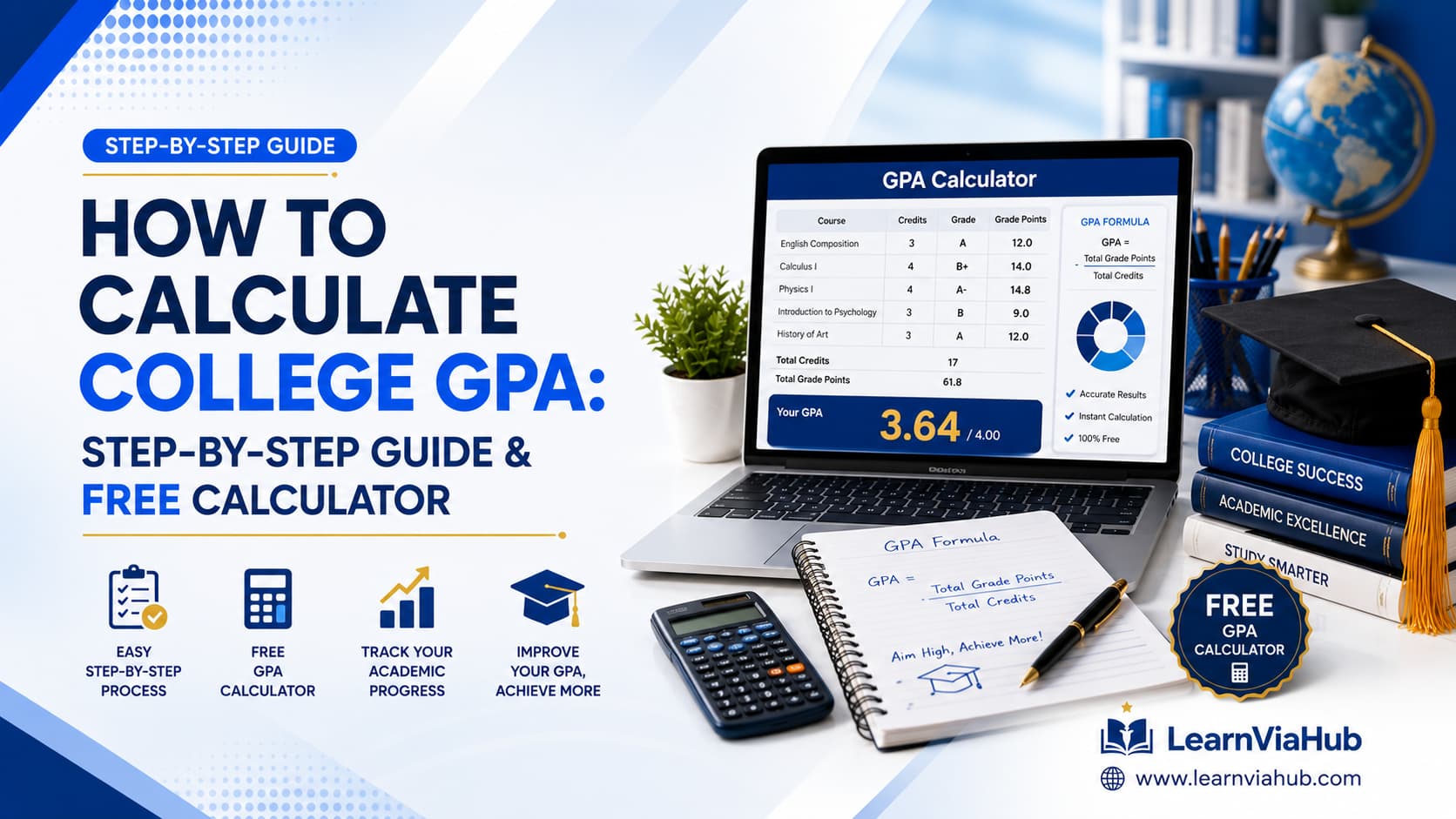
If you want to take control of your academic standing, the first thing you need to learn is how to calculate college GPA. Your GPA boils every assignment and exam down to a single 4.0‑scale number that can impact scholarships, graduate school applications, and even job offers. The math is much simpler than most students realize. This guide walks you through the exact formula, a real‑world example, and gives you a free interactive calculator that does the heavy lifting.
Quick Answer: How to Calculate College GPA
- Convert each letter grade to grade points (A = 4.0, A- = 3.7, B+ = 3.3, etc.).
- Multiply each course’s grade points by its credit hours to get quality points.
- Add all quality points and all credit hours attempted.
- Divide total quality points by total credits — that’s your GPA, rounded to two decimal places.
Use the interactive calculator below to do it instantly ⬇️
Click to Use the Free College GPA Calculator
🎓 College GPA Calculator
How to use: Enter an optional course name, credit hours, select your letter grade, and click “+ Add Course” for additional classes. Then hit “Calculate GPA” — your result appears instantly with a full quality‑point breakdown.
What Is College GPA and Why Should You Track It?
A college Grade Point Average (GPA) is a weighted average that turns your letter grades into a single 4.0‑scale score. Because courses carry different credit hours, a four‑credit biology lecture influences your GPA more than a one‑credit lab. Understanding this weighting is the key to knowing how to calculate college GPA accurately.
For a complete definition and real‑world examples, visit our What Is GPA? guide.
- A GPA of 3.0 (B average) is the national average for undergraduates.
- A 2.0 is typically the minimum required to graduate.
- A 3.5 or higher qualifies for honors and competitive grad programs.
College GPA Scale (Standard 4.0 Chart)
Most U.S. colleges use the 4.0 scale below. Some institutions omit plus/minus grades — always verify your school’s official policy. For international scales and weighted variants, see our full GPA Scales Explained guide.
How to Calculate College GPA – Step‑by‑Step Semester Formula
The core formula you’ll use every time is:
GPA Formula
GPA = Total Quality Points ÷ Total Credit Hours Attempted
Let’s walk through a real example. Imagine a student enrolled in four courses:
Semester GPA = 34.7 ÷ 11 = 3.15 (solid B average).
Need just the formula? Visit our GPA Formula page for a concise mathematical breakdown.
Cumulative GPA: All Semesters Combined
Cumulative GPA counts every college course you’ve taken so far. Never simply average your semester GPAs — that ignores the different credit loads per term.
Correct Cumulative Method
- Add every quality point you’ve earned in every semester.
- Add every credit hour you’ve attempted.
- Divide total quality points by total credits.
Example:
- Semester 1: 45 quality points, 15 credits → 3.00 GPA
- Semester 2: 52 quality points, 16 credits → 3.25 GPA
- Cumulative = (45 + 52) ÷ (15 + 16) = 97 ÷ 31 = 3.13
Notice the cumulative GPA is not 3.125 — the heavier second semester pulls it slightly down. Our calculator above can handle cumulative totals if you enter all courses from every semester. For an interactive tool that tracks multiple semesters, see our Semester vs Cumulative GPA page.
Special Cases: Pass/Fail, Retakes & Transfers
Pass/Fail Courses
Usually excluded from GPA. A “P” (pass) earns credit but no quality points. If you fail a pass/fail course, it may count as a 0.0 — check your college’s specific policy.
Repeated Courses
Many schools use grade replacement: only the most recent attempt counts in your GPA. Others average both grades. Always confirm with your registrar’s office.
Incompletes & Withdrawals
“I” (incomplete) and “W” (withdrawal) typically do not affect your GPA. They contribute zero credit hours and zero quality points.
Transfer Credits
Transfer courses are usually treated like pass/fail: they count toward your degree but are not included in your institutional GPA.
Convert Your College GPA to Percentage
Applying to jobs or universities abroad that use a 0–100 scale? Use the simple formula: Percentage = (GPA ÷ 4.0) × 100. For example, a 3.2 GPA ≈ 80%. For precise conversions on any scale, visit our GPA to Percentage Converter.
What Is a Good College GPA & How to Reach It
- 3.5 – 4.0 — Dean’s List, strong graduate school candidate, eligible for competitive scholarships.
- 3.0 – 3.4 — Solid standing, meets most graduate program minimums.
- 2.5 – 2.9 — Below average; improve to stay competitive for internships and jobs.
- Below 2.0 — Academic probation; retake courses to raise your GPA.
To see exactly what grades you need to reach a specific goal, use our Target GPA Planner — it calculates the required GPA in your remaining credits.
Frequently Asked Questions
What is a good college GPA?
A 3.0 (B average) is the national average. A 3.5+ qualifies for the Dean’s List and competitive graduate programs. A 2.0 is the minimum required to graduate at most institutions.
How does an A- affect my GPA compared to an A?
An A- carries 3.7 grade points instead of 4.0. In a 3‑credit course, that’s 11.1 quality points vs. 12.0 — a small difference that adds up over multiple semesters.
Can I calculate my cumulative GPA by averaging semester GPAs?
No. Because semesters have different credit hour totals, a simple average gives an incorrect number. You must sum all quality points and divide by total credits attempted.
Does a “W” (withdrawal) hurt my GPA?
No. A withdrawal typically contributes zero credits and zero quality points, so it does not directly change your GPA. However, multiple withdrawals may raise concerns with academic advisors or graduate admissions.
What if my college uses a different GPA scale?
The formula (quality points ÷ credits) remains the same, but grade point values may differ. Always refer to your college’s official grading policy. Our GPA Scales Explained guide covers variations like 5.0 and 10.0 systems.
Build Your Complete GPA Toolkit
- How to Calculate GPA – The universal guide for any level
- Free GPA Calculator – Semester, cumulative, and major
- What is GPA? – Meaning and importance
- GPA Formula – The exact math
- GPA to Percentage Converter
- Percentage to GPA Converter
- High School GPA Guide
- Graduate School GPA Guide
- Semester vs Cumulative GPA
- GPA for Scholarships
- University GPA Requirements

Christian Chinonso is the founder of LearnViaHub, with 6+ years of research experience in international education — including GPA systems, scholarships, student financing, and study-abroad guidance — for students worldwide.