
Quick Answer
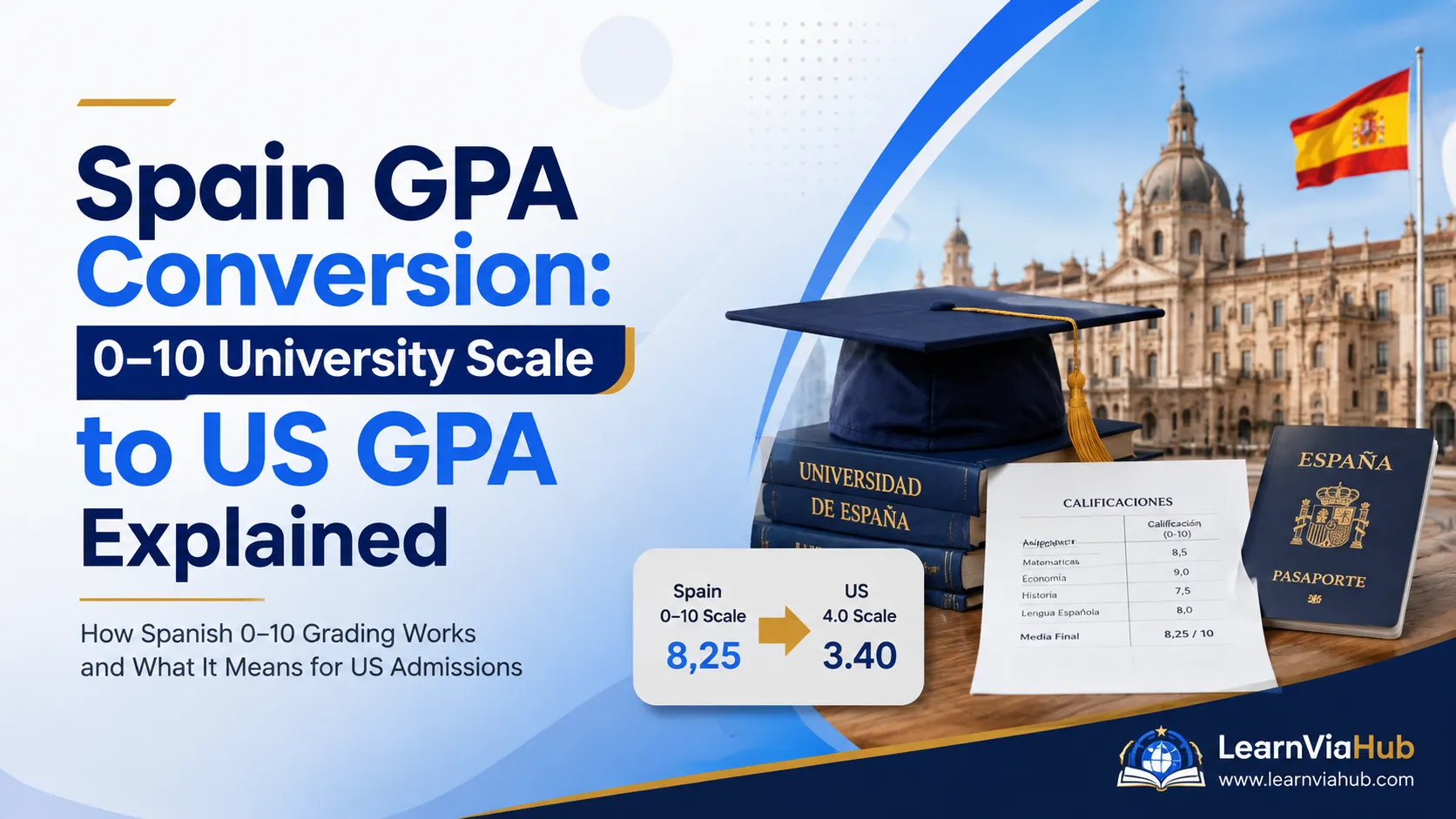
Spanish universities grade on a 0–10 scale, where 5.0 is the minimum passing grade and 10.0 is the highest. Official qualitative descriptors, established by Royal Decree 1125/2003, are: 5.0–6.9 = Aprobado (Pass), 7.0–8.9 = Notable (Very Good), and 9.0–10.0 = Sobresaliente (Outstanding). Professors can award Matrícula de Honor (MH) to students with a grade of 9.0 or higher — this is a special distinction capped at 5% of students per subject. Unlike Italy, Spain records failing grades (0–4.9) on the transcript and does not have a separate final degree scale — final degree marks are calculated as a weighted average on the same 0–10 scale. There is no official Spain-to-US GPA conversion table published by any government body; US universities and credential evaluators like WES convert grades individually.
Spanish Grading Scale at a Glance
- Individual exams and final degree: 0–10 scale (with one decimal place allowed)
- 5.0 is the minimum passing grade — grades below 5.0 are recorded on the transcript as failing grades (0–4.9)
- Official qualitative descriptors: 5.0–6.9 = Aprobado (Pass), 7.0–8.9 = Notable (Very Good), 9.0–10.0 = Sobresaliente (Outstanding)
- Matrícula de Honor (MH) — an honorary distinction awarded to top-performing students, capped at 5% of enrolled students per subject
- Final degree classification is a weighted average on the same 0–10 scale, calculated using ECTS credits
- Spanish universities also use the ECTS grading scale (A–E), based on statistical distribution of passing grades
- Grades of 9+ are exceptional and represent outstanding performance
ECTS Grading System
Grade Lookup Tool
Why No Single GPA Number
A Real US Conversion Example
WES Conversion
Reporting Your GPA
FAQs
Understanding the Spanish 0–10 Scale
Spanish university exams and final degrees are graded on a scale from 0 to 10, established by Royal Decree 1125/2003 of 5 September, which regulates the European credit system and the grading system for official university degrees. A grade of 5.0 is the minimum passing mark — this is the legal standard across all Spanish public universities.
Unlike Italy, where failing grades are not recorded, Spain records all grades from 0 to 4.9 on the transcript as failing grades (Suspenso or Insuficiente). These do not have a corresponding ECTS grade. Students cannot “reject” a passing grade to retake an exam — the accepted grade is final.
The official qualitative descriptors, as published by the Spanish Ministry of Education under Royal Decree 1125/2003, are:
| Spanish Grade (0–10) | Official Descriptor | English Translation |
|---|---|---|
| 9.0–10.0 | Sobresaliente (SB) | Outstanding / Excellent |
| 7.0–8.9 | Notable (NT) | Remarkable / Very Good |
| 5.0–6.9 | Aprobado (AP) | Pass |
| 0–4.9 | Suspenso / Insuficiente | Fail (recorded on transcript) |
What is Matrícula de Honor?
Above the standard 10-point scale, professors can award Matrícula de Honor (MH) — a special distinction for students who achieve a grade of 9.0 or higher and demonstrate exceptional performance. This is not a separate grade but an honorary mention that appears on the transcript alongside the numerical grade (e.g., 9.8 (MH)).
The number of MH awards is legally capped at 5% of students per subject (or 1 student per 20 in small groups), making it a significant achievement. For the purpose of GPA averaging, MH is treated the same as a 10.0 in the weighted average calculation.
Good to know: Spanish grading culture is known to be conservative — grades of 9 and above are exceptional and rarely awarded. A 7.0 represents very good academic performance, while 8.0 is excellent. In STEM fields, it is common for only a small percentage of students to pass, and scores of 9+ are genuinely outstanding. This cultural context is important when interpreting a Spanish transcript.
The ECTS Grading System in Spain
Spanish universities complement the national 0–10 scale with the European Credit Transfer and Accumulation System (ECTS) grading scale (A–E). ECTS grades are not a replacement for national grades — they provide additional context on how a student performed relative to their peers.
At Spanish institutions, ECTS grades are assigned based on the statistical distribution of passing grades in each subject. The distribution follows this reference scale:
| ECTS Grade | Qualitative Definition | % of Passing Students | Spanish Scale (5–10) |
|---|---|---|---|
| A | Excellent | Top 10% | 9.0–10.0 |
| B | Very Good | Next 25% | 8.0–8.9 |
| C | Good | Next 30% | 7.0–7.9 |
| D | Satisfactory | Next 25% | 6.0–6.9 |
| E | Sufficient | Last 10% | 5.0–5.9 |
Source: Royal Decree 1125/2003 and ECTS Users’ Guide. ECTS grades are based on the distribution of passing grades (5.0–10.0) only — failing grades (0–4.9) do not receive an ECTS grade.
Spanish Grade Lookup Tool
This tool shows your grade’s official Spanish descriptor, an approximate ECTS equivalent, and an approximate US GPA equivalent based on commonly accepted conversion standards. It does not generate an official GPA — see the sections below on why that number can’t be produced by a simple formula, and how to get an official conversion.
Why There’s No Single “Correct” US GPA Number
1. No Official Spain-to-US Conversion Authority
There is no official Spain-to-US GPA formula published by the Spanish Ministry of Education, the US Department of Education, or any bilateral agreement. Royal Decree 1125/2003 establishes the grading system for Spain but does not include any conversion to foreign systems. The Spanish government does not publish any official conversion to US GPA.
2. Institution-Specific Charts Vary
Some US universities publish their own conversion charts for Spanish grades (see the Iowa State example below). These are real and usable as reference points, but they apply to that institution’s own grading system — not to every US institution.
3. Middle-Range Grades Have Inconsistent Conversions
Even among reputable sources like Expatica, Scholaro, and Erudera, there is variation in how grades 6–8 map to US letter grades and GPA points. Some sources place 7.0 as a B (3.0), others as a B+ (3.3). The tool above uses the widely accepted mid-point for reference purposes.
A Real US Conversion Example
Iowa State University’s Study Abroad program publishes a grade conversion chart for Spanish universities. It’s a useful concrete example of how one US institution handles the conversion — not a universal standard:
| Spanish Grade | Iowa State University US Grade Equivalent |
|---|---|
| 10 (MH) | A+ |
| 9.0–9.9 | A |
| 8.0–8.9 | B+ |
| 7.0–7.9 | B |
| 6.0–6.9 | C+ |
| 5.0–5.9 | C |
| 0–4.9 | F |
Source: Iowa State University Study Abroad, Grade Conversion Guide. This chart applies specifically to Iowa State’s own credit transfer and grade translation process — your target university’s admissions or study-abroad office may use a different scale entirely.
How WES Converts Spanish Grades
Most US universities, scholarship programs, and immigration processes that require a numeric GPA from a Spanish transcript point applicants to a NACES-accredited credential evaluation service, most commonly World Education Services (WES). WES evaluates Spanish credentials by converting each grade individually and weighting the results by credit hours (ECTS) to produce a final GPA.
- Report type: A “Course-by-Course” evaluation — not a basic “Document-by-Document” report — is what produces a converted GPA. Confirm which type your target program requires.
- Cost and timeline change over time — check wes.org directly for current pricing rather than relying on a fixed figure.
- Apostille/authentication: Spain is a Hague Apostille Convention member, so Spanish academic documents can generally be apostilled if a program requires authenticated copies.
- The result from any pre-evaluation calculator, including the one on this page, is a planning estimate only — not an official evaluation.
How to Report Your Spanish GPA on US Applications
1. Report Your Original Grades First
Don’t self-convert to a 4.0 scale unless the application specifically asks for a US-equivalent GPA. Report your grades on the 0–10 scale as they appear on your transcript.
2. Include Your Grading Scale Explanation
Spanish transcripts don’t always spell out the scale explicitly for a foreign reader — attach a brief explanation or the Diploma Supplement (Suplemento al Título) wherever the application allows supporting documents. The Diploma Supplement includes both the national grade and the ECTS grade.
3. Get a Formal Evaluation If Required
Many US graduate programs and scholarships — including some competitive, merit-based ones — require a WES or equivalent NACES-member evaluation rather than a self-reported conversion.
4. Don’t Round Up
If your evaluated GPA falls in a range, report the figure your evaluator actually gives you — not the top of the band.
Converting other grading systems? See these guides:
Frequently Asked Questions
Can I convert my Spanish grade to a single, official US GPA number?
▼
Is 5.0 a good grade in Spain?
▼
What is Matrícula de Honor?
▼
What’s the difference between the 0–10 scale and the final degree scale?
▼
Should I convert my Spanish GPA myself for scholarship applications?
▼
Are failing grades recorded on Spanish transcripts?
▼

Christian Chinonso is the founder of LearnViaHub, with 6+ years of research experience in international education, GPA systems, and study-abroad guidance for international students.Christian Chinonso is the founder of LearnViaHub, with 6+ years of research experience in international education — including GPA systems, scholarships, student financing, and study-abroad guidance — for students worldwide.