
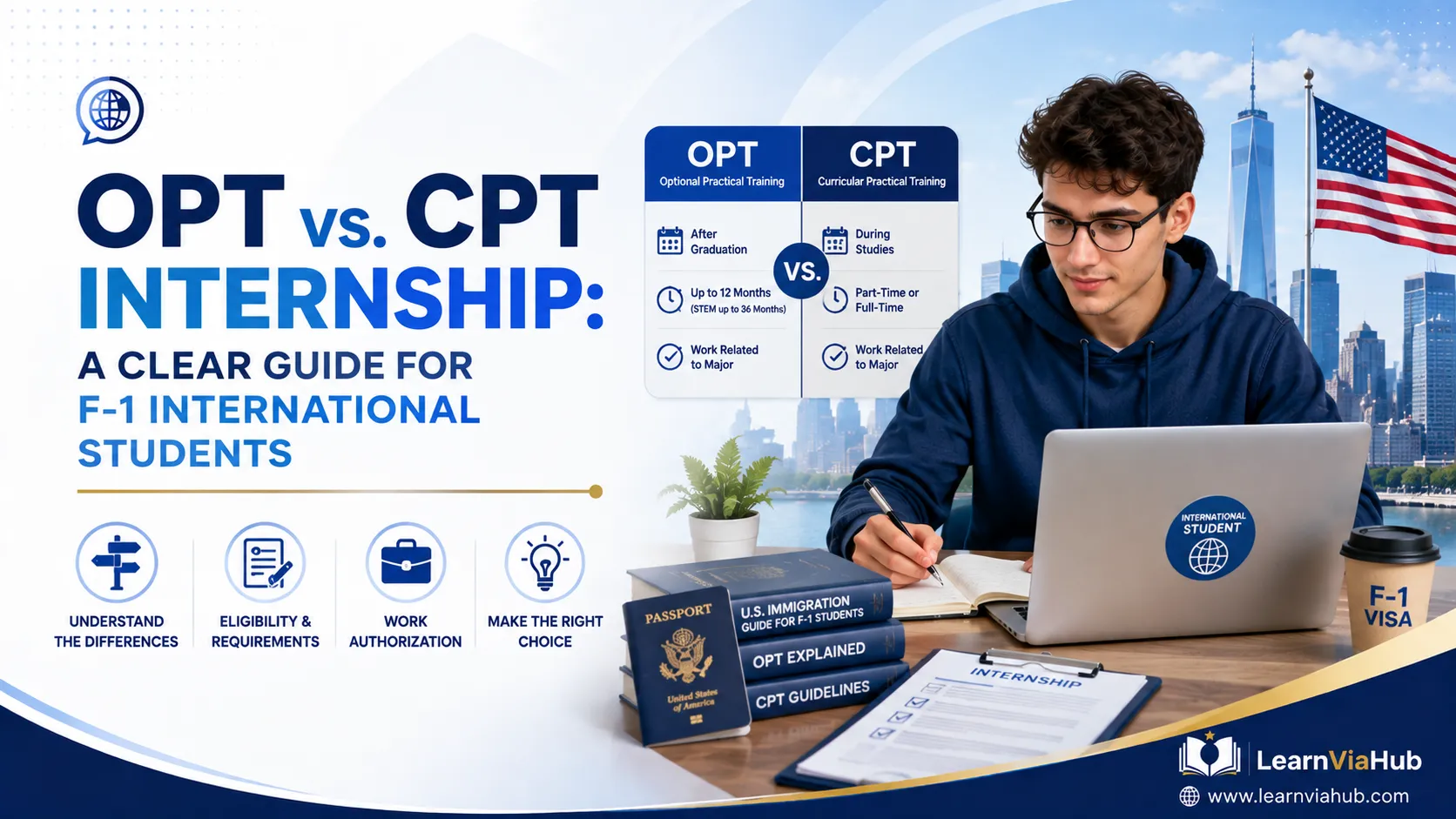
CPT vs OPT — the difference in one paragraph
CPT is pre-graduation, must be required by your degree programme, and is authorised by your school on your I-20. OPT can be used before or after graduation, must relate to your major field, and requires a USCIS-approved Employment Authorization Document (EAD). Twelve months of full-time CPT eliminates OPT eligibility at the same degree level. Part-time CPT does not.
A fifth detail most guides miss: if you are an F-1 nonresident alien, you are not liable for US self-employment tax — that 15.3% figure you see on other sites applies to US citizens and resident aliens, not to you.
This page is part of our broader guide to internships for international students, which compares work authorisation across the US, UK, France, Canada, and Germany.
Jump to a section
What is CPT?
Curricular Practical Training is F-1 work authorization for an internship, practicum, or work experience that is directly required by your degree programme or counts as an integral part of your curriculum. CPT is not a visa category — it is a school-authorised employment benefit recorded on your Form I-20.
CPT eligibility
- You must be in valid F-1 status and enrolled full-time.
- One full academic year of full-time study is generally required first — except for graduate programmes that require CPT from the start.
- The internship must be required by your programme or integral to your curriculum.
- You must receive academic credit, or the work must be formally linked to your course of study.
- Your Designated School Official (DSO) must authorise CPT on your I-20 before you start work.
France takes a different approach — every internship requires a three-party agreement signed before the placement begins. See the France internship visa and convention de stage guide.
Part-time vs full-time CPT
- Part-time CPT: 20 hours or fewer per week. Does not count toward the 12-month full-time threshold.
- Full-time CPT: More than 20 hours per week. Accumulating 12 months (365+ days) of full-time CPT eliminates OPT eligibility at the same degree level.
Day-1 CPT warning: Some universities offer “day-1 CPT” programmes where CPT is authorised from the first term. USCIS has flagged these as a compliance risk when the CPT is used for extended work that displaces a real academic curriculum. If your school promises day-1 CPT on a programme that isn’t genuinely full-time, on-campus, and academically structured, you may lose F-1 status during a USCIS review.
For how remote and cross-border work affects your CPT/OPT authorisation, see our guide to remote internships for international students.
What is OPT?
Optional Practical Training is temporary employment authorisation that allows F-1 students to work in their major field of study. Unlike CPT, OPT requires a formal application to USCIS and an approved Employment Authorization Document (EAD) before you can start work.
| Feature | Pre-Completion OPT | Post-Completion OPT |
|---|---|---|
| Timing | Before graduation, while still enrolled | After completing your degree |
| Duration | Counts against the 12-month standard OPT total | Up to 12 months standard |
| Work hours | Can be part-time or full-time | Generally full-time |
| Unemployment limit | No unemployment limit | 90 days; 150 total if STEM extension approved |
STEM OPT extension
If your degree is in a STEM-eligible field (see the DHS STEM Designated Degree Program List), you may qualify for a 24-month STEM OPT extension — total of 36 months of OPT at the same educational level. The employer must be enrolled in E-Verify, and you must file Form I-983 (Training Plan) with your DSO.
If you’re weighing US OPT against the UK’s post-study options, see the UK internship visa and Graduate Route guide.
CPT vs OPT side by side
| Factor | CPT | OPT |
|---|---|---|
| Timing | Before graduation | Before or after graduation |
| Programme requirement | Must be curricular/integral | Must relate to major field |
| Full-time limit | 12 months of full-time CPT removes OPT | Standard 12 months; STEM 24-month extension |
| Approval | DSO authorizes on Form I-20 | USCIS Employment Authorization Document (EAD) |
| Best for | Required academic internships | Post-graduation work or flexible internships |
| Processing time | Days — approved by your DSO | 3–5 months — USCIS processing |
| Cost | No government fee | I-765 filing fee (~$470 as of 2026 — check USCIS) |
| Paid or unpaid | CPT required even for unpaid internships | OPT required even for unpaid internships |
The 12-month full-time CPT rule
Rule: If you complete 12 months or more of full-time CPT at the same educational level, you become ineligible for OPT at that level. This threshold is based on 365 days of full-time CPT. Part-time CPT does not count toward this limit.
Worked examples
Example 1 — Safe use: 6 months of full-time CPT during your Master’s. You still have 12 months of OPT after graduation.
Example 2 — OPT loss: 13 months of full-time CPT during the same Master’s. Because you crossed the 12-month full-time limit, no OPT at the Master’s level.
Example 3 — Part-time protection: 15 months of part-time CPT (20 hrs/week or fewer). OPT eligibility remains intact.
Example 4 — Higher degree reset: You use 12 months of full-time CPT at Bachelor’s level and lose OPT. You then start a Master’s. At the Master’s level, you get a fresh 12-month OPT window.
Example 5 — Mixed use: 6 months of full-time CPT + 3 months of pre-completion OPT + 3 months of post-completion OPT = 12 months total OPT used. Post-completion OPT available: 0. STEM extension may still apply if eligible.
Tax and reporting — what actually applies to F-1 students
Most guides get this wrong. Here’s what the IRS actually says.
Correction to common claims: F-1 nonresident aliens are not liable for US self-employment tax (15.3% for Social Security and Medicare). That rate applies to US citizens and resident aliens. If you are an F-1 student who has been in the US for fewer than 5 calendar years, the IRS treats you as a nonresident alien and you are exempt from self-employment tax (with rare exceptions under a Totalization Agreement).
What you do owe
- Federal income tax on wages earned during CPT or OPT — withheld by your employer on Form W-2.
- State income tax where applicable.
- FICA (Social Security and Medicare) — F-1 nonresident aliens are generally exempt from FICA on wages for services performed in the US.
- No self-employment tax for nonresident aliens.
W-2 vs 1099 during CPT or OPT
How your employer classifies you matters:
- W-2 (employee): The correct classification for most CPT and OPT work. Employer withholds income tax, issues a W-2, and reports wages to the IRS.
- 1099-NEC (independent contractor): Rare during CPT/OPT and often a red flag. Immigration rules generally do not allow F-1 students to be self-employed. If an employer offers you a 1099, get advice from your DSO before accepting.
Whether your internship is paid or unpaid does not affect whether you need CPT/OPT — see our guide to paid vs unpaid internships for the legality rules by country.
Filing requirements
- You must file Form 8843 every year you are a nonresident alien, even if you had no income.
- If you had US income, file Form 1040-NR (nonresident alien return).
- Both forms are free to file with most tax software providers (many universities arrange free access).
Source: IRS — Foreign Students and Scholars; IRS — Alien liability for Social Security and Medicare taxes.
Unemployment limits during OPT
During post-completion OPT you are allowed up to 90 days of unemployment. With an approved STEM extension, you gain an additional 60 days — a total of up to 150 days across the entire post-completion OPT and STEM OPT period.
Important details:
- Pre-completion OPT has no unemployment limit, but any pre-completion OPT time reduces the total post-completion OPT available.
- Unemployment during the cap-gap automatic extension counts toward the 90/150-day maximum.
- Every calendar day counts — including weekends and holidays.
- Non-qualifying volunteer positions do not stop unemployment accrual.
- If you exceed the limit, your SEVIS record may be terminated, and you may not be eligible for reinstatement.
- Reporting: You must report your employment to your DSO within 10 days of starting or ending a job via the SEVP Portal.
The 5-month absence rule
If you leave the US for more than 5 consecutive months while on F-1 status, you are considered to have broken your SEVIS record. You would need a new I-20, a new SEVIS fee, and a new SEVIS ID to re-enter. This applies during F-1 status, not during post-completion OPT (which has separate travel rules). Exceptions exist for approved study abroad, research or thesis fieldwork abroad, and global co-op — as long as you remain enrolled and active in SEVIS.
Which authorisation fits your situation?
If your US OPT window runs out and you’re considering other countries, our guides to the Canada internship work permit and Germany internship visa cover the alternative post-study work routes.
| Situation | Best choice | Reason |
|---|---|---|
| Programme requires an internship for credit | CPT | Curricular integration requirement fits CPT. |
| Still studying, want flexible part-time work | CPT or pre-completion OPT | CPT is simpler if the role is curricular; OPT if CPT not available. |
| Graduating soon, want to stay in the US | Post-completion OPT | Standard post-graduation work benefit. |
| STEM degree, want extended US work experience | Post-completion OPT + STEM extension | STEM extension adds 24 months. |
| Concerned about losing future OPT | CPT part-time or limited full-time | Stay below 12 months of full-time CPT. |
| Want to use an unpaid internship | CPT or OPT — still required | Unpaid does not exempt you. DOL and university guidance confirm. |
How to apply
CPT application steps
- Obtain a written internship offer that matches your academic programme.
- Confirm with your academic advisor that the internship qualifies for CPT.
- Submit your university’s CPT request form and required documents to your DSO.
- Receive a new I-20 with CPT authorisation.
- Start work on or after the authorised CPT start date.
OPT application steps
- Request an OPT recommendation from your DSO.
- Receive a new I-20 showing the OPT recommendation.
- File Form I-765 with USCIS within the 90-day window before your OPT start date.
- Pay the USCIS filing fee and retain your receipt notice.
- Wait for USCIS processing — commonly 3–5 months — and receive your EAD card.
- Begin work only after the EAD start date and when you have the physical card.
Planning tip: Apply for OPT as early as your DSO allows — up to 90 days before your programme end date. USCIS processing commonly takes 3–5 months, and you cannot start work until your EAD arrives.
Common mistakes
- Starting CPT before the authorised I-20 date.
- Not tracking full-time CPT months and crossing the 12-month OPT elimination threshold.
- Using CPT for an internship that is not actually curricular or integrated into the degree.
- Confusing part-time and full-time CPT definitions.
- Applying for OPT too late, not accounting for USCIS processing delays.
- Assuming pre-completion OPT does not reduce post-completion OPT — it does. All standard OPT is capped at 12 months per level.
- Failing to maintain F-1 status while waiting for OPT approval.
- Not reporting OPT employment or unemployment days within the required timeframes (10-day SEVP Portal rule).
- Assuming an unpaid or remote internship does not require CPT/OPT — it still does if you are physically in the US.
- Accepting a 1099 contractor role — most F-1 self-employment is not permitted.
Frequently asked questions
What is the difference between OPT and CPT?
Can I do CPT after graduation?
Does CPT affect OPT eligibility?
How many months of CPT can I do?
What is pre-completion OPT?
How long does OPT application processing take?
Can I use CPT and OPT at the same time?
Do I pay self-employment tax on CPT or OPT income?
Can I use CPT for an unpaid internship?
Related guides
Internships for International Students
The hub — work authorisation and post-study rights across the US, UK, France, Canada, and Germany.
France internship visa and convention de stage
VLS-TS étudiant vs stagiaire, the three-party convention de stage, and 2026 gratification rates.
UK internship visa and Graduate Route
Graduate Route 18-month change, GAE visa, and student work rights during term.
Canada internship work permit
The April 2026 co-op work permit change, the 50% rule, and PGWP tiers.
Germany internship visa
The 140/280-day work rule, mandatory vs voluntary internships, and the €13.90/hr minimum wage.
Remote internships for international students
Same-country, cross-border, and home-country scenarios — visas, tax, and work authorisation.
Paid vs unpaid internships
Legality by country — FLSA test, French gratification, UK NMW, Canadian provincial rules, German MiLoG.
Sources

Christian Chinonso is the founder of LearnViaHub, with 6+ years of research experience in international education — including GPA systems, scholarships, student financing, and study-abroad guidance — for students worldwide.