
📅 Last Updated August 2026
👨💻 Reviewed By LearnViaHub Editorial Team
⏱️ Reading Time Approximately 8–10 minutes
📚 Sources Reviewed Official MEXT application forms, Study in Japan (JASSO), and Japanese embassy/consulate guidelines for the 2026–2027 cycle.
Quick Answer
What are the MEXT required documents? They are the official application forms and supporting paperwork you must submit to a Japanese embassy (Embassy Recommendation) or a participating Japanese university (University Recommendation).
Key formatting rules: All documents must be printed on A4 paper, submitted unstapled, and translated by a certified translator if not in English or Japanese. The research plan must be within 4 pages, and recommendation letters must be written by a Dean, Department Head, or Academic Supervisor and addressed to the University President.
This page focuses only on documents. For GPA, language scores, and eligibility criteria, see our MEXT Scholarship Requirements Guide and MEXT Eligibility Guide.
Detailed Document Guide
Format Requirements
Translation Rules
Originals vs Copies
Embassy vs University
Preparation Timeline
Common Mistakes
FAQs
If you’re starting fresh, first read our Complete MEXT Scholarship Guide to understand which route you’re applying through. Then return here to assemble every document correctly — without risking disqualification for a missing form.
📖 What Are the MEXT Required Documents?
The MEXT required documents are the official set of application forms and supporting paperwork you must submit to the Japanese embassy (Embassy Recommendation route) or a Japanese university (University Recommendation route) when applying for the MEXT Scholarship. The exact list varies slightly by scholarship category and country, but a core set is required almost universally. This guide explains each document in detail, so you can prepare a complete, polished application.
⚡ Before You Begin: The Golden Rule
Always download the latest application forms and checklist directly from your local Japanese embassy (for Embassy Recommendation) or the university’s international office (for University Recommendation). Forms are updated annually — using an old version can invalidate your entire application.
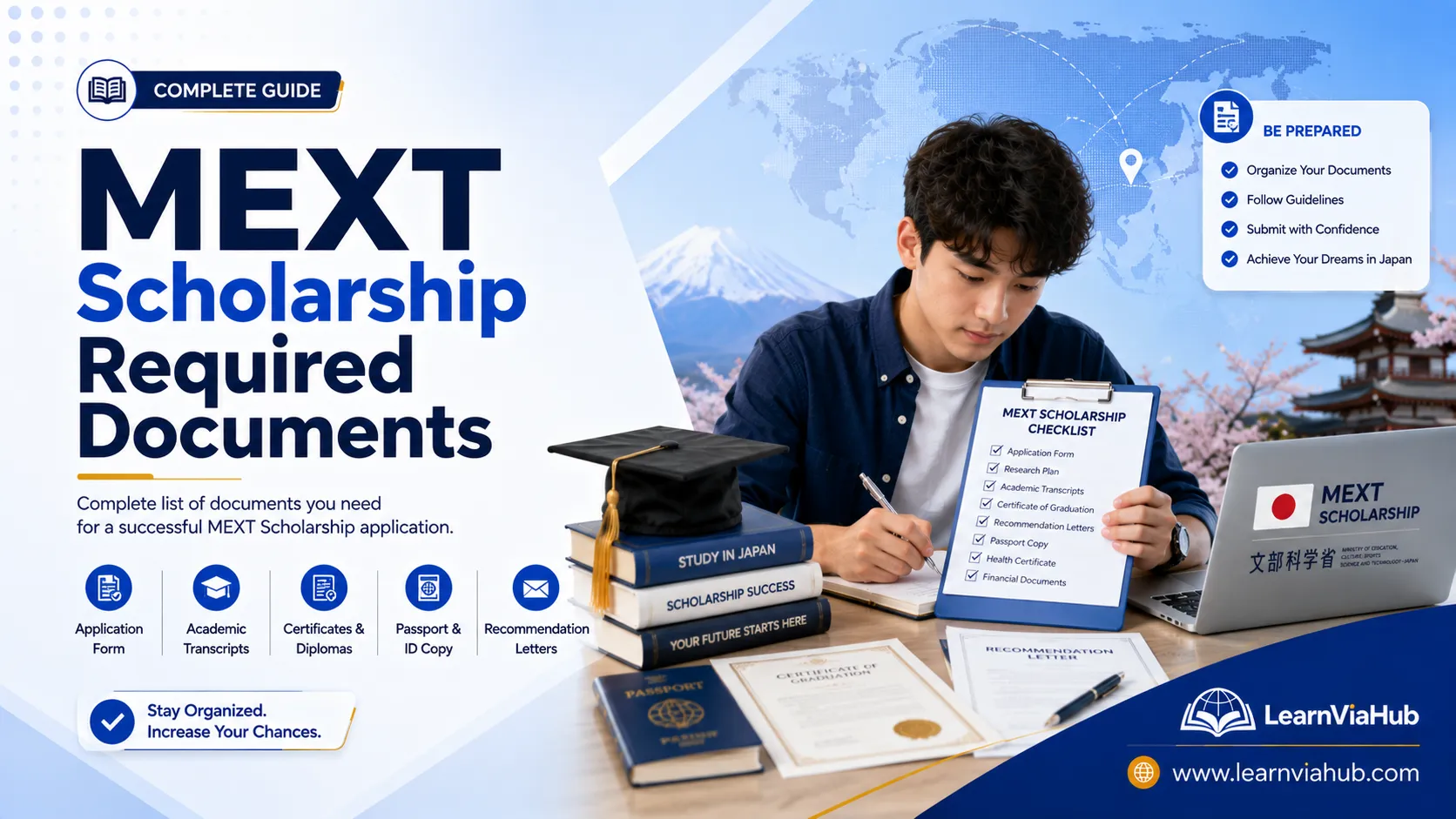
Core MEXT Required Documents Checklist
Below is the standard list of documents. Items marked as “Category-specific” or “Country-specific” depend on your scholarship type or the embassy/university you’re applying to.
| Document | Usually Required? | Quick Purpose |
|---|---|---|
| MEXT Scholarship Application Form | ✅ Yes | Provides your personal details, academic history, and chosen scholarship category. |
| Academic Transcript(s) | ✅ Yes | Official records of your grades from secondary school, college, or university. |
| Graduation Certificate / Expected Graduation Certificate | ✅ Yes | Confirms you have completed (or will complete) your current education level. |
| Recommendation Letter(s) | ✅ Yes (usually 1–2) | Endorsement from a Dean, Department Head, or Academic Supervisor. |
| Medical Certificate | Varies by country | Official health statement signed by a licensed physician on the prescribed MEXT form. |
| Field of Study and Research Plan | Research students only | Detailed proposal of your intended research topic, within 4 pages. |
| Additional Embassy / University Forms | Country- / university-specific | May include declarations, placement preference forms, or local address certificates. |
⚠️ Warning: Submitting all required documents does not guarantee the scholarship, but submitting an incomplete package will almost certainly disqualify you before the first screening even begins.
Detailed Guide to Each MEXT Application Document
Now let’s break down exactly what each document entails, what format it should be in, and the most common mistakes to avoid.
1. MEXT Scholarship Application Form
This is the main document. You’ll fill in your personal information, educational background, chosen field of study, scholarship category, and preferred universities (if asked). It may be a PDF or an online form, depending on the embassy or university.
- Where to get it: Download from your local Japanese embassy’s official website (Embassy Recommendation) or the university’s international admissions page (University Recommendation). You can also refer to the Study in Japan MEXT Scholarship page for general forms and guidance.
- Key tip: Use the same name spelling as your passport. Inconsistent names between the application form and other documents can cause verification delays.
- Common mistake: Leaving fields blank. Write “N/A” or “None” where genuinely not applicable, but don’t skip a section without checking if it’s optional.
2. Academic Transcript(s)
Transcripts must cover all years of your highest level of education (and sometimes secondary school). They should be official documents issued by your institution — typically stamped, signed, or digitally verified.
- Language: If your original transcripts are not in English or Japanese, certified translations are usually required. Check with your embassy or university for their translation rules.
- If you haven’t graduated yet: Submit an “Expected Graduation Certificate” along with your latest available transcript. You’ll need to provide the final graduation certificate later if selected.
3. Graduation Certificate or Expected Graduation Certificate
A separate certificate (distinct from the transcript) confirming your degree or diploma. If you’re in your final year, ask your institution to issue a letter stating your expected graduation date and that you’re on track to complete your program.
- Format: Official letterhead, stamp/seal, and signature of the registrar or dean.
- Deadline note: For Embassy Recommendation, this must be submitted with your initial application. Some universities may allow conditional submission, but don’t rely on that unless explicitly permitted.
4. Recommendation Letter(s)
Most MEXT categories require at least one recommendation letter. The letter must be written by a Dean, Department Head, or Academic Supervisor — not a generic referee. Research student applicants may need two letters.
- Who should write it: Someone who knows your academic work well — a professor, department head, or thesis supervisor. Generic letters from high-ranking officials who don’t know you personally are weaker.
- Addressed to: The University President (not just “To Whom It May Concern”), especially for University Recommendation. For Embassy Recommendation, address it to the Japanese Ambassador or the appropriate embassy official if instructed.
- Format: Must be on institutional letterhead with a stamp/seal. The letter must be signed and sealed in an envelope, with the referee signing across the seal.
- What it should cover: Your academic performance, research potential (for graduate applicants), character, and why you’re suitable for study in Japan.
5. Medical Certificate
Not all countries demand this at the initial application stage, but many do. The certificate must be completed by a licensed physician on the official MEXT medical form. It verifies that you’re physically and mentally fit to study abroad.
- Where to find the form: It’s usually included in the application package from the embassy or university. If not, ask the embassy directly — don’t use a generic health certificate.
- Timing: Medical exams can take time to schedule. Book an appointment early once you know you’ll apply, so you’re not scrambling days before the deadline.
- Chronic conditions: Having a managed medical condition doesn’t automatically disqualify you. Be honest; discrepancies later could invalidate the scholarship.
6. Field of Study and Research Plan (Research Students Only)
For Master’s and PhD applicants, this is arguably the most important document after the application form. It outlines your proposed research, your reasons for choosing Japan, and your academic goals.
- Structure: Typically includes a title, introduction/background, research objectives, methodology, expected outcomes, and a brief bibliography.
- Length: Maximum 4 pages (within 4 pages). Exceeding the limit can signal inability to follow instructions. Always follow the embassy’s or university’s limit.
- Connection to Japan: Explain why your research benefits from being conducted in Japan — mention specific universities, professors, or unique resources. Avoid generic statements like “Japan is a beautiful country.”
7. Additional Embassy- or University-Specific Documents
These vary widely. Examples include:
- Application for Certificate of Eligibility (for visa)
- Placement preference form (ranking your preferred Japanese universities)
- Study in Japan pledge / statement of purpose
- Copy of passport
- Photographs (passport-style, recent)
Always read the checklist published by your specific embassy or university line by line.
Document Format Requirements
Follow these universal formatting rules to avoid unnecessary rejection:
- Paper size: All documents should be printed on A4 paper (210 × 297 mm). Do not use Letter size.
- Staples: Submit documents unstapled. Use paper clips only if permitted by the embassy/university instructions.
- Digital submissions: If online submission is allowed, all files must be in PDF format unless stated otherwise.
- Signature and stamps: Every required signature must be present. Use black or blue ink consistently.
Official Translation Rules
If your original documents are not in English or Japanese, you must provide certified translations.
- Translations must be done by an accredited translator or an embassy-approved translation service.
- Some embassies require a translation accuracy certification — a statement signed by the translator confirming the translation is true and complete.
- Attach the certified translation to the original document. Do not submit translated documents alone without the original.
Originals vs Copies Policy
Knowing when to submit an original versus a copy is critical. The table below summarizes the general policy, but always check your specific embassy or university rules.
| Document | Original Required? | Notes |
|---|---|---|
| Application Form | ✅ Yes | Must be the official original, not a photocopy. |
| Academic Transcripts | ✅ Yes | Official stamped copies issued by the institution are generally accepted as “originals” if they bear original stamps. |
| Graduation Certificate | ✅ Yes | Original certificate or certified true copy. |
| Medical Certificate | ✅ Yes | Original on official MEXT form, signed by physician. |
| Recommendation Letter | ✅ Yes | Must be submitted in original, sealed envelope with signature across seal. |
| Passport Copy | ❌ Copy | Clear photocopy of the personal information page is acceptable. |
| Photographs | ❌ Copy | Digital or printed photos as specified; check embassy rules for exact requirements. |
Embassy vs University Document Differences
The two application routes require different submission targets and sometimes different sets of documents. Use this table to understand what each route demands.
| Feature | Embassy Recommendation | University Recommendation |
|---|---|---|
| Where to Submit | Japanese embassy or consulate in your country | Directly to the participating Japanese university |
| Who Screens | Embassy/consulate first | University first |
| Additional Country-Specific Forms | Often required (declarations, local address certificates, placement forms) | University-specific admission forms and possibly faculty evaluation forms |
| Recommendation Letter Addressee | Typically to the Japanese Ambassador or embassy selection committee | Addressed to the University President |
| Professor Contact | Not required before application | Often required or encouraged |
| Research Plan | May be required for research students | Usually required, and may need to align with a specific professor’s work |
For detailed route procedures, see the Embassy Recommendation Guide and the University Recommendation Guide.
Document Preparation Timeline (2026–2027 Cycle)
Because some documents take weeks to obtain, plan backward from the application deadline. The typical MEXT 2026–2027 cycle runs from December 2026 to October 2027. Use this schedule as a guide.
| When | Action |
|---|---|
| December 2026 – January 2027 | Research scholarships and universities. Identify target programs and note their specific document requirements. |
| February – March 2027 | Request transcripts, recommendation letters, and medical certificate appointment (if required). Begin drafting research plan. |
| April – May 2027 | Finalize research plan, obtain certified translations, and review all forms for completeness. |
| June – July 2027 | Complete final checks, print on A4, prepare envelopes according to instructions, and submit before the embassy/university deadline. |
For the complete annual scholarship calendar, see our MEXT Scholarship Timeline Guide.
Common Document Mistakes That Cause Disqualification
| Mistake | How to Prevent It |
|---|---|
| Using outdated application forms | Download fresh forms from the official embassy or university website for the current 2026–2027 cycle. |
| Missing signatures or stamps | Create a checklist of every place a signature is required and verify each one before sealing the envelope. |
| Inconsistent name spellings | Use the exact name that appears in your passport across all documents. |
| Transcripts not in English/Japanese without certified translation | Check embassy/university requirements. If translation is needed, use a certified translator or your university’s official translation service. |
| Submitting photocopies when originals are required | Some embassies accept copies; others demand originals. Read the fine print. When in doubt, provide originals. |
| Ignoring country-specific additional forms | Your local embassy’s checklist is the definitive list. Don’t rely on a friend’s experience from another country. |
| Research plan exceeding 4 pages | Strictly adhere to the within 4 pages limit. Concision demonstrates your ability to follow instructions. |
❓ Frequently Asked Questions
Can I submit my application without the Medical Certificate if I get it later?▼
What if my transcripts are not in English?▼
How many recommendation letters do I need?▼
Can I hand-write the application form?▼
Should I staple or bind my documents?▼
Do I need to provide proof of language proficiency?▼
Complete Your MEXT Application Preparation
Complete MEXT Scholarship Guide
Overview of all routes, categories, and benefits.
MEXT Scholarship Requirements
GPA formula, language scores, and age limits.
MEXT Eligibility Guide
Detailed nationality, academic, and health criteria.
MEXT Application Process Guide
Step-by-step walkthrough for both routes.
MEXT Embassy Recommendation Guide
Embassy procedures, exams, and interviews.
MEXT University Recommendation Guide
University nomination and admission requirements.
MEXT Scholarship Timeline Guide
Full annual calendar for both routes.
Official External Resources
Always cross-check document requirements with these two official sources:
MEXT Official Scholarship Page
The authoritative source for official application forms, guidelines, and deadlines.
Study in Japan – MEXT Scholarships
JASSO’s official portal with up-to-date MEXT scholarship details and document explanations.
Editorial Note
This guide reflects the general document requirements published by MEXT and Japanese embassies/consulates worldwide for the 2026–2027 cycle. Because individual embassies and universities may set additional requirements or use updated forms, always verify your document list with your specific applying body. The LearnViaHub Editorial Team updates this guide annually after new MEXT recruitment cycles begin. Last reviewed August 2026.

Christian Chinonso is the founder of LearnViaHub, with 6+ years of research experience in international education — including GPA systems, scholarships, student financing, and study-abroad guidance — for students worldwide.