
Every requirement below comes from the 2027 cycle MEXT guideline, Study in Japan, or the embassy pages named in Sources. Where a rule applies only to one route or one country, the text says so.
⚠️ Three things to know before reading:
1. The embassy publishes the definitive list. The core MEXT document set is standard, but each embassy and each university adds its own forms and formatting rules. The checklist published by your applying body overrides anything on this page.
2. Two documents usually need a sealed envelope. Recommendation letters and medical certificates. Where the envelope rule applies, the referee signs across the seal and you submit it unopened. Not every embassy requires this — Indonesia, for example, does not.
3. Formats are country-specific. A4 paper and unstapled submission are near-universal. Ink color, notarization and translation rules are not. Check your embassy’s page before printing anything.
Jump to a section
Quick answer
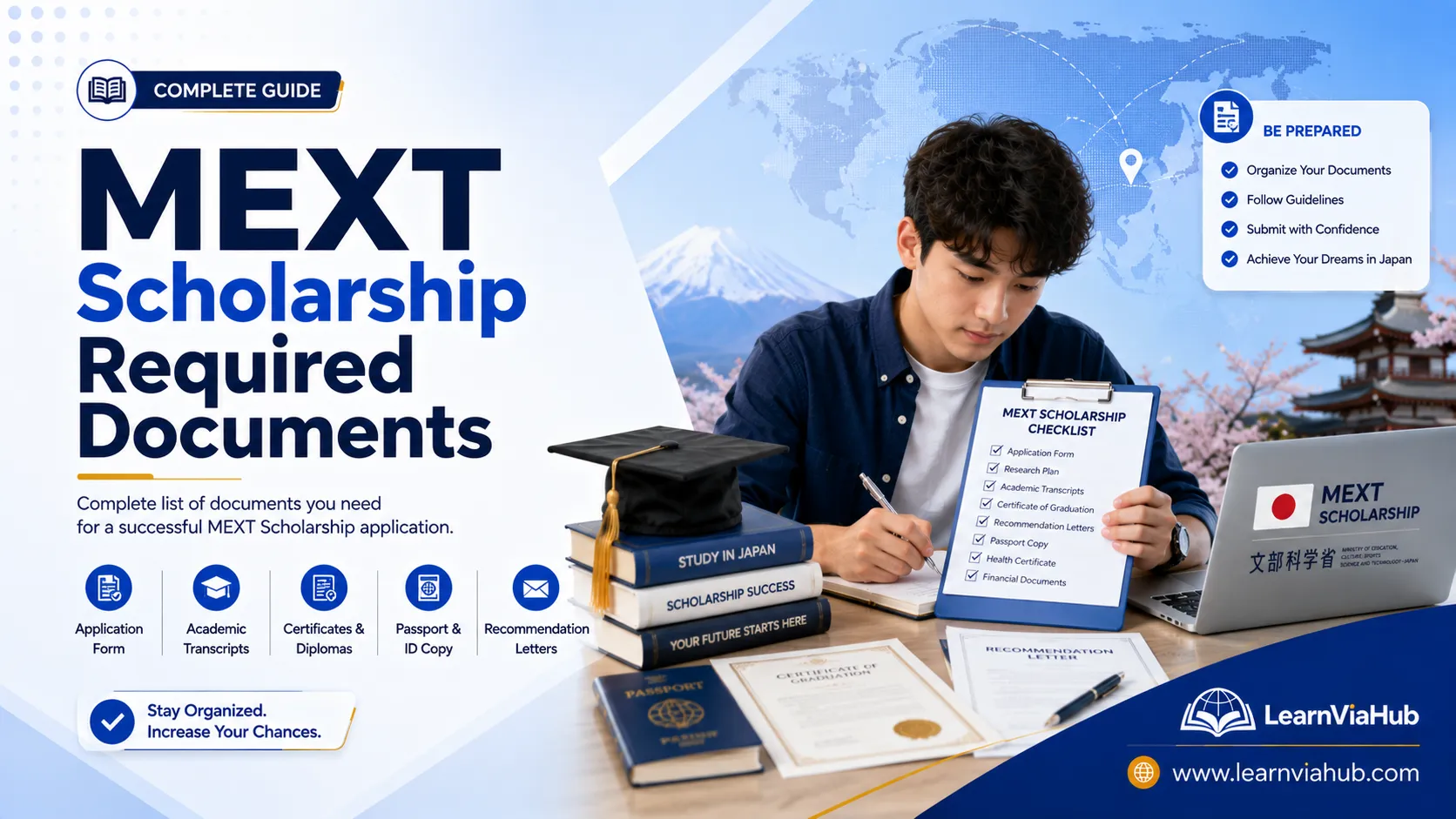
The core MEXT document set is small. Application form, transcripts, graduation certificate, recommendation letters, medical certificate, and a research plan for Research-category applicants. Everything else is embassy-specific or university-specific.
Two rules are near-universal: A4 paper, and no staples. Everything else — translation rules, notarization, ink color, envelope requirements — varies by embassy. The checklist your embassy publishes is the one that counts. Documents must be submitted in English or Japanese; if yours are in another language, you’ll need to attach a translation and check your embassy’s rules for whether self-translation is accepted.
The one rule: the checklist your embassy publishes overrides every general rule on this page. Download it before you print anything.
MEXT required documents: the full checklist
Seven items, standard across most categories. Items marked varies depend on your route, category or country. The exact list depends on both — this page covers the core set, and your embassy’s checklist is the final word.
Undergraduate applicants have a shorter document list than Research applicants. The research plan below does not apply to them. Check your embassy’s checklist for which items apply to your category.
| Document | Required? | Purpose |
|---|---|---|
| Application form | Yes | Personal details, academic history, chosen category. |
| Academic transcripts | Yes | Official grade records from your highest completed level of education. |
| Graduation certificate (or expected-graduation letter) | Yes | Confirms completion or expected completion. |
| Recommendation letter | Yes (1–2) | Academic endorsement on the official MEXT form. |
| Medical certificate | Varies by country | Physician-signed health statement on the official MEXT form. |
| Field of Study and Research Plan | Research students only | Proposed research topic, methodology and reasons for Japan. |
| Additional embassy/university forms | Varies | Declarations, placement preference form, local address certificate, etc. |
If a document on this list is missing from your package, the application is likely rejected at the first screening. MEXT states that incomplete or inaccurate applications may be rejected outright.
Country-specific variations
Where embassies have published requirements that go beyond the core list, they are noted here. For every other country, check your embassy’s page — most publish a checklist.
What we verified
We checked document checklists and guidance from six embassies — India, Nepal, the Philippines, Indonesia, Israel and Pakistan — plus university international-office pages from Tsukuba, JAIST, Tokyo, Hokkaido and Waseda. Two rules held everywhere. Three did not.
Near-universal rules
Rules that vary
This is why the checklist your embassy publishes overrides every general rule — including any rule on this page.
Each document, in detail
1. Application form
Download the current form from your embassy (Embassy Recommendation) or from the university’s international office (University Recommendation). The form is updated each cycle.
2. Academic transcripts
Official records issued by your institution, covering the years specified by your category. Most transcripts need a stamp or signature from the issuing office to count as official.
3. Graduation certificate
A separate document from the transcript. If you’re in your final year, ask your institution for a letter stating your expected completion date and that you’re on track.
Format: institutional letterhead, stamp or seal, signature from the registrar or dean.
4. Recommendation letter
Most categories require one or two. Letters are written on the official MEXT form, not free-form.
5. Medical certificate
Some embassies require this at the initial application stage; others only after selection. Either way, it must be completed by a licensed physician on the official MEXT form, signed and stamped.
Do not use a generic health certificate from your doctor’s office. The prescribed form is the only acceptable version.
6. Field of Study and Research Plan
Research-category applicants only. This is often the most heavily weighted document in the package after the interview.
7. Additional embassy or university forms
Varies widely. Common additions include a placement preference form ranking preferred universities, a declaration or pledge, a passport copy, or a local address certificate. Always read the embassy’s checklist line by line.
Formatting rules
Two rules are near-universal. Everything else varies.
| Rule | Status |
|---|---|
| Print on A4 paper (210 × 297 mm) | Near-universal. Standard across every embassy and university page we checked. |
| Do not staple documents | Near-universal. Use paper clips only if permitted. |
| Typed, not handwritten | Preferred. Handwriting in block letters is accepted by some embassies. |
| PDF, for online submission | Required where online submission is accepted. Not all embassies accept online. |
| Ink color | No official rule found. Follow what your embassy specifies, if anything. |
| Notarization | Country-specific. Some embassies require it (Nepal), others forbid it (Israel). Check your embassy. |
Translation rules
If your original documents are not in English or Japanese, you will likely need to attach a translation. The rules differ by embassy.
Do not assume a “certified translator” is required everywhere. Check your embassy’s page.
Where to get documents translated
Three sources, in order of what embassies most often accept.
Originals vs copies
Knowing when to submit an original versus a copy matters. The table below reflects what most embassies publish, but always confirm against your own applying body.
| Document | Submission form |
|---|---|
| Application form | Original, signed. |
| Transcripts | Original issued by your institution, or an official stamped copy. Some embassies ask for one original plus two photocopies. |
| Graduation certificate | Original, or certified true copy where originals can’t be released. |
| Recommendation letter | Original with wet signature. Where an envelope is required, sealed and signed across the seal. |
| Medical certificate | Original on the official form, signed and stamped by the physician. |
| Passport | Photocopy of the personal information page. |
| Photographs | Printed or digital, per the embassy’s specification. |
What to do this week
Editorial recommendations based on where the 2027 cycle stands on 8 October 2026.
| Your situation | Do this first |
|---|---|
| You haven’t downloaded the application package | Open your embassy’s page today. The list on their page overrides everything here. |
| You have the package but haven’t requested transcripts | Email your registrar now. Certified transcripts take 5–15 business days from most institutions. |
| You have transcripts but no translations yet | Check your embassy’s translation rules before paying a translator. Some accept self-translation; some require notarization. |
| You’re a Research applicant without a research plan | Draft two pages before you draft anything else. The length limit varies by applying body — check yours. |
Frequently asked questions
What documents do Undergraduate applicants need?
Can I submit the medical certificate later?
What if my transcripts aren’t in English?
Where can I get my documents translated?
How many recommendation letters do I need?
Can I handwrite the application form?
Should I staple my documents?
How long can my research plan be?
Does my recommendation letter need to be in a sealed envelope?
How do I know I have the exact right documents?
Sources
Method: I read the 2027 cycle MEXT guidelines, the Study in Japan portal, and document checklists from six embassies — India, Nepal, the Philippines, Indonesia, Israel and Pakistan — plus university international-office pages from Tsukuba, JAIST, Tokyo, Hokkaido and Waseda on 8 October 2026. Where two sources contradicted each other, I reported both rather than picking one.
Corrections so far: Earlier versions of this page stated the research plan was limited to four pages, that recommendation letters had to be addressed to the University President, and that ink must be black or blue. None of those are universal. Four pages is a university-specific limit; the addressee is set by each form; ink color has no official rule. We removed or qualified all three.

Christian Chinonso is the founder of LearnViaHub, with 6+ years of research experience in international education — including GPA systems, scholarships, student financing, and study-abroad guidance — for students worldwide.