
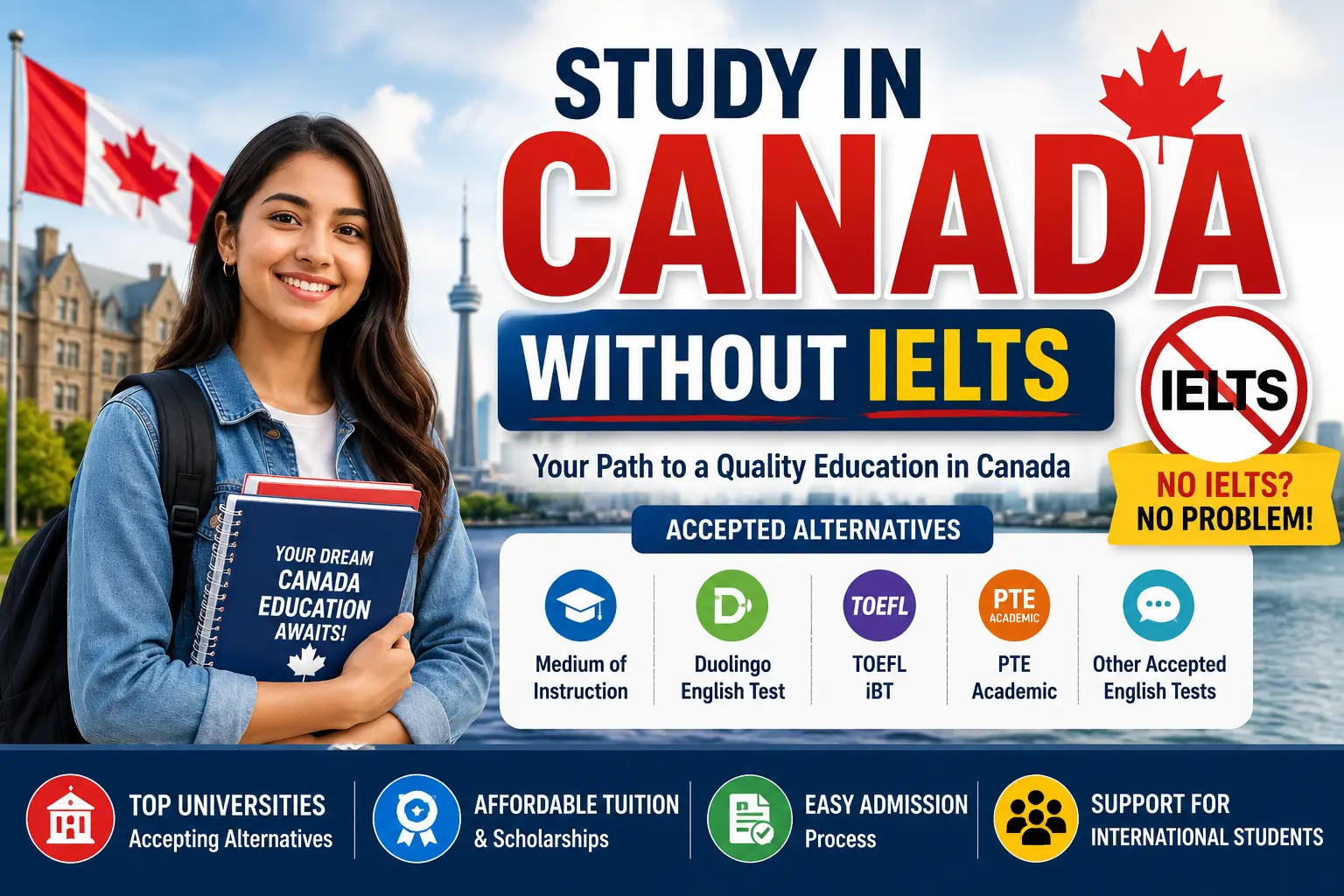
If you’ve been told that an IELTS score is the only way to study in Canada, it’s worth taking a closer look. While many institutions accept IELTS, it isn’t the only option available. Depending on your educational background, the language you studied in, and the university you choose, you may be able to study in Canada without IELTS.
Many students exploring opportunities to study abroad without IELTS successfully qualify through alternative English proficiency tests, a Medium of Instruction (MOI) certificate, or university-approved pathway programs. This guide explains your options, highlights Canadian universities that accept students without IELTS, and shows how to apply confidently while understanding both admission and study permit requirements.
Can You Study in Canada Without IELTS?
Yes, you can study in Canada without IELTS, provided you meet the English language requirements set by your chosen institution through other accepted methods.
Canadian universities and colleges accept alternatives such as the Duolingo English Test, TOEFL, PTE Academic, a Medium of Instruction (MOI) certificate, or completion of an English-language pathway program. The exact requirements vary by institution and program, so always verify the latest admission policy on the university’s official website.
Why IELTS Is Not Required by Every University
IELTS is a widely recognized English proficiency test, but Canadian universities have the authority to determine how applicants demonstrate their English skills. As a result, many institutions accept multiple forms of evidence instead of relying solely on IELTS. For example, if you completed your previous education in English or come from a country where English is the primary language of instruction, you may qualify for an English language waiver or be asked to submit an MOI certificate instead.
University Admission vs. Canadian Study Permit Requirements
One of the most common sources of confusion is assuming that admission to a Canadian university automatically guarantees a study permit. These are two separate processes.
- University admission focuses on whether you meet the institution’s academic and English language requirements.
- A Canadian study permit, issued by Immigration, Refugees and Citizenship Canada (IRCC), evaluates your overall eligibility, including your admission letter, financial capacity, study plan, and other immigration requirements.
This means you can receive admission without IELTS, but you’ll still need to satisfy all applicable study permit requirements before travelling to Canada.
Common Misconceptions
Many students miss valuable opportunities because of outdated or incorrect information. Here are some of the most common myths:
- Every Canadian university requires IELTS. Many universities accept alternative English proficiency evidence.
- No IELTS means no Canadian study permit. A study permit is assessed on several factors, not IELTS alone.
- An MOI certificate is accepted everywhere. Acceptance depends on the university, and some programs may still require a standardized English test.
One university’s policy applies to all institutions. English language requirements vary by university, college, faculty, and even individual programs.
Why Some Canadian Universities Accept Students Without IELTS
Not every Canadian university uses the same method to assess English language proficiency. While IELTS is widely accepted, many institutions recognize that students can demonstrate their language ability through other qualifications. In fact, the Government of Canada’s education portal explains that each university sets its own admission requirements, which is why English language policies vary across institutions.
How Universities Evaluate English Proficiency
Canadian universities want to ensure you can succeed in an English-speaking academic environment. Depending on the institution, you may prove your proficiency through:
- An accepted English language test such as TOEFL, PTE Academic, Duolingo, or CAEL.
- A Medium of Instruction (MOI) certificate confirming your previous education was taught in English.
- Completion of an English language pathway or foundation program.
- Previous academic studies completed in English.
Countries Exempt from IELTS
Universities waive English language testing for applicants from countries where English is the official language or the primary language of instruction. Others may extend the exemption to students who completed several years of full-time education in English, regardless of nationality.
There is no nationwide exemption list, so eligibility depends on the university’s policy. Always review your chosen institution’s admission requirements before assuming you qualify for a waiver.
English-Medium Education Certificate (MOI)
A Medium of Instruction (MOI) certificate is an official letter issued by your school or university confirming that your education was delivered in English. Many Canada universities accepting students without IELTS accept this document as an alternative proof of English proficiency.
Keep in mind that an MOI certificate is not universally accepted. Some institutions accept it for all programs, while others require standardized English test scores for competitive or professional degrees.
Previous Education in English
If you completed a secondary school diploma, bachelor’s degree, or master’s degree in English, you may qualify for an English language waiver. Universities typically consider the duration of your studies, the language of instruction, and the accreditation of your previous institution before granting an exemption.
University Pathway Programs
Students who do not meet the English language requirement can often enroll in a university-approved pathway or academic English program. After successfully completing the program, they can progress directly into their chosen degree without submitting an IELTS score.
This option is especially valuable for students with strong academic records who need additional preparation for university-level English.
Pre-Sessional English Courses
Many Canadian universities also offer pre-sessional English courses before the start of an academic program. These intensive courses are designed to strengthen academic reading, writing, speaking, and listening skills while helping students adapt to the expectations of Canadian higher education.
For some programs, successfully completing a pre-sessional course fulfills the university’s English language requirement without the need for IELTS.
IELTS Alternatives Accepted by Canadian Universities
If you don’t have an IELTS score, you still have several ways to meet the English proficiency requirements in Canada. Many Canadian universities accept internationally recognized English language tests or alternative proof of English proficiency. The accepted option depends on the institution and program, so always verify the latest requirements on your chosen university’s official admissions page before applying.
| English Proficiency Option | Accepted by Canadian Universities | Overall Acceptance |
|---|---|---|
| TOEFL iBT | ✔ Yes | High |
| PTE Academic | ✔ Yes | High |
| Duolingo English Test | ✔ Yes | Medium–High |
| CAEL | ✔ Yes | Medium |
| Cambridge English (C1 Advanced/C2 Proficiency) | ✔ Yes | Medium |
| CELPIP | Limited | Low |
| Medium of Instruction (MOI) Certificate | Some Universities | Varies |
TOEFL (Test of English as a Foreign Language)
TOEFL iBT is one of the most trusted IELTS alternatives for Canada. It evaluates your reading, listening, speaking, and writing skills and is accepted by the majority of Canadian universities for undergraduate and postgraduate programs. You can confirm institution-specific requirements on the official TOEFL website: ETS TOEFL.
PTE Academic
PTE Academic is another widely recognized English proficiency test accepted by many Canadian universities. Because it is computer-based and delivers results quickly, it has become a popular choice among international students. Minimum score requirements vary depending on the university and program.
Duolingo English Test
The Duolingo English Test allows students to take the exam online from home, making it one of the most convenient options. Many Canadian universities now accept Duolingo scores for admission, although some competitive programs may still require another English proficiency test.
CAEL (Canadian Academic English Language Test)
Designed specifically for academic study in Canada, CAEL measures English skills in real university settings. While it is accepted by fewer institutions than TOEFL or IELTS, it remains a respected option for applicants whose chosen universities recognize the test.
Cambridge English Qualifications
Several Canadian universities also accept Cambridge English qualifications, particularly C1 Advanced (CAE) and C2 Proficiency (CPE). These certifications demonstrate advanced English language ability and may satisfy admission requirements for eligible programs.
English Language Waiver
Some universities waive English language testing if you completed your previous education entirely in English or meet other exemption criteria. Approval is determined by each institution, so applicants should review the university’s English language policy before assuming they qualify.
Medium of Instruction (MOI) Letter
A Medium of Instruction (MOI) letter is an official document issued by your previous school or university confirming that your education was taught in English. Many Canada universities accepting students without IELTS recognize an MOI certificate as proof of English proficiency. However, acceptance varies, and some institutions still require standardized test scores for certain programs.
If you’re exploring universities in multiple countries, read our Complete Guide to IELTS Alternatives for Studying Abroad to compare accepted English language tests worldwide.
Universities in Canada Without IELTS for International Students
If you’re planning to study in Canada without IELTS for international students, you’ll find that several Canadian universities and colleges offer alternative ways to meet their English language requirements. Depending on the institution, you may qualify through a Medium of Instruction (MOI) certificate, an alternative English proficiency test such as TOEFL, PTE Academic, or Duolingo, or by completing an approved English pathway program. Since admission policies vary by institution and program, always confirm the latest requirements on the university’s official admissions website before submitting your application.
| University / College | Province | IELTS Waiver Available | Accepted Alternatives | Minimum Academic Requirement | Official Admission Page |
|---|---|---|---|---|---|
| University of Winnipeg | Manitoba | Yes (Eligible Applicants) | MOI, TOEFL, Duolingo, CAEL, Pathway Program | High school or equivalent (UG); Bachelor’s degree (PG) | View Admission Requirements |
| Brock University | Ontario | Yes (Selected Applicants) | TOEFL, PTE Academic, Duolingo, Pathway Program | Program-specific academic requirements | View Admission Requirements |
| Memorial University of Newfoundland | Newfoundland and Labrador | Yes | MOI, TOEFL, Duolingo, Cambridge English | Program-specific academic requirements | View Admission Requirements |
| University of Regina | Saskatchewan | Yes | TOEFL, PTE Academic, Duolingo, CAEL, ESL Pathway | Program-specific academic requirements | View Admission Requirements |
| University of Saskatchewan | Saskatchewan | Limited | TOEFL, PTE Academic, Duolingo, Pathway Program | Program-specific academic requirements | View Admission Requirements |
| Concordia University | Quebec | Yes (Selected Cases) | TOEFL, Duolingo, PTE Academic, Cambridge English | Program-specific academic requirements | View Admission Requirements |
| Carleton University | Ontario | Limited | TOEFL, PTE Academic, Duolingo, CAEL | Program-specific academic requirements | View Admission Requirements |
| University of Prince Edward Island | Prince Edward Island | Yes | MOI, TOEFL, Duolingo, Pathway Program | Program-specific academic requirements | View Admission Requirements |
| Cambrian College | Ontario | Yes | Duolingo, TOEFL, PTE Academic, MOI (Selected Programs) | Secondary school completion | View Admission Requirements |
| Seneca Polytechnic | Ontario | Limited | TOEFL, Duolingo, PTE Academic | Program-specific requirements | View Admission Requirements |
| George Brown College | Ontario | Limited | Duolingo, TOEFL, PTE Academic | Secondary school completion | View Admission Requirements |
| Centennial College | Ontario | Yes (Selected Programs) | Duolingo, TOEFL, PTE Academic | Program-specific requirements | View Admission Requirements |
| Saskatchewan Polytechnic | Saskatchewan | Limited | TOEFL, PTE Academic, Duolingo | Program-specific requirements | View Admission Requirements |
| Fanshawe College | Ontario | Yes (Selected Applicants) | TOEFL, PTE Academic, Duolingo, Pathway Program | Secondary school completion | View Admission Requirements |
| NorQuest College | Alberta | Yes | MOI, TOEFL, Duolingo, PTE Academic, Pathway Program | Program-specific requirements | View Admission Requirements |
If cost is one of your biggest concerns, explore our guide to the cheapest universities in Canada for international students to compare tuition fees, scholarships, and affordable study destinations.
Cheapest Universities in Canada Without IELTS
Studying in Canada doesn’t have to mean paying premium tuition fees. Several Canadian universities offer relatively affordable programs while also providing IELTS waiver options or accepting alternative proof of English proficiency. However, choosing the lowest tuition isn’t always the smartest financial decision. Your total cost of studying includes accommodation, food, transportation, health insurance, books, and other living expenses, which can vary significantly between provinces and cities.
| University | Average Annual Tuition (International Students) | Province | IELTS Waiver Available | Scholarship Opportunities |
|---|---|---|---|---|
| Memorial University of Newfoundland | CAD $11,000–$20,000 | Newfoundland and Labrador | Yes | Entrance, Merit, Graduate Scholarships |
| University of Winnipeg | CAD $16,000–$20,000 | Manitoba | Yes | Entrance Awards, President’s Scholarships |
| University of Regina | CAD $18,000–$25,000 | Saskatchewan | Yes | International Entrance Scholarships |
| University of Prince Edward Island | CAD $16,000–$23,000 | Prince Edward Island | Yes | International Entrance Awards |
| University of Saskatchewan | CAD $22,000–$35,000 | Saskatchewan | Limited | Guaranteed Entrance & Merit Scholarships |
| Cambrian College | CAD $15,000–$19,000 | Ontario | Yes | Entrance Scholarships |
| Fanshawe College | CAD $16,000–$21,000 | Ontario | Yes | International Student Awards |
| NorQuest College | CAD $17,000–$22,000 | Alberta | Yes | International Entrance Scholarships |
Look Beyond Tuition Fees
A university with lower tuition isn’t always the most affordable choice overall. For example, studying in a city with high rent and transportation costs may end up costing more than attending a university with slightly higher tuition in a more affordable province. Before making your decision, compare your estimated annual expenses, including housing, meals, health insurance, utilities, local transportation, and personal costs.
Many universities also offer entrance scholarships, renewable merit awards, bursaries, and on-campus employment opportunities that can significantly reduce your overall study costs. Applying early often improves your chances of receiving financial support.
Expert Tip: Calculate your total cost of attendance, not just tuition. A university with tuition that’s CAD $2,000 higher may actually save you money if it offers generous scholarships or is located in a city with a lower cost of living.
Want to compare more budget-friendly institutions? Explore our comprehensive guide to Affordable Universities in Canada to discover low-tuition universities, living costs, and scholarship opportunities for international students.
Colleges in Canada That Accept Students Without IELTS
If your goal is to gain practical skills, graduate quickly, or reduce tuition costs, Canadian colleges can be an excellent alternative to universities. Many public colleges accept international students without IELTS by recognizing alternative English proficiency tests, a Medium of Instruction (MOI) certificate, or successful completion of an approved English pathway program. Admission requirements vary by institution and program, so always check the official admissions page before applying.
Colleges vs. Universities: What’s the Difference?
| Feature | Colleges | Universities |
|---|---|---|
| Primary Focus | Career-oriented, practical education | Academic and research-based education |
| Programs Offered | Diplomas, Advanced Diplomas, Certificates, Graduate Certificates | Bachelor’s, Master’s, and PhD degrees |
| Program Duration | 1–3 years (most programs) | 3–4+ years depending on the degree |
| Tuition | Often more affordable | Generally higher |
| Learning Style | Hands-on training with industry experience | Theory, research, and academic specialization |
| Career Outcome | Quick entry into the workforce | Professional careers, research, or further studies |
Popular Canadian Colleges Accepting Students Without IELTS
Several colleges offer alternative ways to satisfy English language requirements for eligible international students. Well-known options include:
- Cambrian College
- Seneca Polytechnic
- George Brown College
- Centennial College
- Fanshawe College
- Saskatchewan Polytechnic
- NorQuest College
Many of these institutions accept alternatives such as TOEFL, PTE Academic, the Duolingo English Test, an MOI certificate, or completion of an approved English pathway program.
Graduate Certificate Programs
If you already hold a bachelor’s degree, a graduate certificate can help you develop specialized, job-ready skills in fields such as business, information technology, healthcare, engineering, project management, and digital marketing. These programs usually last one year and are popular among international students seeking affordable education with strong employment prospects.
Some colleges also allow eligible applicants to meet English language requirements through accepted alternatives instead of IELTS.
Pathway Admission Programs
If you don’t currently meet a college’s English language requirement, you may still qualify through a pathway program. These programs strengthen your academic English before you begin your diploma or certificate. After successfully completing the pathway, you can often transition directly into your chosen program without submitting an IELTS score.
If you’re comparing tuition fees and career-focused institutions, explore our guide to Affordable Universities in Canada to evaluate costs, scholarships, and the best options for international students.
How to Study in Canada Without IELTS (Step-by-Step)
If you’re wondering how to study in Canada without IELTS, the process is straightforward when you plan carefully. The key is choosing institutions that accept alternative proof of English proficiency and preparing the required documents before application deadlines. Follow these steps to improve your chances of receiving both an admission offer and a Canadian study permit.
Step 1: Choose Universities Offering IELTS Waivers
Start by researching Canadian universities and colleges that accept students without IELTS. Look for institutions that recognize alternatives such as the Medium of Instruction (MOI) certificate, TOEFL, PTE Academic, the Duolingo English Test, or English pathway programs. Always review the official admission requirements for your chosen program because English language policies can vary within the same university.
Step 2: Check Whether You Qualify for an English Language Exemption
Before registering for another English test, find out whether you qualify for an exemption. Many institutions waive IELTS for students who completed their previous education in English or meet other language waiver criteria. Confirm the eligibility requirements directly with the university to avoid unnecessary testing expenses.
Step 3: Prepare Your Academic Documents
Gather all required application documents early to avoid last-minute delays. Depending on your program, you may need:
- Academic transcripts
- Degree or diploma certificates
- Valid passport
- Statement of Purpose (SOP)
- Letters of recommendation
- Curriculum Vitae (CV) or résumé (for postgraduate programs)
- Financial documents (if required)
Step 4: Obtain a Medium of Instruction (MOI) Certificate
If your previous education was taught in English, request an official Medium of Instruction (MOI) certificate from your school or university. Ensure the document is printed on official letterhead, signed by the appropriate authority, and clearly states that English was the language of instruction throughout your studies.
Step 5: Submit Your Application
Complete your online application through the university’s admissions portal and upload all required documents. Double-check every detail before submission, pay the application fee if applicable, and keep copies of your confirmation email and payment receipt for future reference.
Step 6: Receive Your Admission Offer
If your application is successful, the university will issue a Letter of Acceptance (LOA). Review the offer carefully, meet any outstanding conditions, and follow the institution’s instructions to accept your admission before the stated deadline.
Step 7: Apply for Your Canadian Study Permit
After accepting your admission offer, submit your study permit application through Immigration, Refugees and Citizenship Canada (IRCC). Prepare all required documents, including your Letter of Acceptance, proof of financial support, passport, and any additional documents requested by IRCC. Remember that receiving university admission does not automatically guarantee study permit approval.
Can You Get a Canadian Study Permit Without IELTS?
Yes, it is possible to obtain a Canadian study permit without an IELTS score, but your approval depends on much more than your English language test results. Immigration, Refugees and Citizenship Canada (IRCC) does not require IELTS as a universal condition for every study permit application. Instead, immigration officers assess your overall eligibility, including your admission to a designated learning institution (DLI), financial capacity, study plans, and whether you meet Canada’s immigration requirements.
One of the biggest misconceptions among international students is believing that receiving admission without IELTS automatically guarantees a study permit. In reality, university admission and study permit approval are two separate processes, each with different requirements.
University Admission Does Not Equal Study Permit Approval
A Canadian university determines whether you meet its academic and English language admission requirements. IRCC, on the other hand, decides whether you qualify to study in Canada under the Immigration and Refugee Protection Act.
For example, a university may accept your Medium of Instruction (MOI) certificate instead of IELTS, but IRCC will still evaluate whether you are a genuine student, have enough financial resources, and intend to leave Canada when your authorized stay expires if you do not obtain another legal status.
IRCC Language Requirements
IRCC does not publish a rule stating that every international student must submit an IELTS score when applying for a study permit. Instead, applicants must demonstrate that they have been accepted by a Designated Learning Institution (DLI) and satisfy all applicable immigration requirements. You can verify the latest study permit requirements directly on the Government of Canada’s official website:
Study Permit – Immigration, Refugees and Citizenship Canada (IRCC)
SDS vs. Regular (Non-SDS) Study Permit Applications
The Student Direct Stream (SDS) was permanently discontinued by the Government of Canada in November 2024. Today, international students apply through the regular (non-SDS) study permit process. Regardless of whether your university admitted you without IELTS, IRCC assesses your application based on current immigration rules rather than a separate fast-track program.
Visa Officer Discretion
Every study permit application is assessed individually. Visa officers review all supporting documents before making a decision and may request additional information if needed. A strong application clearly explains your educational goals, demonstrates sufficient financial resources, and shows that your study plans are reasonable and credible.
Proof of Financial Support
One of the most important parts of your study permit application is proving that you can afford your education and living expenses in Canada. Depending on your circumstances, acceptable financial evidence may include:
- Recent bank statements.
- Proof of tuition payment.
- Scholarship or sponsorship letters.
- Guaranteed Investment Certificate (GIC), where applicable.
- Proof of income or financial support from parents or sponsors.
Providing complete and verifiable financial documents helps demonstrate that you can support yourself throughout your studies.
Demonstrate That You Are a Genuine Student
IRCC expects applicants to show that their primary purpose for coming to Canada is education. Your Statement of Purpose (SOP), academic background, career plans, and choice of program should align logically. A well-prepared application helps immigration officers understand why studying in Canada is the right step for your academic and professional goals.
After securing admission, follow our step-by-step guide to applying for a Canadian study permit to understand document requirements, processing times, and common mistakes to avoid.
Study in Canada Without IELTS for Undergraduate Students
International students can pursue a bachelor’s degree in Canada without IELTS if they meet the English language requirements set by their chosen university. Many institutions accept alternative English proficiency tests, a Medium of Instruction (MOI) certificate, or completion of an approved English pathway program. However, admission requirements differ by university and program, so always confirm the latest criteria before applying.
Typical Admission Requirements
- Secondary school certificate or equivalent.
- Competitive academic grades.
- Valid passport.
- Statement of Purpose (if required).
- Proof of English proficiency through an accepted alternative or approved waiver.
Common IELTS Waiver Options
Many universities waive IELTS for applicants who completed several years of education in English or come from schools where English was the official language of instruction. Others accept TOEFL, PTE Academic, Duolingo English Test, or Cambridge English qualifications instead.
Foundation and Pathway Programs
If you don’t meet the university’s English language requirement, you may still qualify through a foundation or English pathway program. These programs help students strengthen their academic English before progressing directly into a bachelor’s degree.
Study in Canada Without IELTS for Master’s Programs
Many Canadian universities allow qualified international students to apply for master’s programs without IELTS by accepting alternative English language qualifications or granting a language waiver. Graduate admissions are often more flexible because universities also evaluate your academic background, research experience, and professional qualifications.
Graduate Admission Requirements
- Recognized bachelor’s degree.
- Minimum GPA required by the university.
- Letters of recommendation.
- Statement of Purpose or personal statement.
- CV or résumé for many programs.
- Alternative proof of English proficiency where accepted.
Research-Based Programs
Research master’s programs place greater emphasis on your academic achievements, research interests, and compatibility with faculty expertise. A strong research proposal can significantly strengthen your application.
Supervisor-Based Admissions
For thesis-based programs, securing support from a potential academic supervisor may improve your chances of admission. Many supervisors evaluate your research experience and academic potential alongside the university’s admission requirements.
Medium of Instruction (MOI) Acceptance
Several universities accept an official Medium of Instruction (MOI) certificate from applicants who completed their previous degree entirely in English. However, acceptance depends on the institution and specific graduate program.
Study in Canada Without IELTS for PhD Programs
Admission to PhD programs focuses primarily on research potential rather than standardized English tests alone. Many universities accept alternative evidence of English proficiency for qualified applicants, particularly those with previous degrees completed in English.
Research-Focused Admissions
PhD applicants are typically evaluated based on their academic record, research publications, thesis quality, research proposal, and alignment with the department’s research priorities.
Supervisor Approval
At many Canadian universities, obtaining support from a faculty supervisor is an important step before submitting a PhD application. A supervisor who is interested in your research can significantly strengthen your application.
English Language Waivers
Some universities waive IELTS if you completed your bachelor’s or master’s degree in English. Others accept TOEFL, PTE Academic, Duolingo, or an MOI certificate as alternative proof of English proficiency.
Funding Opportunities
Many PhD students receive financial support through research assistantships, teaching assistantships, university fellowships, or graduate scholarships. Funding availability varies by institution, department, and research project.
Can African Students Study in Canada Without IELTS?
Yes. Many African students successfully study in Canada without IELTS by meeting alternative English language requirements accepted by Canadian universities. Applicants from countries where English is widely used in education often benefit from Medium of Instruction (MOI) certificates or English language waivers, depending on the institution.
Countries Commonly Eligible
- Nigeria
- Ghana
- Kenya
- Uganda
- South Africa
Medium of Instruction Acceptance
If your secondary school or university delivered instruction entirely in English, some Canadian universities may accept an official MOI certificate instead of IELTS. Acceptance varies by institution and program.
Common University Requirements
- Academic transcripts.
- Recognized educational qualifications.
- MOI certificate or accepted English language alternative.
- Statement of Purpose.
- Letters of recommendation where required.
Document Verification
Universities may verify academic transcripts, certificates, and MOI letters directly with your previous institution. Submit authentic documents and ensure all information matches your application to avoid unnecessary delays.
Can Asian Students Study in Canada Without IELTS?
Yes. Many universities also accept qualified applicants from Asian countries without IELTS, provided they satisfy alternative English language requirements or qualify for an exemption. Eligibility depends on your educational background rather than your nationality alone.
Countries Frequently Represented
- India
- Pakistan
- Bangladesh
- Nepal
- Philippines
Country-Specific Practices
Applicants from India, Pakistan, Bangladesh, and Nepal often qualify through TOEFL, PTE Academic, Duolingo English Test, or approved English pathway programs. Some universities may also accept an MOI certificate if the previous education was completed entirely in English.
Applicants from the Philippines may qualify for English language waivers at some institutions because English is widely used in higher education. However, universities still evaluate each application individually.
Regardless of your country, always verify the English language requirements for your chosen university and program before submitting your application. This simple step helps you avoid unexpected document requests and application delays.
If you’re also looking for financial support, explore our guide to Scholarships for International Students to discover funding opportunities available at Canadian universities and colleges.
Scholarships Available Without IELTS
Yes, you can receive scholarships to study in Canada without IELTS. Most scholarship providers focus on academic performance, leadership potential, research achievements, community involvement, and financial need rather than requiring a specific English language test. If your university accepts an alternative proof of English proficiency, you can still compete for many scholarship opportunities.
For a complete breakdown of funding options, deadlines, and application strategies, see our guide to Scholarships for International Students.
Government Scholarships
The Canadian government and its partner organizations offer scholarships for selected international students through various academic and research programs. Eligibility requirements vary depending on the scholarship, country of residence, and level of study. Always review the official scholarship guidelines to confirm whether an English language test is required.
University Scholarships
Many Canadian universities automatically consider international applicants for entrance awards, while others require a separate scholarship application. Strong academic results, leadership experience, and extracurricular achievements often play a much bigger role than the type of English language test you submitted.
Entrance Scholarships
Entrance scholarships reward outstanding students who meet the university’s admission requirements. Some awards are guaranteed based on academic grades, while competitive scholarships evaluate leadership, volunteer work, and personal achievements.
Research Scholarships
Master’s and PhD students can apply for research scholarships, graduate fellowships, teaching assistantships, and research assistant positions. These awards usually prioritize research potential, academic excellence, and supervisor recommendations rather than IELTS scores.
Documents Required to Study in Canada Without IELTS
Preparing your documents early helps you avoid application delays and increases your chances of receiving an admission offer. While requirements vary by institution and program, most Canadian universities request the following documents from international applicants.
Application Checklist
- ✔ Valid passport.
- ✔ Academic transcripts.
- ✔ Degree or diploma certificates (where applicable).
- ✔ Letters of recommendation.
- ✔ Statement of Purpose (SOP).
- ✔ Curriculum Vitae (CV) or résumé for postgraduate programs.
- ✔ Medium of Instruction (MOI) certificate or another accepted proof of English proficiency.
- ✔ Financial documents or proof of funding, if required.
- ✔ Recent passport-sized photographs (if requested).
- ✔ Application fee payment receipt.
Some universities may request additional documents, such as a portfolio, research proposal, work experience certificates, or standardized test scores, depending on your chosen program.
Common Mistakes Students Make
Many qualified applicants miss valuable opportunities because they rely on outdated information or overlook important admission requirements. Avoid these common mistakes to improve your chances of studying in Canada without IELTS.
Assuming Every University Waives IELTS
Not all Canadian universities accept the same English language alternatives. Some recognize an MOI certificate, while others require TOEFL, PTE Academic, Duolingo, or another approved test. Always verify your chosen program’s language requirements before applying.
Ignoring Study Permit Requirements
Receiving admission from a university does not automatically guarantee a Canadian study permit. Immigration officers assess your financial capacity, study plans, supporting documents, and overall eligibility separately from the university’s admission decision.
Submitting an Invalid or Incomplete MOI Certificate
A Medium of Instruction certificate should be issued by your previous institution, printed on official letterhead, and clearly confirm that English was the language of instruction. Incomplete or unofficial documents may not satisfy university requirements.
Missing Scholarship Deadlines
Many international scholarships close months before academic programs begin. Waiting until you receive admission may cause you to miss valuable funding opportunities. Research scholarship deadlines as early as possible and prepare supporting documents in advance.
Applying Without Confirming the University’s English Language Policy
Admission requirements change regularly. Universities may update accepted English proficiency tests, minimum scores, or waiver policies for each intake. Reviewing the official admission page before submitting your application helps you avoid unnecessary rejections.
Frequently Asked Questions
Can I study in Canada without IELTS?
Yes. Many Canadian universities and colleges accept international students without IELTS if they meet the institution’s English language requirements through alternatives such as TOEFL, PTE Academic, the Duolingo English Test, a Medium of Instruction (MOI) certificate, or an approved English pathway program.
Which universities accept students without IELTS?
Several institutions offer IELTS waiver options for eligible applicants, including the University of Winnipeg, Memorial University of Newfoundland, University of Regina, Concordia University, University of Prince Edward Island, and several public colleges. Always verify your program’s current English language requirements on the university’s official admissions page.
Can I get a Canadian study permit without IELTS?
Yes. A study permit is not automatically tied to an IELTS score. Immigration, Refugees and Citizenship Canada (IRCC) assesses your overall eligibility, including your Letter of Acceptance, financial support, study plans, and supporting documents. Meeting your university’s admission requirements alone does not guarantee study permit approval.
Is the Duolingo English Test accepted in Canada?
Many Canadian universities accept the Duolingo English Test as an alternative to IELTS. However, acceptance varies by institution and program, so confirm the latest policy before submitting your application.
Can I use a Medium of Instruction (MOI) certificate?
Yes, many universities accept an official Medium of Instruction certificate if your previous education was completed in English. However, not every institution recognizes an MOI certificate, and some programs may still require a standardized English language test.
Which Canadian province has the most universities that accept students without IELTS?
Ontario offers the largest number of universities and public colleges that accept alternative English proficiency qualifications. Provinces such as Saskatchewan, Manitoba, Alberta, Newfoundland and Labrador, and Prince Edward Island also have institutions that provide IELTS waiver options for eligible applicants.
Does Canada require IELTS after graduation?
No. Graduating from a Canadian institution does not automatically require you to take IELTS. However, language test requirements may apply if you later apply for permanent residence, professional licensing, or immigration programs that require proof of language proficiency.
Can I work while studying in Canada?
Yes. Eligible international students with a valid study permit can usually work under the conditions outlined by Immigration, Refugees and Citizenship Canada (IRCC). Always review the latest work eligibility rules before accepting employment.
Is IELTS mandatory for scholarships?
No. Most scholarships evaluate academic achievement, leadership, research potential, and community involvement rather than requiring a specific English language test. If your university accepts an alternative proof of English proficiency, you can still qualify for many scholarship opportunities. For a complete list of funding options that don’t require IELTS, see our guide to Scholarships for International Students.
Can I study nursing in Canada without IELTS?
Yes, some universities and colleges offer nursing programs that accept alternative English language qualifications. However, nursing is a regulated profession, and additional language requirements may apply for professional registration after graduation.
Can diploma students apply without IELTS?
Yes. Many Canadian public colleges accept diploma applicants without IELTS if they satisfy the institution’s English language requirements through an approved alternative or language pathway program.
How long is a Medium of Instruction (MOI) certificate valid?
There is no universal validity period for an MOI certificate. Each university determines whether it accepts the document and whether additional conditions apply. If your certificate was issued several years ago, the university may request an updated version or another form of English language evidence.
Practical Next Steps for Studying in Canada Without IELTS
Successfully studying in Canada without IELTS starts with careful planning. Following a structured timeline helps you stay organized, avoid missed deadlines, and submit a stronger application.
Week 1: Research Universities and Programs
- Identify universities and colleges that accept students without IELTS.
- Compare tuition fees, scholarships, and program requirements.
- Review each institution’s official English language policy.
Week 2: Gather Your Academic Documents
- Collect academic transcripts and certificates.
- Prepare your passport, CV, Statement of Purpose, and recommendation letters.
- Translate or certify documents if required.
Week 3: Request Your Medium of Instruction (MOI) Certificate
- Contact your previous school or university.
- Request an official MOI certificate on institutional letterhead.
- Confirm that it clearly states English was the language of instruction.
Week 4: Submit Your University Applications
- Complete each online application carefully.
- Upload all required documents.
- Pay application fees before the deadline.
Week 5: Prepare Your Financial Documents
- Gather bank statements or sponsorship documents.
- Secure scholarship letters if applicable.
- Prepare proof that you can cover tuition and living expenses.
Week 6: Apply for Your Canadian Study Permit
- Accept your admission offer.
- Prepare your study permit application.
- Submit all required documents through IRCC.
- Monitor your application and respond promptly to any additional requests.

Christian Chinonso is the founder of LearnViaHub, with 6+ years of research experience in international education, GPA systems, and study-abroad guidance for international students.Christian Chinonso is the founder of LearnViaHub, with 6+ years of research experience in international education — including GPA systems, scholarships, student financing, and study-abroad guidance — for students worldwide.