
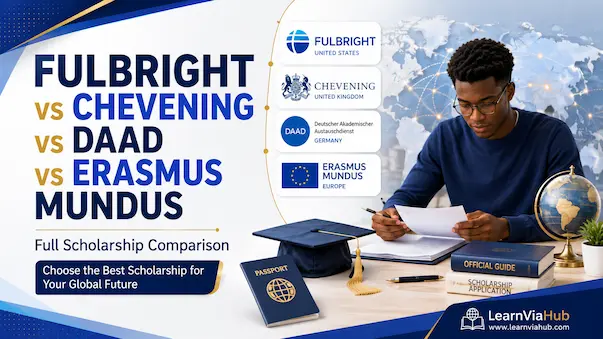
This Fulbright vs Chevening vs DAAD vs Erasmus Mundus: Full Scholarship Comparison helps you choose the best fully funded program. Compare eligibility, funding, degree levels, post-study rules, and more to find the right scholarship for your goals.
📅 Last Updated: September 2026
✅ Fact-Checked Using: Official program websites (Fulbright, Chevening, DAAD, Erasmus Mundus) and participating government agencies
⏱️ Reading Time: Approximately 4–5 minutes
✓ Why Trust This Guide?
This comparison draws on official data from each scholarship program: the U.S. Department of State (Fulbright), UK FCDO (Chevening), DAAD, and the European Commission (Erasmus Mundus). Where a figure is an estimate rather than an officially published number, we note that.
🌍 Explore Fulbright in detail: Visit our Fulbright Foreign Student Program pillar guide for a complete overview, country-specific eligibility, and the interactive tool. For the full application process, see our How to Apply for Fulbright Scholarship guide.
Scholarship Comparison at a Glance
| Feature | Fulbright (USA) | Chevening (UK) | DAAD (Germany) | Erasmus Mundus (Europe) |
|---|---|---|---|---|
| Sponsor | U.S. Department of State | UK Foreign, Commonwealth & Development Office | German Academic Exchange Service | European Commission |
| Study Destination | United States | United Kingdom | Germany | 2+ European countries (consortium) |
| Degree Levels | Master’s, PhD, research | Master’s (one-year taught) | Master’s, PhD, research, language courses | Joint Master’s (1–2 year programs) |
| Funding Type | Fully Funded | Fully Funded | Fully Funded | Fully Funded |
| Tuition | Full tuition (most programs) | Covers full tuition (up to a cap) | No tuition fees at public universities; some programs may have small fees | Full tuition covered (often up to €9,000/year) |
| Living Stipend | ~$2,000/month (varies by host city) | ~£1,200–£1,500/month (approx.) | ~€934–€1,200/month (approx.) | €1,400/month (up to 24 months) |
| Travel / Airfare | Round-trip airfare included | Round-trip airfare included | Travel allowance (usually included) | Travel and installation contribution covered |
| Work Experience Requirement | Not always required (varies by country) | Minimum 2 years | Varies (often preferred, not always mandatory) | Not required (fresh graduates eligible) |
| Post-Study Return Obligation | Many participants are subject to a 2-year home residency rule under J-1 status | 2-year return to home country required | None (can stay and work) | None (can stay and work) |
| Applicants / Awards (approx., per year) | ~4,000–5,900 applicants; ~18–21% receive an award | ~1,500 scholarships awarded (approx.) | Tens of thousands of grants across all DAAD programs (degree scholarships are a smaller subset) | ~2,600 scholarships awarded (2024) |
| Eligible Countries | 160+ countries | 160+ countries | All countries | All countries (10% nationality cap per programme) |
Note: “Applicants / Awards” figures are approximate and not directly comparable across programs — DAAD’s total spans many activity types beyond full degree scholarships, while the other three columns reflect degree-scholarship awards specifically.
1. Fulbright Foreign Student Program (USA)
The Fulbright Program is the U.S. government’s flagship international exchange, offering fully funded master’s and PhD study at any accredited U.S. university. It is administered through U.S. Embassies or Fulbright Commissions in each participating country, meaning requirements, deadlines, and even acceptance rates vary significantly by country — from roughly 3% to 100% depending on your country’s applicant pool. See our Fulbright acceptance rates guide for the full breakdown.
- Best for: Future leaders, researchers, and professionals who want a U.S. degree and a strong alumni network.
- Unique feature: Emphasis on cultural exchange and leadership; includes enrichment seminars and a global alumni community.
- MBA eligibility: Yes, many countries fund MBA programs. See our Fulbright MBA guide.
- Application tip: Start at your country’s commission website. Full step-by-step guide here.
⚠️ Note: Many Fulbright participants are subject to the J-1 visa’s two-year home residency requirement, which may affect future U.S. immigration plans. Whether it applies depends on your specific circumstances — see our J-1 Visa & Residency Guide for details.
2. Chevening Scholarship (UK)
Chevening is the UK government’s fully funded scholarship for one-year taught master’s degrees at any UK university. It targets individuals with demonstrable leadership potential and at least two years of work experience.
- Best for: Mid-career professionals seeking a fast, intensive UK master’s and a global network.
- Unique feature: Strong focus on leadership and networking; scholars attend exclusive events and join the Chevening Alumni network.
- MBA eligibility: Yes, MBA programs are eligible, but you must meet the work experience requirement.
- Application: Apply directly through the Chevening website (typically August–November each year — confirm current dates on the official site).
⚠️ Note: Chevening requires a two-year return to your home country after the program.
3. DAAD Scholarships (Germany)
The DAAD (Deutscher Akademischer Austauschdienst) is the world’s largest scholarship organization, funding study and research in Germany. It offers a wide range of programs for all degree levels, often with no tuition fees at public universities.
- Best for: Students and researchers looking for affordable, high-quality education in Germany with strong industry links.
- Unique feature: Many programs have no tuition fees; the scholarship mainly covers living costs. Strong focus on STEM, arts, and development-related fields (its EPOS track, for example, targets development-relevant postgraduate study).
- MBA eligibility: Some MBA programs are eligible, but DAAD scholarships are more common for technical and development-focused master’s.
- Application: Deadlines and requirements vary by program and country. Always check the DAAD scholarship database directly.
✅ Advantage: No mandatory post-study return obligation. Graduates can apply for an 18-month job-seeker visa and later pursue settlement in Germany.
4. Erasmus Mundus Joint Master’s Degrees (Europe)
Erasmus Mundus funds prestigious joint master’s programs offered by consortia of at least three universities across at least three countries. Students study in a minimum of two of those countries and receive a joint or multiple degree.
- Best for: High-achieving graduates who want a multi-country European experience and a specific joint program.
- Unique feature: You study across 2 or more European countries within a single program. Highly international cohort, and one of the most generous per-month stipends of any major scholarship at €1,400/month.
- MBA eligibility: Some joint MBA or management programs exist, but options are more limited than for traditional MBAs.
- Application: Apply directly to your chosen programme’s consortium — there is no single central application. Deadlines vary by programme, usually October–January. Browse the official Erasmus Mundus Catalogue to find eligible joint master’s programmes, or see our full Erasmus Mundus guide.
✅ Advantage: No post-study return obligation. Graduates can take advantage of post-study work visas in many European countries. Note the 10% cap on scholarships going to any single nationality per programme — a real factor for applicants from high-volume countries.
Detailed Comparison Tables
Funding & Benefits
| Benefit | Fulbright | Chevening | DAAD | Erasmus Mundus |
|---|---|---|---|---|
| Tuition | Full (most cases) | Full (up to cap) | Usually €0 (public uni) | Full (often up to €9,000/yr) |
| Monthly Stipend | ~$2,000 | ~£1,200–£1,500 | ~€934–€1,200 | €1,400 |
| Health Insurance | Included | Included | Included | Included |
| Airfare | Round-trip | Round-trip | Travel allowance | Travel & installation |
| Visa/Residence Permit | Supported | Supported | Supported | Supported |
Eligibility Requirements
| Requirement | Fulbright | Chevening | DAAD | Erasmus Mundus |
|---|---|---|---|---|
| Citizenship | Participating country | Chevening-eligible country (dual UK citizens are not eligible) | Any country | Any country (10% cap per nationality, per programme) |
| Degree | Bachelor’s or equivalent | Bachelor’s or equivalent | Bachelor’s or equivalent | Bachelor’s or equivalent |
| Work Experience | Not always required | 2+ years mandatory | Varies (often preferred) | Not required |
| English Test | TOEFL/IELTS (varies) | IELTS/TOEFL/PTE (specific scores) | IELTS/TOEFL (or German, depending) | IELTS/TOEFL (program-specific; MOI exemptions possible) |
| Age Limit | None | None | Usually none (some programs) | None |
Which Scholarship Should You Choose?
Your choice depends on your academic goals, career stage, preferred destination, and post-study plans. Here’s a quick decision guide — see our full scholarship decision framework for a deeper filter.
Choose Fulbright if:
- You want a U.S. degree and the prestige of the Fulbright network.
- You’re open to a possible two-year home residency requirement, depending on your circumstances.
- You value cultural exchange and leadership development as much as academics.
Choose Chevening if:
- You have at least 2 years of work experience and want a one-year UK master’s.
- You’re drawn to the UK’s professional network and fast-paced degree structure.
- You’re willing to return home for two years after graduation.
Choose DAAD if:
- You’re interested in Germany’s tuition-free education and strong STEM/industry focus.
- You don’t want a mandatory post-study return obligation.
- You’re open to learning German (though many programs are taught in English).
Choose Erasmus Mundus if:
- You want to study in multiple European countries in a single program.
- You’re a recent graduate with little or no work experience.
- You value a diverse, international classroom and flexible post-study options.
Frequently Asked Questions
Can I apply to all four scholarships at the same time? ▼
Which scholarship is the most competitive? ▼
Do these scholarships cover undergraduate degrees? ▼
Can I stay and work in the host country after graduation? ▼
Next Steps: Start Your Application Journey
Now that you understand the differences, it’s time to dive deeper into the program that matches your goals.
📘 Fulbright Resources
- Fulbright Foreign Student Program
- How to Apply for Fulbright Scholarship
- Fulbright MBA Scholarship Guide
- Benefits & Funding Breakdown
- Fulbright Acceptance Rates
- J-1 Visa & Residency Guide
Other Scholarship Guides
Editorial Disclaimer
This guide is published by LearnViaHub for educational purposes. Scholarship details are based on official program websites and cross-checked secondary sources, and may change. Always check the official program pages before applying. LearnViaHub is not affiliated with any of these scholarship programs.
Christian Chinonso is the founder of LearnViaHub, with 6+ years of research experience in international education, GPA systems, and study-abroad guidance for international students.Christian Chinonso is the founder of LearnViaHub, with 6+ years of research experience in international education — including GPA systems, scholarships, student financing, and study-abroad guidance — for students worldwide.