
Quick Answer
The Erasmus Mundus Joint Masters (EMJM) is a highly competitive, fully funded master’s scholarship funded by the European Union. It supports a joint or multiple degree delivered by a consortium of at least three universities from three different countries, and you’ll study in a minimum of two of those countries. The scholarship covers full tuition, travel, health insurance, visa fees, and a monthly living allowance of €1,400 (up to €33,600 over 24 months). Applications are submitted directly to a consortium, typically between October and January for courses starting the following academic year. The overall acceptance rate is around 2–5%. You may apply to a maximum of three different EMJM programmes per year — applying to more risks automatic disqualification, since programmes share applicant data — and no more than 10% of scholarships in a single programme can go to students of the same nationality.
EMJM at a Glance
- Official Name: Erasmus Mundus Joint Masters (EMJM), under the Erasmus+ Programme
- Funding: Full tuition, €1,400/month living allowance (max 24 months), travel/installation contribution, visa fees, health insurance
- Eligibility: Open to all nationalities; bachelor’s degree required; no age limit
- Duration: 1–2 years (most are 2 years / 120 ECTS)
- Application Window: Typically October–January for September/October start
- Acceptance Rate: ~2–5% (highly competitive)
- Key Limits: Max 3 programme applications per year (violating this risks automatic disqualification); 10% nationality cap per programme
- Official Catalogue: Erasmus Mundus Catalogue
Not sure if you qualify? Use our interactive eligibility checker below to quickly map your profile against the common EMJM conditions.
Erasmus Mundus Eligibility Checker
Answer 5 quick questions to see how your profile matches typical EMJM requirements — plus what to strengthen before you apply.
Eligibility
Programme Directory
Benefits & Funding
Application Process
Documents Checklist
Competitiveness & Tips
FAQs
What is the Erasmus Mundus Joint Masters (EMJM)?
The Erasmus Mundus Joint Masters (EMJM) is a prestigious, fully funded international master’s programme designed and delivered by a consortium of at least three higher education institutions from three different countries (at least two of which must be EU Member States or countries associated with the Erasmus+ programme). It is not the same as a standard Erasmus+ exchange — a critical distinction many applicants miss.
A typical Erasmus+ exchange lets undergraduate students study abroad for a semester or an academic year, without earning a degree from the host institution. The EMJM, however, is a complete, integrated degree programme. As a student, you’ll physically study in a minimum of two of the consortium’s countries, and you’ll graduate with either a joint degree (one document issued jointly by multiple universities) or multiple degrees (a separate certificate from each institution you studied at).
Because each consortium designs its own curriculum and admission criteria, there is no single universal set of EMJM admission requirements. Every programme publishes its own eligibility rules, language policies, and document checklists. The scholarship covers all major costs: tuition, travel, a monthly living allowance of €1,400, insurance, and visa fees. It is not a mobility grant bolted onto your home degree; it is a stand-alone master’s that you apply for directly through the consortium.
Key Takeaway
EMJM is a full degree, not a short exchange. You study at multiple universities across different countries, and each consortium sets its own rules. Always check the official programme webpage for the most current information.
Eligibility Criteria
Below is the general eligibility framework. Individual programmes may set higher thresholds (for example, a specific GPA or subject background), so always check the programme’s own page. The key takeaway: there is no upper age limit, and candidates from any country can apply. Being eligible does not mean you’re competitive — it just means your application will be considered. See the Competitiveness & Tips section below for what actually gets applicants selected.
| Criterion | Details |
|---|---|
| Degree requirement | Bachelor’s degree (or equivalent) in a related field. Final-year undergraduates may apply if they graduate before the programme starts. |
| Academic threshold / GPA | No universal minimum GPA. Most consortia expect a strong academic record — often equivalent to an upper second-class (2:1) or a GPA of 3.0–3.5/4.0 and above. The strongest applicants typically present a top 10–15% class rank. Check your transcript against your target programme’s stated grade requirements before applying. |
| English proficiency | IELTS 6.0–7.0 or TOEFL iBT 79–100 is typical. Some programmes accept PTE Academic or Cambridge certificates. Exemptions may apply if you studied in English. Always verify which tests are accepted by your chosen programme. |
| Nationality | Open to all nationalities. There are two funding tracks — often referred to as Category A (Partner Countries, i.e. non-EU/associated countries) and Category B (Programme Countries, i.e. EU/EEA and associated countries). Category A applicants often have more scholarship spots reserved for them and typically receive a higher travel contribution. Note: no more than 10% of the scholarships in a single programme can go to students of the same nationality. |
| Age limit | None. |
| Work experience | Not required, but relevant professional or research experience can strengthen an application — especially for practice-oriented programmes. |
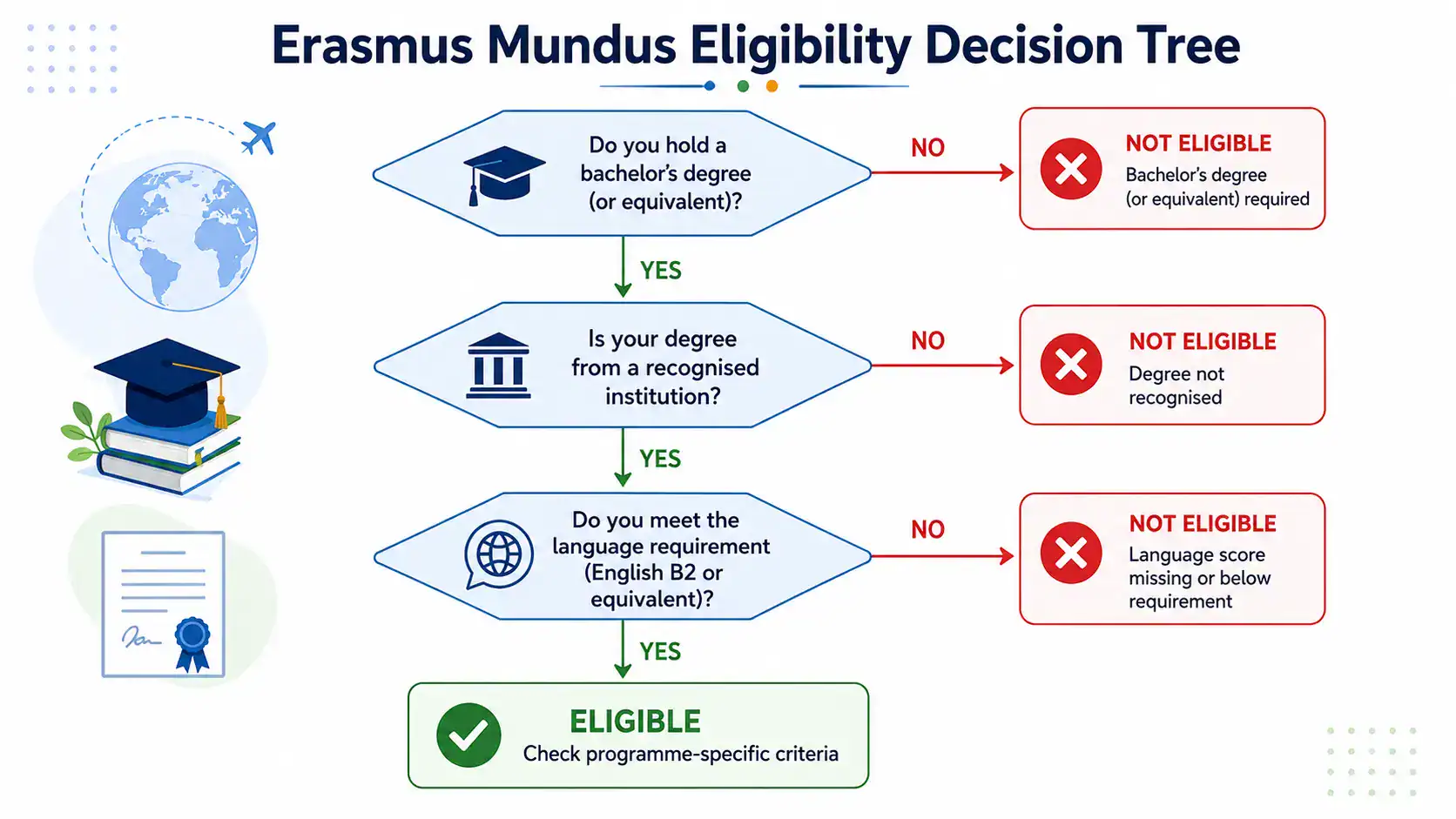
Figure: Erasmus Mundus eligibility decision tree — use this to check if you meet the basic criteria before diving into programme-specific requirements.
Programme Directory (by Discipline)
All programmes listed are confirmed active in the 2021–2027 Erasmus Mundus Joint Masters catalogue and accepting applications for the 2026 intake, verified against the official catalogue. Programmes are grouped by field and tagged with a data-field attribute to support a future filterable search tool. The EMJM catalogue changes every year, so always confirm current deadlines on the official Erasmus Mundus catalogue before applying.
Engineering & Technology
- Smart Cities and Communities (SMACCs) – 2 years, Spain, Belgium, Finland, etc.
- Advanced Materials Science and Engineering (AMASE) – 2 years, Germany, Sweden, Italy, etc.
- Management and Engineering of Environment and Energy (ME3) – 2 years, France, Spain, Italy, etc.
- Photonics for Security, Reliability and Safety (PSRS) – 2 years, France, Italy, Germany, etc.
- Sustainable Biomass and Bioproducts Engineering (SBBE) – 2 years, Finland, Germany, etc.
- Flood Risk Management (FLOODRisk) – 2 years, Netherlands, Slovenia, UK, etc.
- Fire Safety Engineering (IMFSE) – 2 years, Belgium, UK, Sweden, etc.
Data Science & Artificial Intelligence
- Data Science (DASC) – 2 years, Spain, France, Italy, etc.
- Big Data Management and Analytics (BDMA) – 2 years, Belgium, France, Germany, etc.
- Data Science and AI for Business (Data4BI) – 2 years, Belgium, France, Germany, etc.
- Artificial Intelligence for Sustainable Societies (AISS) – 2 years, Estonia, Sweden, Finland, etc.
- Security and Cloud Computing (SECCLO) – 2 years, Finland, Netherlands, Norway, etc.
- Software Engineering for Green and Digital Transition (SEGDT) – 2 years, Italy, France, Finland, etc.
- Geospatial Technologies (GeoTech) – 2 years, Portugal, Germany, Spain, etc.
Natural & Environmental Sciences
- Master in Astrophysics and Space Science (MASS) – 2 years, Italy, Germany, Serbia, etc.
- Environmental Contamination and Toxicology (ECT+) – 2 years, Portugal, France, Spain, etc.
- Marine Environment and Resources (MER) – 2 years, Spain, Belgium, Italy, etc.
- Nano and Advanced Materials for Sustainability (NanoAMS) – 2 years, Belgium, France, Sweden, etc.
- Evolutionary Biology (MEME) – 2 years, Netherlands, Germany, Sweden, etc.
- Molecular Biology and Evolution (MBE) – 2 years, Germany, Denmark, France, etc.
- Marine Biotechnology for a Sustainable Blue Economy (MARBIO-SBE) – 2 years, France, Spain, Norway, etc.
- Chemical Innovation and Regulation (ChIR) – 2 years, Italy, Spain, Portugal, etc.
Law
- Law and Economics (EMLE) – 1 year, Germany, Netherlands, Italy, etc.
- International Law of Peace, Security and Armed Conflict (ILPSAC) – 2 years, Belgium, Norway, UK, etc.
- European Master in Law and Governance (EMLG) – 2 years, Netherlands, Portugal, Spain, etc.
Social Sciences & Political Science
- European Politics and Society (EPS) – 2 years, Czech Republic, Poland, Spain, etc.
- Global Studies (EMGS) – 2 years, Germany, Austria, Poland, etc.
- International Security (IMSISS) – 2 years, UK, Czech Republic, Estonia, etc.
- Sports Ethics and Integrity (MAiSI) – 2 years, UK, Greece, Belgium, etc.
- Education Policies for Global Development (GLOBED) – 2 years, Spain, Cyprus, UK, etc.
- Human Rights Policy and Practice (HURIPR) – 2 years, UK, Sweden, Spain, etc.
Business & Economics
- Economics of Globalisation and European Integration (EGEI) – 2 years, Belgium, Italy, Spain, etc.
- International Business Economics (IBE) – 2 years, Denmark, UK, Finland, etc.
- Sustainable Food Systems Engineering, Technology and Business (SFS) – 2 years, Belgium, Ireland, France, etc.
- Digital Communication Leadership (DCL) – 2 years, Austria, Denmark, Finland, etc.
Humanities, Arts & Media
- Journalism, Media and Globalisation (Mundus Journalism) – 2 years, Denmark, Netherlands, Czech Republic, etc.
- European Literary Cultures (CLE) – 2 years, France, Italy, Greece, etc.
- Euroculture: Society, Politics and Culture in a Global Context (EUROCULTURE) – 2 years, Germany, Spain, Poland, etc.
- Children’s Literature, Media and Culture (CLMC) – 2 years, UK, Denmark, Ireland, etc.
- Kino Eyes: The European Movie Masters (Kino Eyes) – 2 years, Portugal, UK, Estonia, etc.
- Crossways in Cultural Narratives – 2 years, UK, Spain, France, etc.
Health & Medicine
- Medical Imaging and Applications (MIA) – 2 years, Spain, France, Italy, etc.
- Public Health in Disasters (PHiD) – 2 years, UK, Sweden, Spain, etc.
Benefits & Funding Breakdown
The EMJM scholarship is designed to eliminate financial barriers. Successful scholars receive a comprehensive package that covers virtually every direct cost of the degree.
| Benefit | Details |
|---|---|
| Full tuition fees | 100% of tuition (often up to €9,000 per year) is covered. You pay nothing to the consortium. |
| Monthly subsistence allowance | €1,400 per month, for a maximum of 24 months. Over a 2-year programme: €33,600 total. |
| Travel & installation contribution | A standard lump-sum contribution toward travel and settling-in costs. The exact amount and disbursement method vary by consortium — some deduct it from your monthly stipend, others pay it separately. Check your programme’s funding page. |
| Visa fees | Reimbursed or directly covered as part of participation costs. |
| Health insurance | Comprehensive health and accident insurance for the entire study period. |
| Degree type | Joint degree (one diploma signed by all consortium partners) or multiple degrees (separate diplomas from each institution), depending on the programme. |
| Alumni network | Access to the Erasmus Mundus Alumni Association (EMAA), offering lifelong networking, mentoring, and career development opportunities. |
Step-by-Step Application Process
- Browse the official EMJM catalogue and shortlist up to 3 programmes. You may apply to a maximum of three different EMJM programmes per academic year. Programmes share applicant data, and applying to more than three risks automatic disqualification from all of them — choose deliberately. Select programmes aligned with your academic background, career goals, and mobility preferences.
- Check each programme’s specific requirements. Go to the consortium’s own website. Verify degree prerequisites, minimum GPA, language test score cut-offs, and any additional tests (GMAT/GRE, portfolio). Do not rely solely on the general EU catalogue.
- Prepare all required documents (see the checklist below). Pay special attention to your Statement of Purpose — it must explain why you are a fit for a multi-institution programme, not just a single university.
- Apply directly through the consortium’s online portal. During the application, you will be asked whether you wish to be considered for the Erasmus Mundus scholarship. You must explicitly select “Yes” for scholarship consideration — this is one of the most commonly missed steps. If you do not opt in, your application may be treated as self-funded.
- Submit before the deadline. Deadlines normally fall between October and January for courses starting the following September. Late submissions are not accepted.
- Wait for the evaluation results. Shortlisted candidates may be invited for an online interview. Final scholarship offers are usually announced between March and May.
- Accept the offer and complete visa procedures. Once you confirm your scholarship, the consortium will provide the documents you need for your student visa(s). Start this immediately — multi-country visa processes can take time.
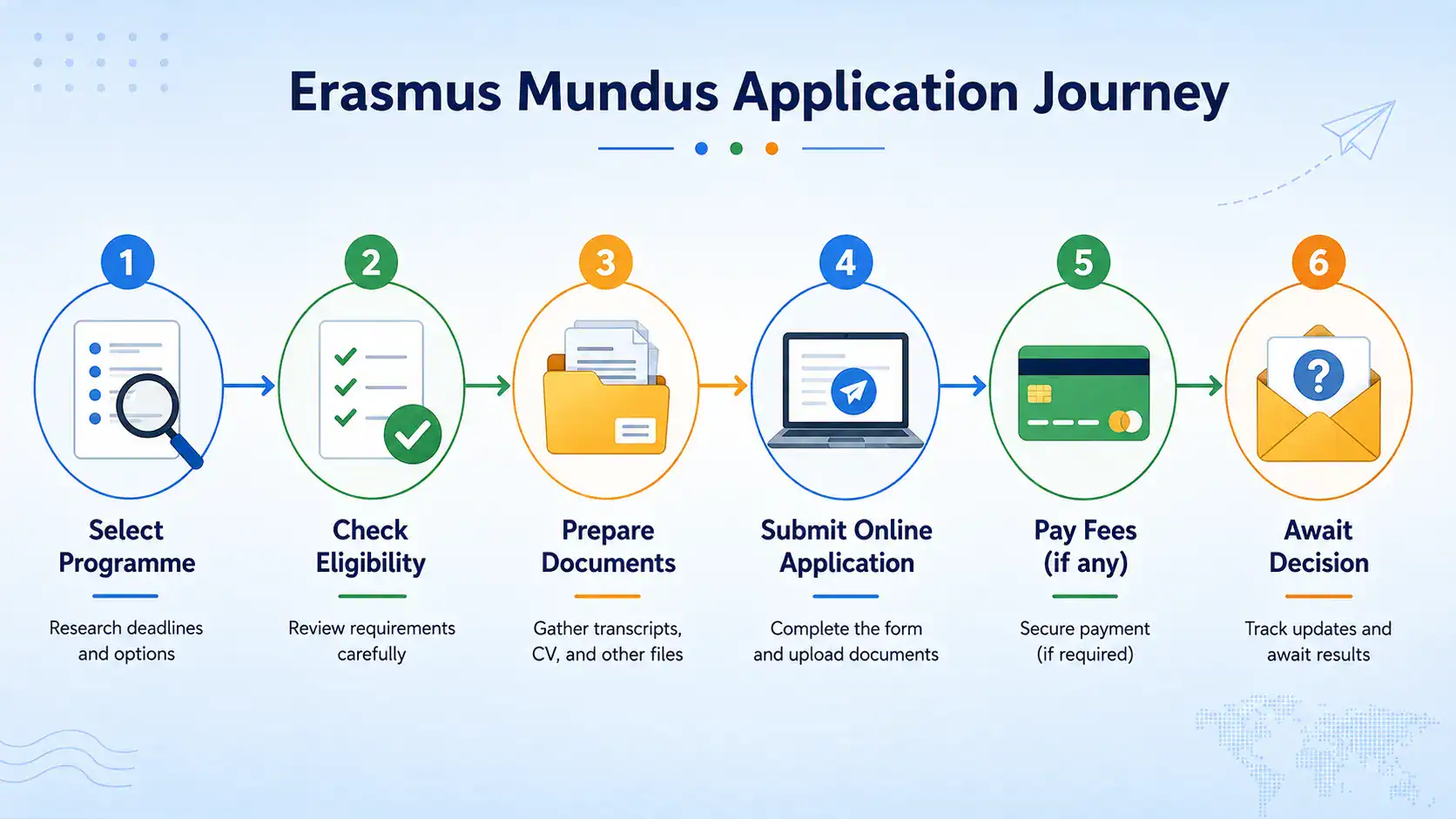
Figure: The complete EMJM application journey — from programme selection to final submission.
Required Documents Checklist
Use this checklist to stay organised. All documents must be in English (or accompanied by a certified translation) and submitted by the programme-specific deadline.
| Document | Notes |
|---|---|
| Valid passport | Must be valid for the entire duration of the programme. |
| Official academic transcripts | Transcripts from all post-secondary institutions attended, showing grades and degree conferral. |
| English proficiency test scores | IELTS, TOEFL, PTE Academic, or Cambridge certificate. Some programmes accept a Medium of Instruction certificate. |
| Statement of Purpose (SOP) | Tailored to the EMJM — see our tips below for a winning structure. |
| Curriculum Vitae (CV) | Europass format recommended but not mandatory. Keep it to two pages. |
| Letters of Recommendation (2–3) | Usually a mix of academic and professional referees. Make sure at least one referee can speak to your ability to thrive in a multicultural, mobile degree. |
| Research proposal (if required) | Some programmes, especially in sciences and law, require a short research outline. Follow the consortium’s template exactly. |
| Portfolio (creative fields) | Relevant for journalism, film, design, and architecture programmes. |
| GRE / GMAT scores (if required) | Some business and economics programmes may request these. Check the programme’s admission page. |
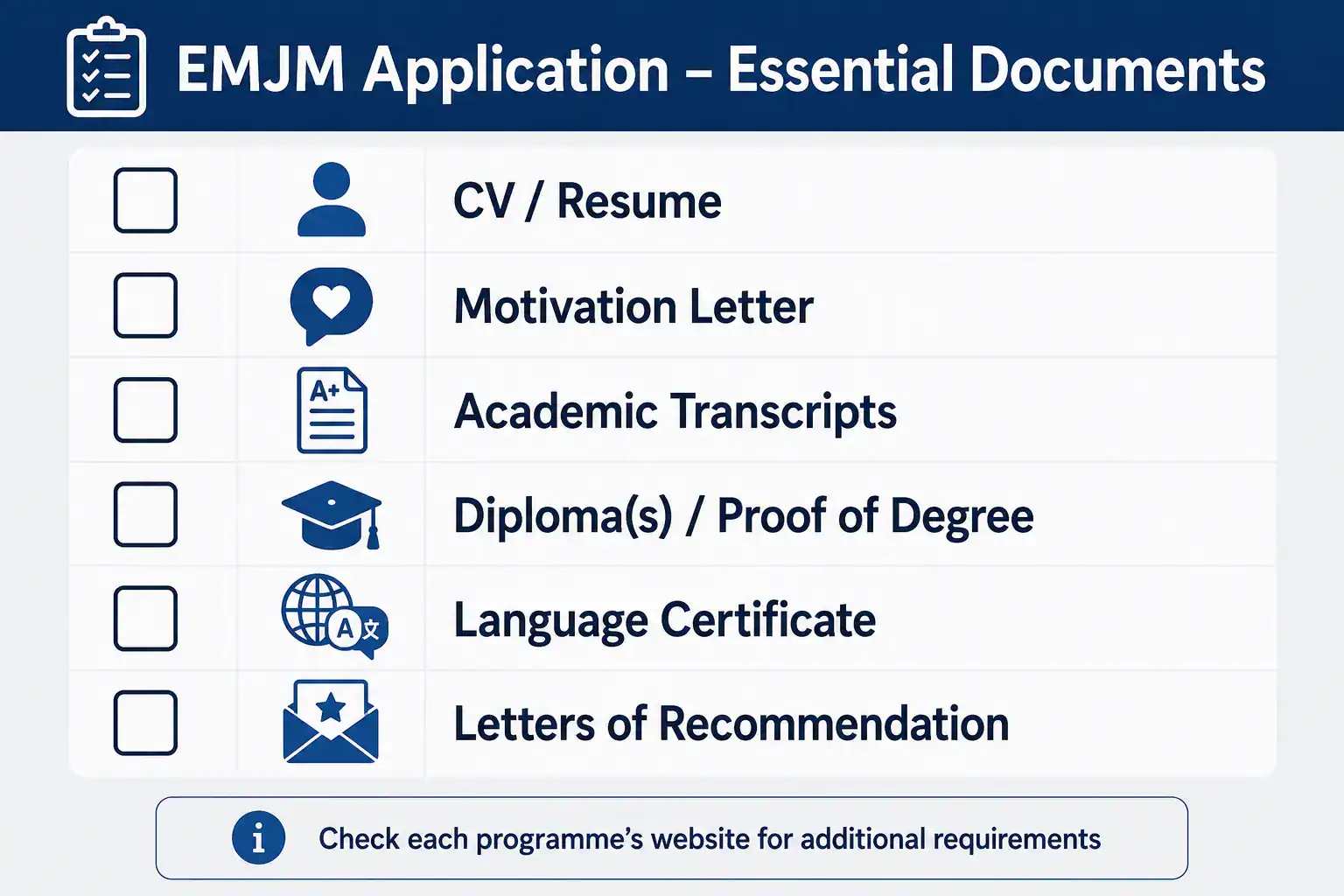
Figure: Visual summary of the key documents you’ll need for your EMJM application.
How Competitive Is EMJM? (And How to Win)
Current Competitiveness Statistics
- Overall acceptance rate: ~2–5%. Some flagship programmes receive over 1,000 applications for 20–25 scholarship slots.
- Most recent full-year figure: 2,603 students from 137 countries were awarded EMJM scholarships in 2024 — the most current official annual total published by the European Commission.
- Top individual recipient countries in 2024: Pakistan (189), India (146), Bangladesh (119), and Brazil (84) led the pack that year. Note that while India has been the largest cumulative beneficiary since the programme’s 2004 launch, Pakistan actually received the most awards of any single country in the 2024 cohort specifically.
- Geographical balance rule: no more than 10% of the scholarships in any one programme can go to students of the same nationality — a real factor if you’re applying from a high-volume country.
- Long-term reach: since 2004, close to 50,000 students have taken part in Erasmus Mundus programmes from well over 150 countries, with close to gender parity among recipients.
Tips That Go Beyond “Get a Good GPA”
Most guides tell you to have a high GPA and strong English. That’s the baseline. To stand out in a 2–5% pool, you need to think strategically. Here’s how.
- Sequence your letters of recommendation like a narrative. Don’t just collect two generic academic references. If the programme has a research component, make sure one referee details your research capability. If the consortium values work experience, have a professional referee highlight cross-cultural teamwork. Each LOR should reinforce a different dimension of your profile so the committee sees a complete picture.
- Write your SOP for a multi-institution degree, not a single university. Explain why you are choosing this specific consortium, not just the subject. Mention at least two partner universities by name and describe what you’ll gain from each. Show that you understand the mobility track — how moving between countries will shape your expertise. Avoid the common mistake of writing a generic master’s SOP.
- Choose your 3 programmes strategically. Applying to three ultra-competitive programmes in the same narrow sub-field lowers your odds unnecessarily. Instead, build a mini-portfolio: one aspirational programme, one strong match where your profile aligns perfectly with the consortium’s priorities, and one safety where historical acceptance data suggests you’re in the top tier of applicants. Ensure all three are genuinely in your field so your SOPs remain credible — do not scatter across unrelated disciplines just to increase chances.
- Demonstrate mobility readiness. The EMJM wants scholars who will thrive in a mobile life. If you have previous exchange experience, volunteer work abroad, or even a semester at an international campus, highlight it. If not, use your SOP to show how your personal projects or collaborations have prepared you to work across cultures.
- Contact the consortium before applying. A brief, polite email to the programme coordinator asking one intelligent question about the curriculum or research focus can put your name on their radar. It also gives you material to cite in your SOP (“In my conversation with the coordinator, I was particularly drawn to…”).
- If you’re applying from a high-volume country, factor in the 10% cap. Applicants from Pakistan, India, and Bangladesh are competing not just on merit but against a built-in ceiling on how many of their compatriots any one programme can fund. A strong, differentiated application matters even more if you’re applying from one of these countries.
Want a fully funded option with fewer mobility requirements? See these guides:
Frequently Asked Questions
What is the difference between Erasmus+ and Erasmus Mundus? ▼
What GPA do I need for Erasmus Mundus? ▼
Is the Erasmus Mundus scholarship fully funded? ▼
Can I apply for more than one Erasmus Mundus programme? ▼
Is there an age limit for Erasmus Mundus? ▼
How competitive is the EMJM scholarship? ▼
When are Erasmus Mundus results announced? ▼
Can I work while studying on an EMJM scholarship? ▼
Can I apply without IELTS? ▼
Can I apply before graduating from my bachelor’s degree? ▼
Can HND holders apply? ▼
Does meeting the minimum requirements guarantee admission or a scholarship? ▼
Continue your scholarship journey with these related guides:

Christian Chinonso is the founder of LearnViaHub, with 6+ years of research experience in international education — including GPA systems, scholarships, student financing, and study-abroad guidance — for students worldwide.