
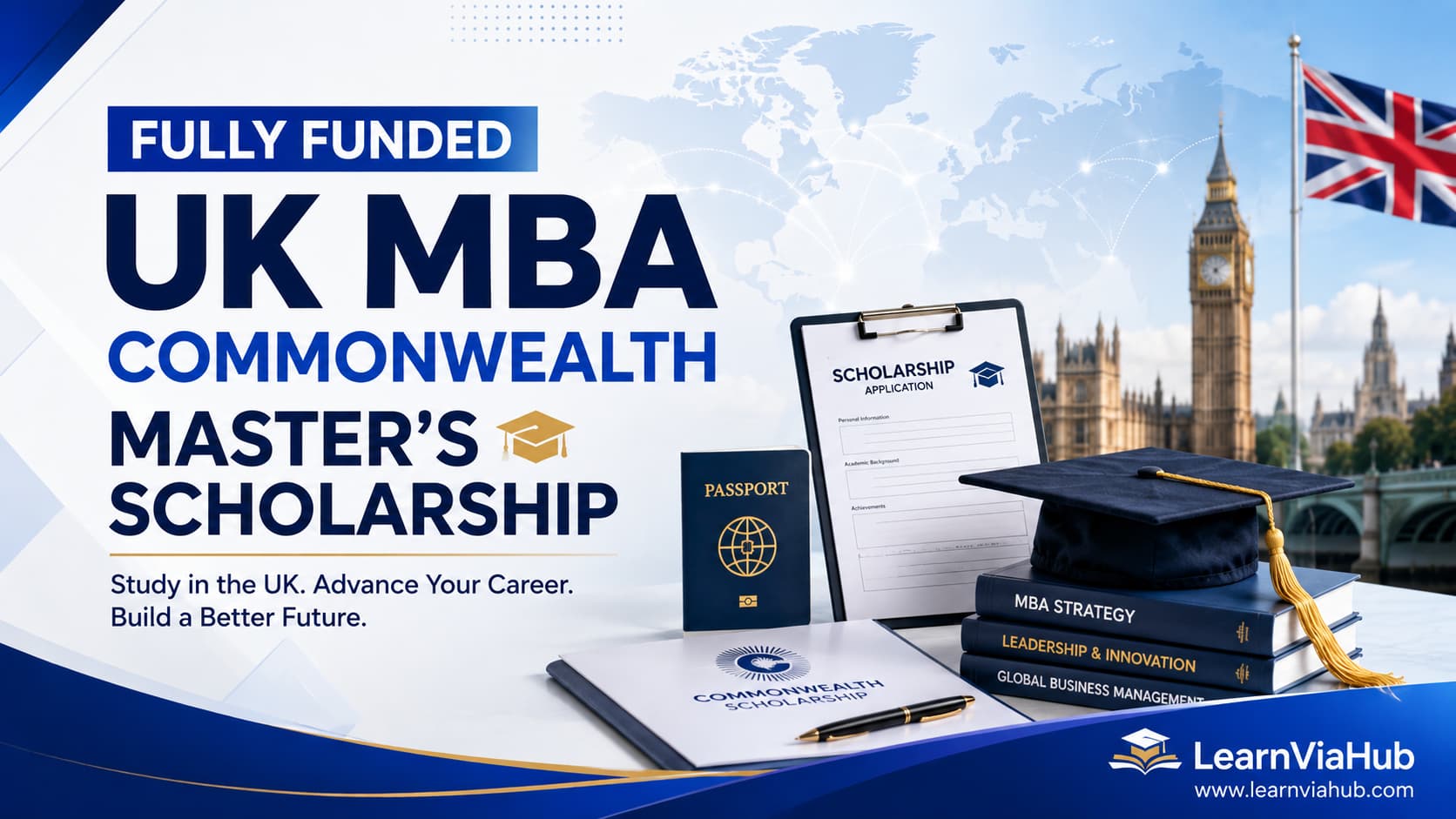
Quick Answer
The Commonwealth Master’s Scholarship fully funds an MBA at any UK university. It covers full tuition (no cap), a monthly living allowance (£1,452–£1,781/month), round‑trip airfare, and a one‑off warm clothing contribution of £522 where applicable. You must be a Commonwealth citizen, hold an upper second‑class degree (2:1) or equivalent, and apply through a nominating agency in your home country — not directly. A two‑year return‑home obligation applies after graduation. Approximately 700 awards are made annually across all Commonwealth programmes, with Master’s scholarships forming a significant portion.
Commonwealth Master’s Scholarship at a Glance
- Host Country: United Kingdom
- Funding Type: Fully Funded
- What It Covers: Full tuition (no cap), monthly living allowance (£1,452–£1,781), round‑trip airfare, £522 warm clothing (if applicable), study travel grant, thesis grant
- MBA Eligibility: Yes — any full‑time UK MBA
- Academic Requirement: Upper second‑class degree (2:1) or equivalent
- Work Experience: Not required (but beneficial)
- Application Route: Nominating agency in your home country
- Post‑Study Obligation: Return home for 2 years (mandatory)
- Official Website: cscuk.fcdo.gov.uk
Key Dates for the 2027‑2028 Cycle
| When | Action |
|---|---|
| June – August 2026 | Research UK MBA programmes and identify your nominating agency. Start gathering documents. |
| August – September 2026 | Submit application to your nominating agency. This is the first critical deadline. |
| September – Mid‑October 2026 | If nominated, complete the CSCUK online application system. |
| February – March 2027 | Results announced. Successful candidates receive scholarship offer. |
| September – October 2027 | Travel to the UK and begin your MBA. |
Benefits
Eligibility
Nominating Agency
Application Process
Documents
MBA Universities
After Winning
vs Chevening & Fulbright
Common Mistakes
FAQs
What is the Commonwealth Master’s Scholarship?
The Commonwealth Master’s Scholarship is a fully funded UK government award funded by the Foreign, Commonwealth & Development Office (FCDO) and managed by the Commonwealth Scholarship Commission (CSCUK). It enables talented individuals from Commonwealth countries to pursue a one‑year taught master’s degree — including an MBA — at any UK university. The scholarship is designed to support future leaders who will contribute to the development of their home countries after graduation.
This is not the same as Chevening. While both are UK government scholarships, the Commonwealth Master’s is exclusively for Commonwealth citizens, places a stronger emphasis on academic merit (a 2:1 degree or equivalent), and requires applicants to apply through a nominating agency in their home country — not directly. It also has a unique development‑impact focus tied to the CSC’s thematic priorities, such as science and technology for development, strengthening health systems, and economic growth.
Commonwealth Scholarship Benefits: Full Tuition, Airfare, and Living Allowance
The Commonwealth Master’s Scholarship is one of the most comprehensive fully funded awards available. It covers every major expense for the duration of your MBA. Here’s the full package for the 2025/26 academic year (rates are updated annually).
| Benefit | Details |
|---|---|
| Full tuition fees | 100% of your MBA tuition, paid directly to the university. No cap — unlike Chevening’s £22,000 limit, this covers the full cost of even the most expensive programmes. |
| Monthly living allowance | £1,781/month (London) or £1,452/month (outside London). Covers accommodation, food, and daily expenses. |
| Round‑trip airfare | Return economy flights from your home country to the UK at the start and end of your studies. |
| Warm clothing allowance | A one‑off payment of £522 where applicable, to help with winter clothing costs. This is provided on a case‑by‑case basis, not universally. |
| Study travel grant | Funding for travel within the UK or overseas that is essential to your programme (e.g., research visits, field work). |
| Thesis grant (if applicable) | A contribution towards the cost of preparing a thesis or dissertation, where required by your MBA programme. |
Commonwealth Master’s Scholarship Eligibility
The eligibility criteria are among the clearest of all government‑funded awards, but they are strictly enforced. The three most important requirements: you must be a citizen of a Commonwealth country, hold at least an upper second‑class (2:1) degree, and demonstrate a clear commitment to development in your home country.
| Criterion | Details |
|---|---|
| Commonwealth citizenship | Must be a citizen of a Commonwealth country. Not open to UK citizens or those with Indefinite Leave to Remain (ILR). |
| Academic degree | Upper second‑class (2:1) degree or equivalent. In many countries, this translates to a GPA of 3.0/4.0 or higher, or 60%+. Lower second‑class (2:2) may be accepted with a relevant postgraduate qualification. Not sure how your grades translate? Use our GPA to percentage converter. |
| Development impact | Must demonstrate how the MBA will contribute to your home country’s development, aligned with CSC thematic priorities (economic development, health systems, science and technology, governance). |
| Age limit | None — applicants of any age are welcome. |
| Work experience | Not required, but relevant professional experience strengthens your application. |
| English proficiency | CSCUK defers to the university’s requirements. You must meet the English entry standard of your chosen MBA programme (typically IELTS 6.5+). Pre‑sessional English courses are not normally supported. |
The Nominating Agency System: How to Apply
The Commonwealth Master’s Scholarship has a unique application route: you cannot apply directly to the CSCUK. You must submit your application through a nominating agency in your home country — typically your Ministry of Education, a scholarship board, or a designated national commission. The agency reviews applications, selects nominees, and forwards them to the CSCUK.
⚠️ Two Deadlines — The Agency Deadline Comes First
Most nominating agencies set their own deadline — often August–September 2026, well before the CSCUK’s October deadline. If you miss the agency deadline, you cannot be nominated, and your application will not reach the CSCUK.
Nominating Agency Directory
| Country | Nominating Agency | Typical Agency Deadline |
|---|---|---|
| India | Ministry of Education / UGC | August – September |
| Nigeria | Federal Ministry of Education | August – September |
| Kenya | Ministry of Education | August – September |
| Pakistan | Higher Education Commission (HEC) | August – September |
| Bangladesh | Ministry of Education | August – September |
| Ghana | Ministry of Education | August – September |
| Sri Lanka | Ministry of Higher Education | August – September |
| South Africa | Department of Higher Education and Training | August – September |
| Malaysia | Public Service Department (JPA) | August – September |
| Tanzania | Ministry of Education, Science and Technology | August – September |
| Uganda | Ministry of Education and Sports | August – September |
Step‑by‑Step Application Process
- Research UK MBA programmes (June – August 2026). Identify your country’s nominating agency and note its exact deadline. Start gathering documents early.
- Submit to your nominating agency (August – September 2026). This is the most critical step. Include all required documents and your development‑impact statement. If you miss this, you cannot proceed.
- Complete the CSCUK online application (September – October 2026). If nominated, you’ll receive a link to the CSCUK online application system. Complete the form and upload documents before the mid‑October deadline.
- Apply to your chosen university in parallel. A university offer letter isn’t mandatory upfront but strengthens your application. Secure a conditional offer if possible.
- Wait for results (February – March 2027). Successful candidates receive a scholarship offer letter from the CSCUK.
- University placement and visa (May – July 2027). The CSCUK works with your university to finalise admission. You’ll receive your CAS for the Student Visa.
- Travel to the UK (September – October 2027). Begin your MBA programme.
Required Documents & Development‑Impact Statement
| Document | Notes |
|---|---|
| Degree certificates and transcripts | Certified copies, translated into English. Must clearly show 2:1 equivalent or higher. |
| Curriculum Vitae (CV) | Professional format, highlighting leadership, development‑related work, and community engagement. |
| Two references | At least one academic reference. Referees must comment on your ability and development commitment. |
| Proof of Commonwealth citizenship | Valid passport bio‑data page. |
| Development‑impact statement | 500‑1,000 word essay — the core written submission (see tips below). |
| English language test scores | IELTS Academic (6.5+) or TOEFL iBT (90+), as required by your university. Some universities may accept a Medium of Instruction certificate. |
| University offer letter | Optional but strongly recommended. Include if you hold a conditional or unconditional offer. |
How to Write the Development‑Impact Statement
The development‑impact statement is a 500‑1,000 word essay that explains:
- What is the specific development challenge you want to address? Name a concrete problem in your country. Use data if possible.
- How will the MBA equip you to address it? Reference specific courses, skills, and networks.
- How does this align with the CSC’s thematic priorities? Link your goals to economic development, health systems, science and technology, or governance.
- What is your return‑home plan? Outline short‑term (2‑3 years) and long‑term (5‑10 years) career goals after the MBA.
MBA‑Eligible UK Universities for Commonwealth Scholars
The scholarship can be used at any UK university offering a full‑time taught master’s programme — no restricted list. Below are popular UK MBA programmes among Commonwealth scholars.
| University | MBA Programme | Duration | Key Strengths |
|---|---|---|---|
| University of Edinburgh | Full‑Time MBA | 1 year | AACSB & EQUIS; sustainability and social impact focus. |
| University of Manchester | Full‑Time MBA | 1 year | Triple‑crown accredited; strong in international business. |
| Warwick Business School | Full‑Time MBA | 1 year | AACSB, EQUIS & AMBA; leadership and innovation focus. |
| University of Birmingham | MBA (Full‑Time) | 1 year | Affordable tuition; global development and public policy links. |
| University of Glasgow | MBA (Full‑Time) | 1 year | AACSB & AMBA; sustainability and social enterprise focus. |
After Winning: Visa, Return Obligation, and Starting Your MBA
If awarded the scholarship, you will be notified in February–March 2027. The university and CSCUK will guide you through the final steps. You must apply for a UK Student Visa using your CAS and scholarship award letter. The scholarship does not cover the visa fee or Immigration Health Surcharge (IHS).
⚠️ Mandatory Two‑Year Return‑Home Obligation
All Commonwealth Master’s Scholars must return to their home country for at least two years after completing their degree. This is a legal condition of the scholarship. Failure to comply may result in repayment of the full scholarship value and visa restrictions.
Commonwealth Master’s vs Chevening vs Fulbright
| Feature | Commonwealth Master’s (UK) | Chevening (UK) | Fulbright (USA) |
|---|---|---|---|
| Funding | Fully funded (no tuition cap) | Fully funded (£22K tuition cap) | Fully funded (no cap) |
| Citizenship | Commonwealth countries only | 160+ eligible countries | 160+ eligible countries |
| Academic Requirement | Upper second‑class (2:1) | Undergraduate degree | Undergraduate degree |
| Work Experience | None required | 2 years (2,800 hours) | Not mandatory |
| Application Route | Nominating agency → CSCUK | Direct online application | Country Fulbright commission |
| Return Obligation | 2‑year return to home country | 2‑year return to home country | 2‑year home residency |
Common Mistakes to Avoid
- Missing the nominating agency deadline — this is the most common reason applications fail. Start in June 2026.
- Not meeting the 2:1 degree requirement — a hard filter for most agencies. If you hold a lower class but also a postgraduate degree, mention this explicitly.
- Submitting a generic development‑impact statement — vague promises won’t stand out. Be specific about a concrete development problem and your return‑home plan.
- Ignoring the return‑home obligation — if you plan to stay abroad immediately after your MBA, this scholarship is not the right fit.
- Applying to a non‑eligible programme — ensure your MBA is a full‑time, taught programme at a recognized UK institution.
- Waiting until the last minute to contact your nominating agency — agencies may require hard‑copy documents weeks before the online deadline.
Frequently Asked Questions
Can I apply without IELTS?
▼
How competitive is the Commonwealth Master’s Scholarship?
▼
Can I bring my family on the scholarship?
▼
Is there an age limit?
▼
Do I need work experience?
▼
Can I work while studying?
▼
What’s the difference between the Commonwealth Master’s and Commonwealth Shared Scholarship?
▼
Official Resources
| Resource | Link |
|---|---|
| Commonwealth Scholarship Commission (CSCUK) | cscuk.fcdo.gov.uk |
| CSCUK – Nominating Agency Directory | cscuk.fcdo.gov.uk/apply/nominating-agencies |
| CSCUK – Online Application System | cscuk.fcdo.gov.uk/apply |
| UK Student Visa – GOV.UK | gov.uk/student-visa |
Continue your scholarship journey with these related guides:
Christian Chinonso is the founder of LearnViaHub, with 6+ years of research experience in international education — including GPA systems, scholarships, student financing, and study-abroad guidance — for students worldwide.