
QUICK ANSWER
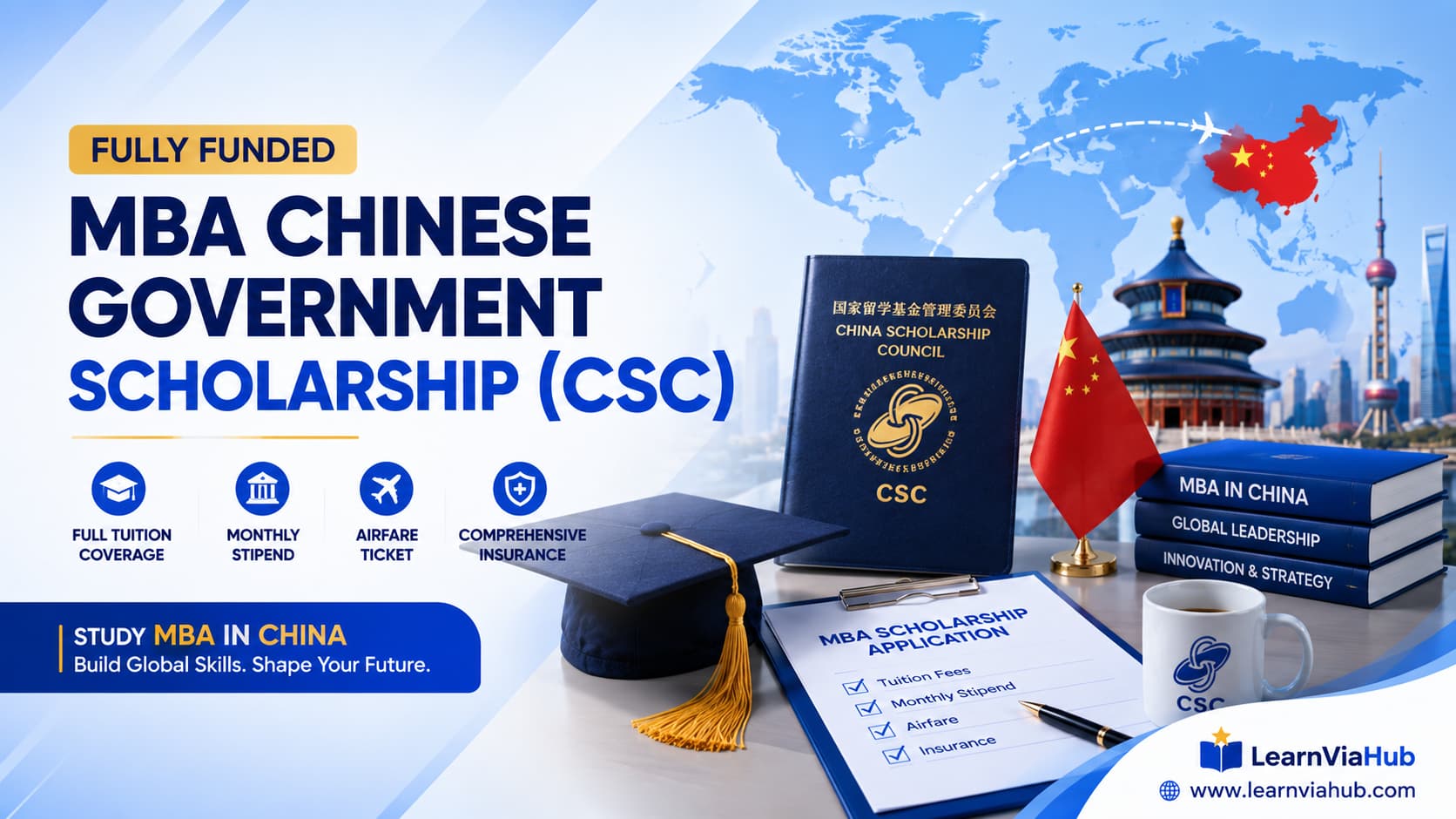
Yes – the Chinese Government Scholarship (CSC) fully funds an MBA at top Chinese universities. It covers tuition, free dormitory, a monthly stipend of 3,000 RMB, and health insurance. There are two application channels: Type A (through the Chinese embassy) and Type B (directly to a university). The age limit is under 35 for master’s, and no work experience is required.
CSC Scholarship MBA Snapshot
| Host Country | China |
| Funding Type | Fully Funded |
| Monthly Stipend | 3,000 RMB for master’s students |
| Accommodation | Free university dormitory (or subsidy if dorm is full) |
| Other Benefits | Full tuition waiver, comprehensive health insurance |
| Work Experience | None required |
| Application Channels | Type A (Embassy) or Type B (University) |
| Typical Deadlines | January – April 2027 (varies by channel) |
| Eligible Countries | All countries (non‑Chinese citizens) |
| Post‑Study Obligation | None (you are free to stay, return, or go elsewhere) |
| Official Link | campuschina.org |
🔗 Sources: campuschina.org & Chinese Embassies
LearnViaHub is an independent educational guide, not affiliated with the Chinese Government or the CSC. Always verify details on the official website.
What Is the Chinese Government Scholarship (CSC)?
The Chinese Government Scholarship, often called the CSC scholarship, is the People’s Republic of China’s flagship fully funded scholarship for international students. It is administered by the China Scholarship Council (CSC) under the Ministry of Education. The program supports undergraduate, master’s, and doctoral studies at Chinese universities, including MBA programs, with the goal of promoting cultural exchange and global talent development.
What makes CSC unique is its two separate application channels: you can apply through the Chinese embassy in your home country (Type A) or directly to a Chinese university (Type B). Both routes lead to the same generous benefits, and there is no formal return obligation after graduation—you are free to pursue your career anywhere in the world.
Chinese Government Scholarship Benefits: Full Tuition, Free Dormitory, and Monthly Stipend
The CSC scholarship covers every major expense for the duration of your MBA program. The package is among the most comprehensive in the world, with free on‑campus housing being a standout benefit. Here is the full breakdown for the 2027‑2028 academic year.
| Benefit | Details |
|---|---|
| Full Tuition Waiver | 100% of your MBA tuition fees, paid directly to the university. No cap. |
| Free Accommodation | Free university dormitory provided. If the dormitory is full, the scholarship provides a monthly housing subsidy (usually 700‑1,000 RMB) instead. |
| Monthly Living Stipend | 3,000 RMB per month for master’s students. This is sufficient to cover food, transportation, and personal expenses. |
| Comprehensive Health Insurance | Medical insurance covering outpatient, inpatient, and accidental injury treatments throughout the scholarship period. |
| No Application Fee | The CSC application itself is free. |
🏠 Free dormitory—a major advantage. Very few fully funded scholarships include accommodation. This benefit alone can save you thousands of dollars over the course of your MBA.
Chinese Government Scholarship Eligibility: Age Limit, No Work Experience Required
The CSC scholarship has a few straightforward requirements. The most notable are the age limit of 35 for master’s applicants and the absence of a work experience requirement. Here’s the full list:
- Nationality: You must be a non‑Chinese citizen in good health. Citizens of all countries are eligible.
- Education: A completed bachelor’s degree (or equivalent) from a recognised institution. You must have a strong academic record.
- Age limit: You must be under 35 years old at the time of application for master’s programmes (including MBA). This is a strict rule enforced by CSC.
- Work experience: None required. Recent graduates are welcome to apply. However, some top MBA programmes may prefer candidates with professional experience—check individual university requirements.
- Language proficiency: For English‑taught MBA programmes, you generally need TOEFL (80+ iBT) or IELTS (6.0+). For Chinese‑taught programmes, you need HSK 4 or 5 (depending on the university). Some universities waive this if your prior degree was in English or Chinese.
- Physical examination: You must complete a Foreigner Physical Examination Form and submit it with your application. This is a mandatory document—do not skip it.
🌟 No work experience? No problem. The CSC scholarship is open to fresh graduates—focus on your academic record and study plan.
⚠️ Age limit: You must be under 35 years old at the time of application. If you are 35 or older, you are not eligible for the master’s category.
CSC Application Channels: Type A (Embassy) vs Type B (University)
The CSC scholarship offers two distinct application channels. Both lead to the same scholarship benefits, but the process, timeline, and selection differ. You can even apply through both channels simultaneously to increase your chances. Here’s how they compare.
| Feature | Type A (Embassy Recommendation) | Type B (University Recommendation) |
|---|---|---|
| How it works | Apply through the Chinese embassy/consulate in your home country. The embassy reviews and forwards your application to universities. | Apply directly to a Chinese university that nominates you for the CSC scholarship. You must meet the university’s admission requirements first. |
| Agency Number | Your local Chinese embassy’s agency number (find it on their website). | The specific university’s agency number (provided on the university’s CSC page). |
| Typical Deadline | January – March 2027 (varies by country) | December 2026 – April 2027 (varies by university) |
| Who it’s best for | Applicants without a specific university in mind; those who want embassy support; those applying to multiple universities at once. | Applicants who have a clear university/MBA programme preference; those who have already contacted a professor or admissions office. |
📌 Strategy: Apply through both channels at the same time. Use Type A to reach a broad set of universities and Type B for your top‑choice MBA programme. The CSC allows multiple applications as long as you use the correct agency numbers. This doubles your chances of securing the scholarship.
MBA‑Eligible Chinese Universities for the CSC Scholarship
The CSC scholarship is accepted at hundreds of Chinese universities, but not all offer an MBA. Below are the top business schools that regularly welcome CSC scholars for their MBA programmes. Many of these offer English‑taught MBAs, making them accessible to international students without HSK proficiency.
| University | MBA Programme | Language | Location | Duration | Notes |
|---|---|---|---|---|---|
| Tsinghua University | MBA (Tsinghua SEM) | English / Chinese | Beijing | 2 years | AACSB & EQUIS accredited; one of the best business schools in Asia. |
| Peking University | MBA (Guanghua School of Management) | English / Chinese | Beijing | 2 years | AACSB & EQUIS; strong links with Chinese state‑owned enterprises. |
| Fudan University | MBA (School of Management) | English / Chinese | Shanghai | 2 years | AACSB & EQUIS; located in China’s financial hub. |
| Shanghai Jiao Tong University | MBA (Antai College) | English / Chinese | Shanghai | 2 years | AACSB, EQUIS, & AMBA (triple‑crown); strong in entrepreneurship. |
| Renmin University of China | MBA (School of Business) | Chinese (English‑taught tracks available) | Beijing | 2 years | Strong in finance and economics; check for English‑taught MBA availability. |
When applying, you can choose up to three university preferences in the CSC online application. Mix one or two top‑tier schools with a solid mid‑range option to balance your chances. For the most current list of universities and their CSC agency numbers, always check the official CSC website and the university’s international admissions page.
Chinese Government Scholarship Eligibility: Age Limit, No Work Experience Required
The CSC scholarship has a few straightforward requirements. The most notable are the age limit of 35 for master’s applicants and the absence of a work experience requirement. Here’s the full list:
- Nationality: You must be a non‑Chinese citizen in good health. Citizens of all countries are eligible.
- Education: A completed bachelor’s degree (or equivalent) from a recognised institution. You must have a strong academic record.
- Age limit: You must be under 35 years old at the time of application for master’s programmes (including MBA). This is a strict rule enforced by CSC.
- Work experience: None required. Recent graduates are welcome to apply. However, some top MBA programmes may prefer candidates with professional experience—check individual university requirements.
- Language proficiency: For English‑taught MBA programmes, you generally need TOEFL (80+ iBT) or IELTS (6.0+). For Chinese‑taught programmes, you need HSK 4 or 5 (depending on the university). Some universities waive this if your prior degree was in English or Chinese.
- Physical examination: You must complete a Foreigner Physical Examination Form and submit it with your application. This is a mandatory document—do not skip it.
🌟 No work experience? No problem. The CSC scholarship is open to fresh graduates—focus on your academic record and study plan.
⚠️ Age limit: You must be under 35 years old at the time of application. If you are 35 or older, you are not eligible for the master’s category.
CSC Application Channels: Type A (Embassy) vs Type B (University)
The CSC scholarship offers two distinct application channels. Both lead to the same scholarship benefits, but the process, timeline, and selection differ. You can even apply through both channels simultaneously to increase your chances. Here’s how they compare.
| Feature | Type A (Embassy Recommendation) | Type B (University Recommendation) |
|---|---|---|
| How it works | Apply through the Chinese embassy/consulate in your home country. The embassy reviews and forwards your application to universities. | Apply directly to a Chinese university that nominates you for the CSC scholarship. You must meet the university’s admission requirements first. |
| Agency Number | Your local Chinese embassy’s agency number (find it on their website). | The specific university’s agency number (provided on the university’s CSC page). |
| Typical Deadline | January – March 2027 (varies by country) | December 2026 – April 2027 (varies by university) |
| Who it’s best for | Applicants without a specific university in mind; those who want embassy support; those applying to multiple universities at once. | Applicants who have a clear university/MBA programme preference; those who have already contacted a professor or admissions office. |
📌 Strategy: Apply through both channels at the same time. Use Type A to reach a broad set of universities and Type B for your top‑choice MBA programme. The CSC allows multiple applications as long as you use the correct agency numbers. This doubles your chances of securing the scholarship.
MBA‑Eligible Chinese Universities for the CSC Scholarship
The CSC scholarship is accepted at hundreds of Chinese universities, but not all offer an MBA. Below are the top business schools that regularly welcome CSC scholars for their MBA programmes. Many of these offer English‑taught MBAs, making them accessible to international students without HSK proficiency.
| University | MBA Programme | Language | Location | Duration | Notes |
|---|---|---|---|---|---|
| Tsinghua University | MBA (Tsinghua SEM) | English / Chinese | Beijing | 2 years | AACSB & EQUIS accredited; one of the best business schools in Asia. |
| Peking University | MBA (Guanghua School of Management) | English / Chinese | Beijing | 2 years | AACSB & EQUIS; strong links with Chinese state‑owned enterprises. |
| Fudan University | MBA (School of Management) | English / Chinese | Shanghai | 2 years | AACSB & EQUIS; located in China’s financial hub. |
| Shanghai Jiao Tong University | MBA (Antai College) | English / Chinese | Shanghai | 2 years | AACSB, EQUIS, & AMBA (triple‑crown); strong in entrepreneurship. |
| Renmin University of China | MBA (School of Business) | Chinese (English‑taught tracks available) | Beijing | 2 years | Strong in finance and economics; check for English‑taught MBA availability. |
When applying, you can choose up to three university preferences in the CSC online application. Mix one or two top‑tier schools with a solid mid‑range option to balance your chances. For the most current list of universities and their CSC agency numbers, always check the official CSC website and the university’s international admissions page.
How to Apply for the Chinese Government Scholarship – Step by Step
The application process differs depending on which channel you choose. Below are the step‑by‑step instructions for both Type A (Embassy) and Type B (University). You can apply through both channels at the same time to maximise your chances. All applications are submitted online at campuschina.org.
Type A (Embassy Recommendation)
- Check your local Chinese embassy website for the CSC scholarship call (usually announced in November‑December 2026). Note the agency number and the exact deadline (typically January–March 2027).
- Create an account at campuschina.org. Select “Type A” and enter the embassy’s agency number.
- Fill in the online application form: personal details, educational background, and up to three university/programme preferences. Choose your MBA programmes carefully.
- Upload all required documents (see the checklist in the next section). The study plan is especially important.
- Submit the application online and download the completed form. Print and sign it.
- Send the physical application package (if required by your embassy) to the embassy address by the deadline. Some embassies now accept fully digital submissions—check their website.
- Wait for the result. The embassy will forward your application to the universities you selected. You will be notified of the final decision around July–August 2027.
Type B (University Recommendation)
- Contact your target university early—ideally by October 2026. Visit the university’s international admissions page and find their CSC scholarship section. Confirm that the MBA programme accepts CSC scholars and note the university’s agency number.
- Apply for admission to the MBA programme directly through the university’s application system. Meet all admission requirements (academic transcripts, language scores, recommendation letters).
- Once you receive a pre‑admission or acceptance letter from the university, go to campuschina.org and create an account. Select “Type B” and enter the university’s agency number.
- Complete the CSC online application form and upload all required documents. Attach your university acceptance letter—this significantly increases your chances.
- Submit the online application before the university’s CSC deadline (usually December 2026–April 2027).
- The university nominates you to CSC. CSC makes the final approval, and results are typically announced June–August 2027.
⚠️ Deadlines are early and strict. Type A deadlines vary by country but are often as early as January. Type B deadlines depend on the university and can be as early as December. Start preparing your documents in October–November 2026 to avoid missing out.
CSC Scholarship Required Documents
The document list for the CSC scholarship is detailed. Missing or incorrectly formatted files are a common reason for rejection. Prepare these at least 2‑3 months before the deadline.
- CSC online application form – filled in on campuschina.org and printed/signed (for Type A if required).
- Highest degree certificate and transcripts – certified copies, translated into Chinese or English.
- Study plan / Research proposal – for MBA applicants, this is typically 800‑1,000 words (see the next section for a full guide).
- Two letters of recommendation – from professors or associate professors, in Chinese or English, on official letterhead.
- Foreigner Physical Examination Form – completed by a recognised doctor. This is mandatory and must follow the official CSC template.
- Valid passport – bio‑data page copy.
- Language proficiency certificate – IELTS/TOEFL for English‑taught MBA, or HSK for Chinese‑taught. Some universities waive this if your previous degree was in English/Chinese.
- Acceptance letter from a Chinese university – strongly recommended for Type B applicants. For Type A, it is optional but helpful.
- Non‑criminal record certificate – sometimes required; check your embassy or university requirements.
Writing Your CSC Study Plan / Research Proposal for an MBA
The study plan (also called a research proposal) is the most important written document in your CSC application—even for an MBA. It must convince the reviewers that you have a clear academic focus, that you understand how the MBA programme fits your goals, and that your studies will benefit both your home country and China. The expected length is usually 800‑1,000 words.
What the Reviewers Look For
- A clear academic or business problem: Frame your MBA as a way to explore a specific business or management challenge. For example: “How can supply chain digitisation improve agricultural exports from my country to China?”
- Why China: Show that you have researched why China is the right place to study this topic. Mention Chinese companies, industries, or academic expertise that are relevant.
- Realistic objectives: List 2‑3 specific objectives for your MBA studies. What do you want to learn or accomplish?
- Connection to your background: Link the study plan to your previous degree, internships, or any professional experience you have.
- Home‑country impact: Explain how the knowledge gained will be applied after you graduate.
Suggested Structure
- Title: A concise, descriptive title for your study plan.
- Background & Motivation (1‑2 paragraphs): Introduce yourself, your academic background, and why you are interested in this MBA and China.
- Study Objectives (1 paragraph): List 2‑3 clear learning objectives for your MBA.
- Research/Study Plan Outline (1‑2 paragraphs): Describe the courses, projects, or research areas you intend to focus on during the MBA. Mention specific faculty or programmes if possible.
- Expected Outcomes & Post‑Study Plan (1 paragraph): What do you expect to achieve after your MBA? How will your home country benefit? Include a short‑term (2‑3 years) and long‑term career vision.
💡 Expert Tip from a CSC MBA Alum
“I framed my study plan around the Belt and Road Initiative and how my MBA at Fudan would help me connect African agribusiness to Chinese markets. The reviewers told me the clear China link made my application memorable. Be specific, mention real Chinese companies or policies.”
🔗 Read our full guide on writing a powerful Statement of Purpose / Study Plan →
After Winning the CSC Scholarship: Visa, Arrival, and No Return Obligation
If you are awarded the CSC scholarship, you will be notified by July–August 2027. The university will send you an admission notice and a JW201 or JW202 form (Visa Application for Study in China). Here is what to do next.
1. Student Visa (X1 Visa)
Take your admission notice, JW201/202 form, and scholarship award letter to the nearest Chinese embassy/consulate to apply for a Chinese student visa (X1). The scholarship greatly simplifies the visa process—you do not need to show additional financial proof.
2. Arrival and Registration
Your MBA programme will typically start in September 2028. Arrive a few weeks early to settle in. Upon arrival at the university, register at the international student office, move into your free dormitory (or arrange the housing subsidy), and complete the health check if required. Your monthly stipend begins shortly after registration.
3. No Formal Return Obligation
One of the best features of the CSC scholarship is that there is no mandatory return‑home requirement. After completing your MBA, you are free to stay in China to work, return to your home country, or pursue opportunities elsewhere. The only expectation is that you use your education to contribute positively to global development.
🌍 No Return Obligation – Total career flexibility. Unlike many government scholarships, CSC does not tie you to any post‑study location. You have complete freedom to choose where to build your career after graduation.
Chinese Government Scholarship vs Other Government MBA Scholarships
How does the CSC scholarship compare to other fully funded government MBA programmes? Here’s a side‑by‑side look at the key features.
| Feature | CSC (China) | Chevening (UK) | Fulbright (USA) | MEXT (Japan) | Türkiye Scholarships |
|---|---|---|---|---|---|
| Funding | Fully funded (tuition, dormitory, stipend, insurance) | Fully funded (£22K tuition cap, stipend, flights) | Fully funded (no cap, stipend, flights, insurance) | Fully funded (tuition exempt, stipend, flights) | Fully funded (tuition, dormitory, stipend, flights, language course) |
| Work Experience | None required | 2 years (2,800 hours) | Not mandatory (preferred) | None required | None required |
| Age Limit | Under 35 for master’s | No limit | No limit | No limit | No limit (under 30 preferred) |
| Accommodation | Free dormitory | Not included | Not included | Not included | Free dormitory |
| Application Channels | Type A (Embassy) + Type B (University) | Single online application | Country Fulbright commission | Embassy or University routes | Single online application |
| Return Obligation | None | 2‑year return to home country | 2‑year home residency (J‑1 visa) | None formal | None |
| Official Link | campuschina | chevening.org | foreign.fulbrightonline.org | studyinjapan.go.jp | turkiyeburslari.gov.tr |
CSC is ideal if you are under 35, want a tuition‑free MBA with free housing, and value the flexibility of two application channels and no post‑study return obligation. The age limit is the only significant restriction compared to other scholarships.
🔗 Explore the full list of 12 government‑funded MBA scholarships → | Chevening MBA guide → | Fulbright MBA guide → | MEXT scholarship guide → | Türkiye Scholarships guide →
Common Mistakes to Avoid
Many applicants miss out on the CSC scholarship because of simple, preventable errors. Here are the most frequent pitfalls and how to avoid them.
❌ Mistake 1: Using the Wrong Agency Number
Type A requires your embassy’s agency number; Type B requires the university’s. Entering the wrong number can make your application invalid. How to avoid: Double‑check the number on the official embassy or university CSC page before submitting.
❌ Mistake 2: Missing the Early Deadline
Some embassy deadlines are in January, and some university deadlines are in December. How to avoid: Start preparing in October. Create a calendar with the exact deadlines for each channel you plan to use.
❌ Mistake 3: Submitting a Generic Study Plan
A vague plan that doesn’t mention China, the specific university, or a clear business problem will not stand out. How to avoid: Use the framework in the section above. Name courses, professors, and Chinese industry connections.
❌ Mistake 4: Forgetting the Physical Examination Form
This is a mandatory document that many applicants overlook. How to avoid: Download the official CSC form and have a registered doctor complete it well before the deadline.
❌ Mistake 5: Ignoring the Age Limit
You must be under 35 at the time of application. How to avoid: Check your birth date against the application deadline. If you are 34 or younger on the deadline date, you are eligible.
❌ Mistake 6: Applying to Only One Channel
You can apply through both Type A and Type B at the same time. How to avoid: Maximise your chances by submitting a Type A application through your embassy and a Type B application directly to your top‑choice university.
Frequently Asked Questions
▸ Can I bring my family on the CSC scholarship?
The CSC scholarship does not provide additional funding for dependants. You may bring your family, but you are responsible for their visa fees, living costs, and health insurance. The dormitory and stipend are designed for a single person.
▸ Is there an age limit for the CSC scholarship?
Yes — for master’s programmes, you must be under 35 years old at the time of application. There is no flexibility on this rule.
▸ Do I need HSK (Chinese language test) for an English‑taught MBA?
No — if your MBA is taught in English, you do not need HSK. You will need IELTS or TOEFL instead. Some universities may waive language tests if your previous degree was in English.
▸ Is the dormitory really free?
Yes — CSC scholars are provided with a free university dormitory place. If the dormitory is full, the scholarship provides a monthly housing subsidy (usually 700‑1,000 RMB) instead.
▸ How competitive is the CSC scholarship?
It is highly competitive, especially for top universities like Tsinghua and Peking. A strong study plan, good academic record, and applying through both channels significantly improve your chances.
▸ Can I work while studying in China?
Yes — international students in China can work part‑time with permission from the university and a work permit. The monthly stipend covers living expenses, so working is optional and should not interfere with your studies.
Official Resources & Application Portal
Use these official channels to start your CSC scholarship application. Always verify deadlines and agency numbers on the official sites.
| Resource | Link |
|---|---|
| CSC Official Website | campuschina.org |
| CSC Online Application System | studyinchina.csc.edu.cn |
| Chinese Embassies (Global List) | fmprc.gov.cn (embassy list) |
| LearnViaHub – Full MBA Scholarships Hub | 12 Government‑Funded MBA Scholarships |
Ready to Apply for Your CSC Scholarship MBA?
Choose your channel — Type A (Embassy) or Type B (University) — and start preparing your documents now. The early deadlines wait for no one.
Then return here to follow the step‑by‑step guide and write a winning study plan.
LearnViaHub is an independent educational platform, not affiliated with the Chinese Government or the CSC. Always verify information on official websites.

Christian Chinonso is the founder of LearnViaHub, with 6+ years of research experience in international education — including GPA systems, scholarships, student financing, and study-abroad guidance — for students worldwide.