
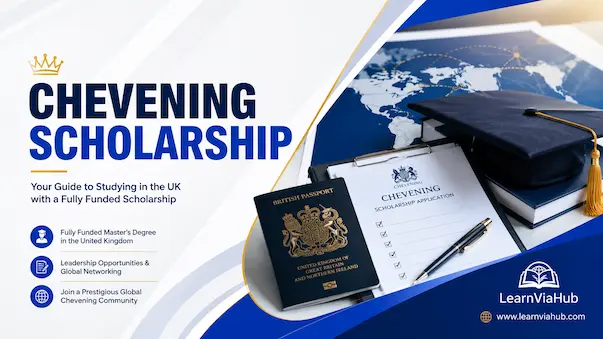
QUICK ANSWER
The Chevening Scholarship is a fully funded UK government global leadership programme that funds a one‑year taught master’s degree at any UK university. It covers full tuition (with an MBA fee cap of £22,000), a monthly living stipend (confirmed in your Final Award Letter — varies by location and is reviewed annually, so we don’t quote a fixed number here), return flights, arrival/departure allowances, and more. For the 2027/2028 cycle, applications close on October 6, 2026 at 11:00 UTC. Designed for future leaders from 160+ eligible countries.
📌 Jump to Section
📂 Part of our Fully Funded Scholarships guide — see the full list of fully funded options for international students.
Scholarship Snapshot
| Official Name | Chevening Scholarship |
| Provider | UK Government (FCDO) |
| Level | One‑year taught master’s |
| Funding Type | Fully funded (tuition, living stipend, flights, etc.) |
| Monthly Living Stipend | Confirmed in your Final Award Letter — varies by location and government pay grade; reviewed annually. Not published as one fixed public number. |
| MBA Fee Cap | £22,000 — you cover any additional cost above this |
| Annual Scholars | ~1,500+ from 160+ countries |
| Application Deadline (2027/2028) | October 6, 2026 at 11:00 UTC |
| Unconditional Offer Deadline (2027/2028) | July 8, 2027 at 17:00 BST |
| Official Website | chevening.org |
What Is the Chevening Scholarship?
The Chevening Scholarship is the UK government’s flagship international leadership development programme, funded by the Foreign, Commonwealth & Development Office (FCDO). Each year, it awards over 1,500 fully funded master’s scholarships to outstanding professionals from 160+ eligible countries, enabling them to study a one‑year taught master’s at any UK university.
Chevening isn’t just financial support — it’s a lifelong network of global influencers. Scholars are selected for their leadership potential, ambition, and a clear plan to drive positive change after returning home. It’s part of our broader Fully Funded Scholarships hub, where we cover other prestigious awards worth weighing against Chevening.
Chevening Scholarship Eligibility
✅ Quick Eligibility Summary
- ✔ Citizen of a Chevening‑eligible country — check the official list on chevening.org
- ✔ Completed an undergraduate degree equivalent to a UK 2:1 or higher
- ✔ At least 2,800 hours of eligible work experience (roughly two years of full-time work at 35 hours/week), gained after completing your undergraduate degree
- ✔ Meet the English language requirement set by your chosen UK university
- ✔ No previous UK government‑funded master’s scholarship
- ✔ Willing to commit to returning to your home country for at least two years after your studies
- ✔ No age limit (common myth – you’re eligible at any age)
Nationality and Country Eligibility
You must be a citizen of a Chevening‑eligible country. The full official list is maintained on the Chevening website, covering 160+ nations. Some countries also have Chevening Partnership Awards that may offer additional benefits or reserved courses. Always check your local British Embassy or High Commission’s page for country‑specific instructions.
🔗 See the official Chevening eligible country list →
Work Experience: The 2,800‑Hour Rule
Chevening requires at least 2,800 hours of work experience completed after your undergraduate degree and before the application deadline. The calculation is based on total hours, not just years. Eligible work includes:
- Full‑time or part‑time employment
- Internships (paid or unpaid)
- Voluntary work
- Freelance or self‑employment
- Work placements after your undergraduate degree
Work experience gained before graduating (e.g., internships that counted toward your degree) generally does not count. Note also that each application cycle effectively sets a “graduated by” cutoff — if you completed your undergraduate degree too recently to have accumulated 2,800 post-graduation hours by the deadline, you won’t yet be eligible for that cycle. Check the current cycle’s exact guidance on chevening.org before assuming you qualify.
🔗 Official Chevening work experience guidance →
English Language & IELTS Requirements
Chevening does not require a specific English test itself. Your chosen UK university sets its own English language requirements, which vary by course. Chevening accepts several tests; universities commonly expect scores in this range, but always check your specific course:
| Test | Typical Minimum Score |
|---|---|
| IELTS Academic | Commonly ~6.5 — confirm on your course page |
| TOEFL iBT | Commonly ~79 — confirm on your course page |
| PTE Academic | Commonly ~58 — confirm on your course page |
| Cambridge C1 Advanced | Commonly ~176 — confirm on your course page |
Test results must be valid at the time you apply (typically within two years). You don’t need the score at application submission, but you must meet the requirement by the unconditional offer deadline.
🔗 Official Chevening eligibility guidance →
Chevening GPA Requirement
Chevening does not publish a strict GPA cut‑off. However, you must hold an undergraduate degree equivalent to a UK 2:1 (upper second class honours). Each UK university sets its own GPA equivalent, so your target GPA may vary by programme. A strong academic record is advisable, but leadership potential and career narrative often weigh heavily alongside grades.
LearnViaHub Advice: If your degree classification is not immediately clear, use the UK ENIC equivalency tool or speak to your target university’s admissions team before applying.
What Does the Chevening Scholarship Cover?
Chevening is a fully funded scholarship. Here’s exactly what’s included:
| What’s Covered | Details |
|---|---|
| Tuition Fees | Full tuition for your one‑year master’s programme, paid directly to the university. MBA fee cap: £22,000 — you cover any additional cost above this. |
| Monthly Living Stipend | Not a fixed public figure. Confirmed in your Final Award Letter after you’re offered a place. Varies by location (inside/outside London) and government pay grade, reviewed annually. |
| Return Flights | An economy return airfare from your home country to the UK and back at the end of your studies. |
| Arrival Allowance | A one‑off settling-in payment to help with initial costs when you arrive in the UK, such as accommodation essentials and a UK SIM card. |
| Departure Allowance | A one‑off payment at the end of your studies to support your return home, plus a contribution toward excess baggage fees for your return journey. |
| Visa Application Fee | Chevening reimburses the cost of your UK student visa application. |
| Thesis & Study-Related Grants | A grant toward dissertation-related costs (printing, binding, research materials) if your course requires a thesis, plus a separate grant for UK-based travel tied to your academic work — fieldwork, archive visits, or conferences within the UK. Neither is automatic; you apply for them once you’re on the programme, and exact amounts are set by Chevening rather than published as a fixed figure. |
📌 Important: The Living Stipend
The monthly stipend is not published as a single fixed number on the Chevening website. It’s set per individual based on the government’s pay grade at the time of your award, varies by location, and is reviewed annually. You’ll see your exact figure on your Final Award Letter after being offered a place. Treat any specific number you see on a third‑party site as an approximation, not an official Chevening figure.
⚠️ What Is Not Covered
- Additional accommodation costs for family members
- Personal travel (holidays, visits home beyond the provided return flight)
- Expenses for dependents (visa, healthcare, schooling)
- University application fees (some universities charge these)
- Any tuition costs above the MBA fee cap (if applicable)
For a detailed breakdown and the latest rates, always check the official Chevening financial support page. If you need more information on the visa process, see our UK Student Visa Guide.
How to Choose Your Courses and Universities
One of the most strategic parts of your Chevening application is selecting three eligible UK master’s courses. You don’t need an offer when you apply, but you’ll need an unconditional offer for at least one of them by July 8, 2027 at 17:00 BST — the confirmed deadline for the 2027/2028 cycle.
LearnViaHub Strategy: The 4‑Step Course Selection Method
- Define your career goal. What role do you want after your master’s? Your chosen courses must clearly link to your career plan essay.
- Research UK master’s programmes. Use university websites and the official Chevening course guidance to build a longlist of programmes aligned with your goal.
- Evaluate entry requirements. Check if you meet academic and English conditions — you need an unconditional offer later, so don’t choose a course you can’t realistically get accepted to.
- Balance ambition and feasibility. A mix of one highly competitive course and two solid but realistic choices often works best. All three must be distinct, but they can be at the same university.
Don’t pick courses solely on university prestige. Chevening wants to see a clear narrative connecting your past experience, the course content, and your future impact. For a specialist track, explore our Chevening MBA Scholarship Guide if you’re considering an MBA.
🔗 Official Chevening course guidance →
Chevening Application Process: Step by Step
The entire application is completed online via the Chevening Online Application System (OAS). There are no application fees. The system saves your progress, so you can work on it over several weeks.
- Create an account on the Chevening OAS website and verify your email.
- Complete the eligibility quiz — you must pass this before seeing the full form.
- Fill in personal and education details. Provide accurate information about your degree, work history, and background.
- Select your three master’s courses (as chosen using the strategy above).
- Write the required essays — Chevening sets essay prompts each cycle. Recent cycles have used themes covering leadership, networking, and your career plan. Always check the current application form for the exact prompts and word/character limits, since these are only visible inside the OAS and can change.
- Submit referee details — your referees will be emailed a link to upload their references directly.
- Review and submit before the deadline. No changes are allowed after submission.
Shortlisted candidates are invited to interview at a British embassy or high commission. Results are typically announced several months later, after which you must secure an unconditional university offer to confirm the scholarship.
🔗 Official Chevening application portal →
References: Who to Ask and How to Guide Them
You need two references submitted directly by your referees. Typically one is an academic referee and the other a professional referee. Chevening wants evidence of your leadership, character, and impact — not a generic recommendation.
📌 How to Prepare Your Referee
- Ask early — give your referees at least 4 weeks’ notice.
- Brief them on what Chevening evaluates: leadership, networking, and career ambition.
- Share your CV and a summary of the courses you’re applying to.
- Remind them the reference must be in English and submitted via their unique link.
Chevening Essays — Approach & Tips
The essays are the heart of your application. Chevening wants to see genuine stories that demonstrate leadership, relationship‑building, and a clear career vision — not generic statements.
⚠️ Official prompts and word/character limits are only visible inside the OAS and can change each cycle. The guidance below reflects established, recurring essay themes, not a guaranteed current prompt list — confirm the exact wording when you log in to apply.
Leadership and Influence
This theme asks you to describe a specific situation where you demonstrated leadership. Chevening defines leadership broadly — you don’t need a managerial title. They want to see how you motivated others, drove change, or influenced an outcome.
What assessors look for: a clear example, your role in it, the impact you made, and what you learned. Use the STAR method (Situation, Task, Action, Result) but keep the story tight.
📌 LearnViaHub Suggested Outline
- Context: Set the scene — what was the challenge?
- Your action: What exactly did you do? Show initiative, not just participation.
- Result & reflection: Quantify the outcome and state what you learned about leadership.
Networking
Chevening believes future leaders must be skilled networkers. This theme asks you to show how you’ve built and maintained professional relationships, and how you plan to use the Chevening network.
📌 Suggested Structure
- Your networking experience: A relationship you initiated or leveraged, and the mutual benefit.
- Maintenance strategy: Show networking is a long‑term investment, not just contact-collecting.
- Chevening network contribution: Be specific about how you’ll engage with fellow scholars.
Career Plan
This theme connects your past experience, your chosen UK master’s, and your future goals into one storyline, including why you want to study in the UK specifically. Chevening invests in people who will return home and make a difference.
📌 Suggested Structure
- Short‑term goals: Job role, organisation type, specific projects.
- Gap analysis: What skills/knowledge do you lack, and how does the master’s address that?
- Why the UK / this course: Specific modules, faculty, or research centres — avoid generic praise.
- Long‑term vision and return on investment: The broader change you aim to lead, and why funding you makes sense.
Selection Process and Criteria
Chevening assesses every applicant against four core areas throughout the whole process — essays, references, and interview all get evaluated against the same four criteria, rather than each essay mapping one-to-one to a single criterion:
2. Networking — Your ability to build and sustain professional relationships, and how you’ll contribute to the Chevening alumni network.
3. Influencing and Persuading — Can you persuade people to support your ideas, negotiate, and build consensus?
4. Studying in the UK — A clear, researched rationale for why the UK and your specific course choices fit your goals.
How the Review Works:
- Essay screening: Your application is first assessed on the strength of your essays against these four areas.
- Reference check: Your references are reviewed to corroborate your claims.
- Interview: Shortlisted candidates are invited to a competency‑based interview at a British embassy or high commission.
- Final selection: Offers are made based on a holistic assessment of your entire application.
Chevening Application Timeline
The Chevening cycle runs for close to a year. Missing a deadline can disqualify you. The application window and the unconditional offer deadline are both officially confirmed for 2027/2028; the stages in between follow the general shape of past cycles and should be reconfirmed on the official site as your cycle progresses.
| Stage | Date |
|---|---|
| Applications open | Confirmed: August 4, 2026, 11:00 UTC |
| Application deadline | Confirmed: October 6, 2026 at 11:00 UTC |
| Shortlisting & interview invites | Typically Jan–Feb the following year — confirm on chevening.org |
| Interviews | Typically Feb–Apr the following year — confirm on chevening.org |
| Results announced | Typically around June the following year — confirm on chevening.org |
| Unconditional offer deadline | Confirmed: July 8, 2027 at 17:00 BST |
| Course starts | September/October 2027 |
🔗 Check the official Chevening timeline for the latest dates →
Chevening Interview: Preparation and Tips
If you’re shortlisted, you’ll attend a competency‑based interview at a British embassy or high commission. The panel typically includes embassy staff, Chevening alumni, or local partners, assessing your leadership, career plan credibility, networking skills, and motivation — essentially what you wrote in your essays, but in conversation.
📌 Common Chevening Interview Question Themes
- Tell us about a time you led a team.
- How did you build a key professional relationship?
- Walk us through your career plan.
- Why the UK and these specific courses?
- How will you contribute to the Chevening community?
- Describe a failure and what you learned.
Preparation approach: use the STAR method to structure answers, review your essays but don’t memorise them, and have at least three strong examples of leadership and networking ready.
After the Interview: Offers, Visa, and Next Steps
1. Secure an unconditional offer. Once results are announced, you must hold an unconditional offer for at least one of your three chosen courses by July 8, 2027 at 17:00 BST. Start converting conditional offers immediately.
2. Apply for your student visa. Chevening guides you through the Student visa process and reimburses the application fee. You’ll need a Confirmation of Acceptance for Studies (CAS) from your university. Our UK Student Visa Guide walks you through the paperwork.
3. Attend pre‑departure briefing. Many embassies host an orientation — a good chance to meet fellow scholars.
4. Understand the return requirement. Chevening requires you to return to your home country for at least two years after your studies. This is central to the scholarship’s purpose.
⚠️ Risk reminder: The unconditional offer deadline is strict. If you miss it, you lose the scholarship. Start working with universities as soon as you’re shortlisted, not after results.
Chevening vs. Other UK Scholarships
| Feature | Chevening | Gates Cambridge | Commonwealth Master’s |
|---|---|---|---|
| Citizenship | Chevening-eligible countries | Any country outside UK | Commonwealth countries only |
| Degree level | Master’s only | Master’s, PhD, MLitt | Master’s only |
| Work experience | 2,800 hours (~2 years) required | Not required | Not required |
| Funding | Full tuition + monthly living allowance (confirmed per Final Award Letter). MBA fee cap: £22,000 | Full tuition + £22,050/year stipend (2025–26 rate) | Full tuition + monthly stipend (reviewed annually) |
| Number of awards | ~1,500+ globally | ~80 per year | Confirm current cohort size on cscuk.fcdo.gov.uk |
| Best for | Mid-career professionals with 2+ years’ experience | Outstanding academics with leadership potential | Commonwealth citizens with a development focus |
When to target Chevening: You have 2+ years of work experience, are pursuing a one‑year master’s, and have a clear plan for how your UK education will benefit your home country.
When to target Gates Cambridge: You have an exceptional academic record, strong leadership experience, and are applying for a PhD or research-focused master’s.
When to target Commonwealth: You’re a Commonwealth citizen with a strong academic record and a study plan aligned with development priorities in your home country.
Common Mistakes to Avoid
- Miscalculating work experience hours. Not all experience counts — verify your total carefully against the 2,800-hour threshold before applying.
- Picking courses without a career rationale. Your choices must reflect your career plan essay.
- Submitting generic essays. Avoid vague statements like “I’ve always been a leader.” Anchor every claim with a specific, personal example.
- Leaving references to the last minute. A rushed reference stands out negatively.
- Assuming a conditional offer is enough. You need an unconditional offer by the deadline. Start the conversion process early.
- Ignoring the official guidance. Always cross‑check your plan against chevening.org. Third‑party advice can be outdated.
Frequently Asked Questions
Is Chevening fully funded?
Yes. Chevening covers full tuition (MBA fee cap £22,000), a monthly living stipend (confirmed in your Final Award Letter), return airfare, arrival and departure allowances, visa costs, and thesis/UK-travel grants where relevant to your course. The exact monthly stipend is not a fixed public number — it varies by location and government pay grade and is reviewed annually.
Does Chevening require IELTS?
Not directly. Chevening itself does not require IELTS or any specific English test — your chosen UK university sets its own requirement, so check with your specific course.
What is the Chevening monthly stipend?
Chevening does not publish a fixed monthly stipend figure. The living allowance is confirmed in your Final Award Letter after you’re offered a place, and varies by location and government pay grade. Any specific number you see on a third‑party site is an approximation, not an official figure.
Can I apply to Chevening without a job?
Yes. You don’t need to be currently employed. The requirement is 2,800 hours of eligible work experience accumulated before the deadline, which can include internships, voluntary work, and freelance work.
How many Chevening Scholarships are awarded each year?
Approximately 1,500+ scholarships are awarded annually to applicants from 160+ countries. The exact number varies by cycle.
Can I apply if I’ve already studied in the UK?
Chevening requires that you have not already studied in the UK on a UK government‑funded scholarship. If you’ve studied elsewhere on a self‑funded basis, you may still be eligible — check the official eligibility page for current conditions.
When is the unconditional offer deadline for 2027/2028?
July 8, 2027 at 17:00 BST. This is officially confirmed for the 2027/2028 cycle — you must hold at least one unconditional offer from your three chosen courses by this date to keep your scholarship.
Official Resources and Final Checklist
✅ Your Final Application Checklist
- Confirm citizenship in eligible country
- Calculate work experience (≥2,800 hours)
- Choose 3 master’s courses aligned with career plan
- Prepare degree transcripts and passport
- Complete essays with specific, personal examples
- Contact and brief two referees
- Review application before final submission
- After selection, secure unconditional offer by July 8, 2027 and apply for visa
Exploring other funded routes to a master’s degree? Browse our full Fully Funded Scholarships hub for side-by-side coverage of Chevening, Gates Cambridge, Commonwealth, and more.
Sources & Methodology
This guide was compiled by cross‑referencing the official Chevening website and direct verification of scholarship figures. We prioritised primary global-source pages over third-party aggregators or single-country pages wherever possible.
| Figure | Official Source | Date Checked |
|---|---|---|
| Application deadline: Oct 6, 2026, 11:00 UTC | chevening.org/scholarships/application-timeline/ | Sep 2026 |
| Applications open: Aug 4, 2026 | chevening.org/apply | Sep 2026 |
| Unconditional offer deadline: Jul 8, 2027, 17:00 BST | chevening.org/scholarships/application-timeline/ | Sep 2026 |
| Work experience: 2,800 hours | chevening.org/eligibility | Sep 2026 |
| ~1,500+ scholarships/year, 160+ countries | chevening.org | Sep 2026 |
| MBA fee cap: £22,000 | chevening.org/eligibility | Sep 2026 |
| Living stipend: confirmed per Final Award Letter (not fixed public figure) | chevening.org/scholarship | Sep 2026 |
| Thesis and UK-travel grants exist, request-based, amount not fixed | Cross-checked against multiple verified Chevening benefits guides | Sep 2026 |
| No age limit; return-to-home-country requirement | chevening.org/eligibility | Sep 2026 |
Note: Essay prompts and exact word/character limits are not published publicly — only visible inside the OAS. Shortlisting, interview, and results-announcement stages reflect the general shape of past cycles, not confirmed dates for 2027/2028 — always check chevening.org as your cycle progresses. The application open/close dates and the unconditional offer deadline, however, are officially confirmed.
This guide is independently produced by LearnViaHub and is not affiliated with or endorsed by the UK government or the FCDO. Always verify requirements on the official Chevening website.
Last updated: September 2026
Christian Chinonso is the founder of LearnViaHub, with 6+ years of research experience in international education — including GPA systems, scholarships, student financing, and study-abroad guidance — for students worldwide.