
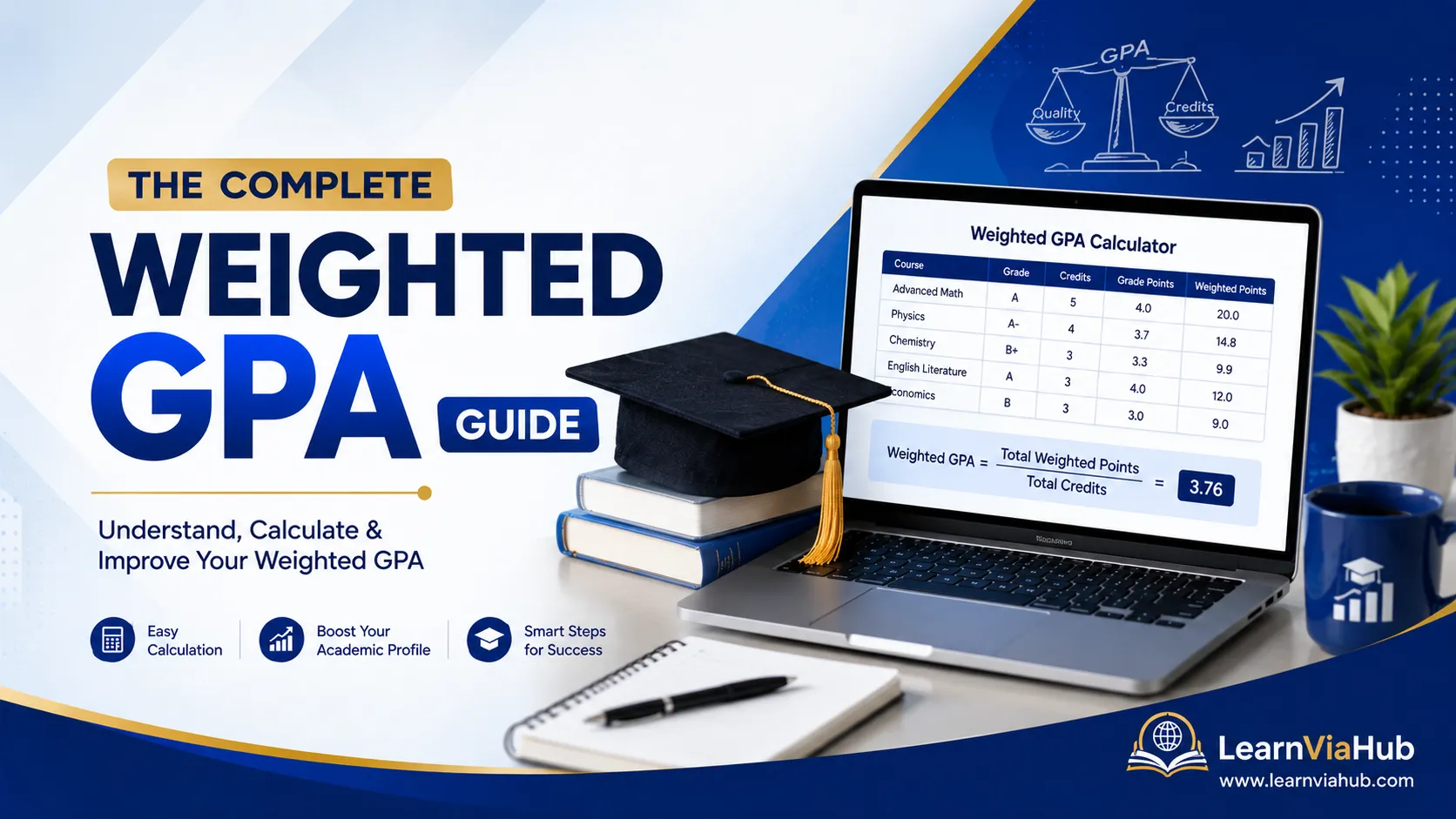
Quick Answer
A weighted GPA is a grade point average that gives extra “weight” to challenging courses like AP, IB, and Honors. While an unweighted GPA uses a standard 4.0 scale, a weighted GPA typically uses a 5.0 scale—an A in an AP class can earn 5.0 points instead of 4.0.
Weighted GPAs reward academic rigor and are often used for class rank, college admissions, and scholarship eligibility.
Expand the weighted GPA calculator below to compute your unweighted and weighted GPA instantly, or scroll to learn how to calculate weighted GPA step‑by‑step.
Add your courses, select the type (Regular, Honors, AP/IB), and enter your grades. Click “Calculate” to see your Unweighted GPA (4.0 scale) and Weighted GPA (5.0+ scale) side‑by‑side.
Weighting: Regular = +0.0, Honors = +0.5, AP/IB = +1.0. School policies vary; always verify with your institution.
📊 Click to Use the Weighted GPA Calculator (Unweighted & Weighted)
Course (optional)
Credits
Grade
Type
Need a cumulative or unweighted GPA calculator?
Use our full GPA Calculator for semester and cumulative GPAs, or see the Unweighted GPA Guide for the standard 4.0 scale.
What Is a Weighted GPA? (Weighted GPA Meaning)
A weighted GPA is a grade point average that assigns extra “weight” to more challenging courses based on their difficulty level. While an unweighted GPA treats all courses equally on a 4.0 scale, a weighted GPA gives additional points for advanced classes like Honors, AP, IB, and Dual Enrollment. This weighted GPA meaning is simple: it’s a number that rewards you for taking tougher classes.
According to Arizona State University’s admissions office, “a weighted GPA takes into account course difficulty. Most high school GPAs are unweighted”. The weighted GPA scale is most often a 5.0 GPA scale, where an A in an AP class is worth 5.0, an A in Honors is 4.5, and a regular A stays at 4.0. This scale can go higher depending on the school, but 5.0 is the most common reference point.
Key Difference
Unweighted GPA = All courses equal (4.0 max)
Weighted GPA = Advanced courses earn extra points (5.0+ max)
Why Schools Use Weighted GPAs
- Reward academic rigor: Encourages students to take challenging courses
- Class rank accuracy: Prevents students who take easier courses from having higher GPAs
- College preparation: Recognizes students who are ready for college‑level work
- Scholarship eligibility: Many scholarships consider weighted GPA
Who Uses Weighted GPAs
- Most U.S. high schools that offer AP, IB, or Honors courses
- Some colleges recalculate GPAs using their own weighted scale
- Competitive universities use weighted GPAs to evaluate course rigor
- Scholarship committees often consider both weighted and unweighted GPAs
What Courses Count as Weighted?
Not all courses are created equal in a weighted GPA system. The following course types typically receive extra weight, moving your GPA from a standard 4.0 scale to a weighted GPA scale that can reach 5.0 or higher:
AP (Advanced Placement)
College‑level courses offered in high school. Typically receive the highest weight—often +1.0 points or more. An A in AP is often worth 5.0 points on the AP GPA scale.
IB (International Baccalaureate)
Another rigorous college‑level program. IB courses typically receive the same weight as AP—often +1.0 points or more. The IB weighted GPA works the same way.
Honors Courses
Advanced courses that are more challenging than standard classes but less rigorous than AP/IB. Typically receive moderate weight—often +0.5 points. The Honors GPA scale often tops at 4.5 for an A.
Dual Enrollment
College courses taken while in high school. Often receive weight similar to AP/IB, depending on the institution. Dual enrollment GPA weight varies by state.
Different Weighting Systems
Schools use different methods to weight courses. Here are the most common:
| Weighting System | How It Works | Example |
|---|---|---|
| +1.0 System | Adds 1.0 point to grade value for AP/IB | A (4.0) → 5.0 |
| +0.5 System | Adds 0.5 point for Honors | A (4.0) → 4.5 |
| Percentage‑Based | Weight calculated as percentage of grade points | A = 4.5, B = 3.375 |
| 5.0 Scale | All grades on 5.0 scale for weighted courses | A=5.0, B=4.0, C=3.0 |
Important: Weighting Policies Vary by School
Every school has its own weighting policy. Some schools weight AP and IB differently. Some weight all advanced courses equally. Others don’t weight at all. Always check your school’s specific policy to understand how your weighted GPA is calculated.
How to Calculate Weighted GPA (Step‑by‑Step)
According to Rutgers University’s GPA guide, “you can calculate your gpa by using the Weighted Average method in mathematics”. The process is similar to calculating an unweighted GPA, but with adjusted grade point values for advanced courses. If you want to calculate my weighted GPA manually, follow these steps, or use the weighted GPA calculator above for instant results.
According to Rice University’s GPA calculation guide, GPA is “a weighted average of the numerical equivalents of number grades”. The process is complicated if you take courses earning different amounts of credit, so you must weigh the average by credit values. See our GPA Formula guide for more details.
Here are the 5 steps to calculate your weighted GPA:
Step 1: List Courses with Grades and Credit Hours
Record every course from the semester. For each course, note the letter grade, the credit hours, and whether the course is weighted (AP, IB, Honors, etc.).
Step 2: Convert Letter Grades to Weighted Grade Points
Use your school’s weighted grading scale. For example, on a 5.0 weighted scale:
AP/IB courses: A=5.0, B=4.0, C=3.0, D=2.0, F=0.0
Honors courses: A=4.5, B=3.5, C=2.5, D=1.5, F=0.0
Standard courses: A=4.0, B=3.0, C=2.0, D=1.0, F=0.0
Step 3: Multiply by Credit Hours
Multiply the weighted grade point value by the credit hours for each course.
Formula: Weighted Grade Points = Weighted Grade Point Value × Credit Hours
Example: A in AP course (5.0) × 4 credits = 20 Weighted Grade Points
Step 4: Add All Weighted Grade Points
Add together every weighted grade point from every course you took this semester. This is your Total Weighted Grade Points.
Step 5: Divide by Total Credit Hours
Formula: Weighted GPA = Total Weighted Grade Points ÷ Total Credit Hours
Example: 56.0 Weighted Grade Points ÷ 14 Credit Hours = 4.0 Weighted GPA
Real Example: Weighted GPA Calculation (How to Calculate Weighted GPA on a 5.0 Scale)
Let’s walk through a complete weighted GPA calculation using a real student’s transcript. This shows exactly how to calculate weighted GPA on a 5.0 scale.
Meet Alex, a high school student who just finished a semester with a mix of AP, Honors, and standard courses.
Alex’s Semester Transcript
| Course | Type | Credit Hours | Letter Grade | Weighted Grade Points | Calculation |
|---|---|---|---|---|---|
| AP Biology | AP | 4 | A | 5.0 | 5.0 × 4 = 20.0 |
| Honors English | Honors | 3 | B+ | 3.8 | 3.8 × 3 = 11.4 |
| AP Chemistry | AP | 4 | B | 4.0 | 4.0 × 4 = 16.0 |
| Standard History | Standard | 3 | A− | 3.7 | 3.7 × 3 = 11.1 |
| Totals | 14 | 58.5 |
Step 5: Divide Total Weighted Grade Points by Total Credit Hours
Weighted GPA = Total Weighted Grade Points ÷ Total Credit Hours
58.5 ÷ 14 = 4.18
✅ Alex’s Weighted Semester GPA: 4.18
Weighted vs Unweighted Comparison
Alex’s Weighted GPA: 4.18 (on a 5.0 scale)
Alex’s Unweighted GPA: 3.65 (on a 4.0 scale)
The difference: Alex’s weighted GPA is 0.53 points higher because of the extra weight earned in AP and Honors courses. This difference can significantly impact class rank and college applications.
Weighted vs Unweighted GPA: Key Differences
Understanding the difference between weighted vs unweighted GPA is essential for college applications and academic planning. For a deeper dive, see our full Weighted vs Unweighted GPA guide.
| Feature | Unweighted GPA | Weighted GPA |
|---|---|---|
| Scale | 4.0 | 5.0+ |
| Course Difficulty | All courses equal | Advanced courses get extra points |
| Maximum GPA | 4.0 | 5.0+ |
| What It Measures | Academic performance only | Performance + rigor |
| Common Users | Most colleges, universities | High schools, scholarship committees |
| Class Rank Impact | Moderate | Significant |
Which One Matters More for College Admissions?
According to MEFA’s guide on weighted vs unweighted GPAs, “many colleges recalculate applicants’ GPAs on an unweighted scale, then perform a rigor assessment to determine how many courses in that unweighted, recalculated GPA are honors or AP (or IB)”.
The bottom line: Colleges look at both weighted and unweighted GPAs. Your unweighted GPA shows your baseline performance. Your weighted GPA shows how much you challenged yourself. Top colleges value students who take rigorous courses AND perform well.
Why Colleges Care About Weighted GPA
Colleges don’t just look at your GPA number, they look at what’s behind it. Weighted GPA gives them critical information about your academic choices and preparation. For more on how GPAs are evaluated, see our University GPA Requirements page.
Course Rigor Assessment
Weighted GPA tells colleges how challenging your course load was. According to MEFA, colleges perform a “rigor assessment” to determine how many courses in your transcript are honors, AP, or IB. A student with a 4.0 in all standard courses is viewed differently than a student with a 3.8 in all AP courses.
College Recalculation
Many colleges recalculate your GPA using their own weighted scale. According to Miami University’s recalculation policy, “if a school does not calculate a weighted 4.0 GPA, we will use the recalculation scale below to add weight and use the better of the two GPAs in our review”.
Class Rank
Weighted GPA is often used to determine class rank. Since students who take advanced courses can earn higher weighted GPAs, class rank more accurately reflects academic achievement and rigor.
Preparation for College
Students who take AP, IB, and Honors courses are better prepared for college‑level work. Weighted GPA helps colleges identify students who are ready for academic rigor. The maximum value possible on UCLA’s recalculated scale is 5.00.
Key insight: According to UCLA’s first‑year profile, “the evaluation of applicants takes into consideration the courses and educational opportunities available at their specific high school”. Colleges understand that not all schools offer the same advanced courses, they evaluate your weighted GPA in the context of what was available to you.
Common Weighted GPA Myths
There are many misconceptions about weighted GPAs. Here are the most common myths and the truth behind each one.
❌ Myth 1: “Weighted GPA is always better than unweighted GPA”
The Truth: According to MEFA, “many colleges recalculate applicants’ GPAs on an unweighted scale”. A weighted GPA does not automatically beat an unweighted GPA. What matters most is the context: the rigor of your courses and your overall performance. Top colleges value students who challenge themselves AND perform well.
❌ Myth 2: “You should take all AP classes to boost your weighted GPA”
The Truth: Don’t overload yourself. Colleges want to see that you can handle challenging courses—but they also want to see you succeed. Struggling in too many AP courses can hurt your unweighted GPA. Balance is key. Take rigorous courses in subjects you excel in or are passionate about.
❌ Myth 3: “Colleges only look at weighted GPA”
The Truth: Colleges look at both weighted and unweighted GPAs. Your unweighted GPA shows your baseline academic performance. Your weighted GPA shows how much you challenged yourself. According to MEFA, colleges “perform a rigor assessment to determine how many courses in that unweighted, recalculated GPA are honors or AP (or IB)”.
❌ Myth 4: “Weighted GPA is the same everywhere”
The Truth: Every school has its own weighting policy. Some weight AP and IB differently. Some weight all advanced courses equally. Some don’t weight at all. According to Miami University’s policy, “if a school does not calculate a weighted 4.0 GPA, we will use the recalculation scale below to add weight”. Always check your school’s specific policy.
FAQs About Weighted GPA
What is a weighted GPA? (Weighted GPA meaning) ▼
A weighted GPA gives extra “weight” to challenging courses like AP, IB, and Honors. While an unweighted GPA uses a standard 4.0 scale, a weighted GPA typically uses a 5.0 scale, an A in an AP class can earn 5.0 points instead of 4.0.
How do you calculate weighted GPA? ▼
Convert each letter grade to its weighted grade point value (e.g., AP A = 5.0, Honors A = 4.5, Regular A = 4.0), multiply by credit hours, sum all weighted grade points, and divide by total credit hours.
What is the difference between weighted and unweighted GPA? ▼
Unweighted GPA treats all courses equally on a 4.0 scale. Weighted GPA gives extra points for advanced courses like AP, IB, and Honors on a 5.0+ scale. Weighted GPAs can exceed 4.0.
Do colleges look at weighted or unweighted GPA? ▼
Colleges look at both. According to MEFA, “many colleges recalculate applicants’ GPAs on an unweighted scale, then perform a rigor assessment to determine how many courses in that unweighted, recalculated GPA are honors or AP (or IB)”.
What is a good weighted GPA? ▼
On a 5.0 scale: 3.5+ is solid, 4.0+ is strong, 4.5+ is excellent. For top colleges, a weighted GPA above 4.0 shows strong rigor. For more context, see our What Is a Good GPA? guide.
Should I take AP classes for weighted GPA? ▼
Yes, if you can handle the workload. AP classes boost your weighted GPA and show colleges you can handle rigorous coursework. But balance is key—too many APs can hurt your unweighted GPA.
What is a 5.0 GPA scale? ▼
A 5.0 GPA scale is typically used for weighted GPAs where advanced courses earn extra points. On a 5.0 scale, an A in an AP/IB class is worth 5.0 points, an A in Honors is 4.5, and a regular A is 4.0. The maximum possible is 5.00.
Is weighted GPA on a 5.0 scale? ▼
Most often, yes. The most common weighted GPA scale is 5.0, but some schools use scales that go up to 6.0 or even higher, depending on how much extra weight is given to advanced courses. Always check your school’s policy.
Complete GPA Toolkit
Master every aspect of GPA with our free calculators and guides:
- How to Calculate GPA – The universal step‑by‑step guide
- Free GPA Calculator – Semester, cumulative, and major
- What is GPA? – Meaning and importance
- GPA Meaning
- GPA Formula – The exact math

Christian Chinonso is the founder of LearnViaHub, with 6+ years of research experience in international education — including GPA systems, scholarships, student financing, and study-abroad guidance — for students worldwide.