Understanding the Erasmus Mundus Joint Master’s Degree program requirements is one of the most important steps before preparing your scholarship application. Although all Erasmus Mundus Joint Master’s (EMJM) programmes are funded under the European Union’s Erasmus+ initiative, each programme sets its own admission requirements, eligibility criteria, and document requirements. Applicants are generally expected to hold a relevant bachelor’s degree (or be in the final year of study where permitted), satisfy the programme’s academic and language requirements, submit the required application documents, and meet the published application deadline.
This comprehensive guide explains the common eligibility requirements shared by most Erasmus Mundus Joint Master’s programmes, highlights where requirements may differ between universities, and provides practical advice to help you prepare a stronger application. Whether you are a recent graduate, a final-year student, or a working professional planning to study in Europe, this guide will help you understand what to expect before applying.
📅 Last Updated: August 2026
👨💻 Reviewed By: LearnViaHub Editorial Team
⏱️ Reading Time: Approximately 4–8 minutes
✓ Why Trust This Guide?
This guide has been researched using official information published by the European Commission, the Erasmus+ Programme, the official Erasmus Mundus Catalogue, and participating universities offering Erasmus Mundus Joint Master’s programmes.
Because individual programmes establish their own admission requirements, this guide focuses on the common eligibility criteria shared across most Erasmus Mundus Joint Master’s programmes while highlighting where programme-specific requirements may differ.
Although every effort has been made to ensure the information is accurate at the time of publication, admission requirements, scholarship rules, English language policies, application deadlines, eligible countries, and required documents may change. Always verify the latest information through the official Erasmus Mundus programme webpage before submitting your application.
👤 Who This Guide Is For
- International students planning to study in Europe.
- Recent university graduates seeking a fully funded master’s degree.
- Final-year bachelor’s students preparing future applications.
- Working professionals interested in international postgraduate study.
- Applicants comparing Erasmus Mundus programmes across different universities.
- Students looking for a complete explanation of Erasmus Mundus Joint Master’s programme requirements.
📌 In This Guide You’ll Learn
- Who is eligible to apply for an Erasmus Mundus Joint Master’s programme.
- The general admission requirements shared by most programmes.
- Academic qualification and GPA expectations.
- English language requirements and possible exemptions.
- Which documents are commonly required during the application process.
- How Erasmus Mundus applications are evaluated.
- Common mistakes that reduce applicants’ chances of admission or scholarship selection.
- Answers to frequently asked questions about Erasmus Mundus Joint Master’s programme requirements.
Erasmus Mundus Joint Master’s Degree Program Requirements
To qualify for most Erasmus Mundus Joint Master’s Degree (EMJM) programmes, applicants generally need a recognized bachelor’s degree (or an equivalent qualification), satisfy the programme’s academic and English language requirements, submit all required application documents before the deadline, and meet any programme-specific eligibility criteria established by the participating universities. Since every Erasmus Mundus Joint Master’s programme is independently managed by a consortium of universities, admission requirements, scholarship selection criteria, accepted English tests, and required documents may vary. Always review the official webpage of the specific programme before applying.
Quick Overview
- ✔ Hold a recognized bachelor’s degree (or equivalent qualification).
- ✔ Meet the academic admission requirements for your chosen programme.
- ✔ Demonstrate English language proficiency if required.
- ✔ Submit the required application documents before the deadline.
- ✔ Meet any programme-specific eligibility criteria.
- ✔ Apply directly through the official Erasmus Mundus programme website.
Important: There is no single universal set of Erasmus Mundus admission requirements. Every Joint Master’s programme determines its own eligibility criteria, document requirements, language policies, and selection process. Applicants should always verify the latest information using the official programme webpage.
Estimated Preparation Time
Preparing a competitive Erasmus Mundus Joint Master’s application usually takes several weeks, especially if you need to obtain language test results, request recommendation letters, or prepare a strong motivation letter. Starting early gives you more time to research programmes, organize your documents, and submit a complete application.
| Stage | Estimated Time |
|---|---|
| Research Erasmus Mundus Programmes | 3–7 days |
| Shortlist Universities & Programmes | 1 week |
| Prepare Required Documents | 1–3 weeks |
| Write Motivation Letter | 1–2 weeks |
| Request Recommendation Letters | 2–3 weeks |
| Final Review & Submission | 1–2 days |
Erasmus Mundus Requirements Snapshot
| Requirement | Typical Requirement |
|---|---|
| Programme Type | Joint Master’s Degree offered by multiple European universities. |
| Academic Qualification | Recognized bachelor’s degree or equivalent. |
| English Requirement | Programme-specific (IELTS, TOEFL, or accepted alternatives where applicable). |
| Work Experience | Usually not mandatory, but some programmes may value relevant experience. |
| Application Method | Direct application through the official programme website. |
| Scholarship Availability | Competitive scholarships may be available for eligible applicants. |
| Study Location | Two or more participating universities in different countries. |
| Official Information | Always verify programme-specific requirements on the official Erasmus Mundus programme webpage. |
What Is an Erasmus Mundus Joint Master’s Degree (EMJM)?
Before reviewing the admission requirements, it’s important to understand exactly what an Erasmus Mundus Joint Master’s Degree (EMJM) is. Many prospective applicants use terms such as Erasmus+, Erasmus Mundus, Erasmus Mundus Scholarship, and Erasmus Mundus Joint Master’s Degree interchangeably, even though they refer to different parts of the same European education initiative.
Understanding these differences will help you identify the correct programme, apply through the appropriate application portal, and avoid relying on inaccurate information during your scholarship search.
Quick Explanation
Erasmus+ is the European Union’s programme that supports education, training, youth, and sport. One of the opportunities funded through Erasmus+ is the Erasmus Mundus Joint Master’s Degree (EMJM), an international master’s programme jointly delivered by a consortium of universities. Many EMJM programmes offer competitive scholarships that cover tuition fees and other study-related costs for selected students.
What Is Erasmus+?
Erasmus+ is the European Union’s flagship programme supporting international cooperation in education, vocational training, youth development, and sport. It funds numerous initiatives that encourage academic mobility, international partnerships, and collaborative learning across Europe and other regions of the world.
The Erasmus Mundus Joint Master’s Degree is one of the prestigious programmes funded under the broader Erasmus+ initiative.
What Is an Erasmus Mundus Joint Master’s Degree?
An Erasmus Mundus Joint Master’s Degree (EMJM) is an internationally integrated master’s programme jointly designed and delivered by a consortium of higher education institutions located in different countries.
Instead of studying at a single university, students normally study at two or more participating universities during the programme. Depending on the course structure, graduates may receive:
- A joint degree awarded by multiple universities.
- Multiple national degrees issued by participating institutions.
- A combination of both, depending on the programme.
Each consortium establishes its own admission requirements, application process, course curriculum, and scholarship selection procedures.
What Is the Erasmus Mundus Scholarship?
Many Erasmus Mundus Joint Master’s programmes offer competitive scholarships to outstanding applicants. These scholarships are intended to help reduce the financial barriers associated with international postgraduate study.
Depending on the programme and funding available for a particular application cycle, successful scholarship recipients may receive support for expenses such as:
- Tuition fees.
- Living expenses.
- Travel costs.
- Installation or relocation support where applicable.
- Other approved study-related expenses.
Important: Receiving admission to an Erasmus Mundus Joint Master’s programme does not automatically guarantee a scholarship. Scholarship selection is usually competitive and based on each programme’s published evaluation criteria.
Who Organizes Erasmus Mundus Joint Master’s Programmes?
Unlike traditional university master’s degrees offered by a single institution, Erasmus Mundus Joint Master’s programmes are managed by partnerships of universities known as consortia. These partner universities work together to:
- Design the curriculum.
- Manage admissions.
- Evaluate scholarship applications.
- Coordinate student mobility.
- Award the final degree or degrees.
Because every consortium manages its own programme, applicants should always read the admission requirements published on the official webpage of the programme they intend to join.
Erasmus+ vs Erasmus Mundus Joint Master’s Degree
| Term | Meaning |
|---|---|
| Erasmus+ | The European Union’s programme supporting education, training, youth, and sport. |
| Erasmus Mundus Joint Master’s Degree (EMJM) | A jointly delivered international master’s programme funded under Erasmus+. |
| Erasmus Mundus Scholarship | Competitive financial support available for selected students enrolled in eligible EMJM programmes. |
| Participating Universities | Multiple universities that jointly deliver the programme and manage admissions. |
Key Takeaway
The Erasmus Mundus Joint Master’s Degree is not a single university programme with one universal application process. Each programme is managed by its own university consortium and establishes its own admission requirements, scholarship criteria, document checklist, English language policy, and application deadlines. Always consult the official webpage of your chosen programme before applying.
Erasmus Mundus at a Glance
- 🌍 Erasmus Mundus Joint Master’s programmes are delivered through international partnerships of universities across Europe and beyond.
- 🏛️ Hundreds of higher education institutions participate in Erasmus Mundus consortia, allowing students to study in multiple countries during a single master’s programme.
- 🎓 Every application cycle attracts thousands of applicants from around the world, making Erasmus Mundus scholarships highly competitive.
- 📖 Each programme consortium publishes its own admission requirements, meaning there is no single universal application standard for all Erasmus Mundus Joint Master’s Degree programmes.
Source: This overview is based on information published by the European Commission, the Erasmus+ Programme, and the official Erasmus Mundus Catalogue. Programme structures, participating universities, scholarship availability, and admission requirements may change over time. Always consult the official webpage of your chosen Erasmus Mundus programme for the most current information before applying.
Who Can Apply for an Erasmus Mundus Joint Master’s Degree?
The Erasmus Mundus Joint Master’s Degree (EMJM) is designed to attract talented students from around the world. Although each programme establishes its own admission requirements, most welcome applications from qualified candidates regardless of nationality, provided they meet the published eligibility criteria.
Whether you are a recent graduate, a final-year university student, or a working professional seeking international postgraduate education, you may be eligible to apply if you satisfy both the general Erasmus Mundus requirements and the programme-specific admission requirements.
Important
There is no single universal eligibility policy that applies to every Erasmus Mundus Joint Master’s programme. While many requirements are similar across programmes, participating university consortia may introduce additional academic, language, or professional requirements depending on the subject area.
International Students
Most Erasmus Mundus Joint Master’s programmes actively encourage applications from international students across all regions of the world. Applicants from both European Union (EU) and non-European Union (non-EU) countries are generally eligible to apply, provided they satisfy the admission requirements for their chosen programme.
Nationality alone does not determine admission. Instead, applicants are assessed according to the programme’s published eligibility criteria and selection process.
Recent University Graduates
If you have already completed a recognized bachelor’s degree or an equivalent qualification, you will usually satisfy one of the main academic requirements for admission. Your degree should normally be relevant to the master’s programme you intend to study, although some interdisciplinary programmes accept applicants from a wider range of academic backgrounds.
Programme coordinators may also evaluate your academic performance, completed coursework, and how well your previous studies align with the curriculum.
Final-Year Bachelor’s Students
Many Erasmus Mundus Joint Master’s programmes accept applications from students who are in the final year of their bachelor’s degree, provided they are expected to graduate before the master’s programme begins.
Applicants in this category may be asked to submit provisional academic transcripts during the application process and provide their final degree certificate before enrolment.
Because this policy varies between programmes, always confirm whether final-year students are eligible on the official programme webpage.
Working Professionals
Applicants with professional work experience are encouraged to apply, particularly where their experience complements the academic focus of the programme. Although many Erasmus Mundus Joint Master’s programmes do not require prior employment, relevant professional experience can strengthen an application by demonstrating practical knowledge, leadership, or commitment to the field.
Some specialized programmes may specifically value experience in research, public policy, engineering, healthcare, environmental studies, business, or other relevant disciplines.
Applicants from Different Academic Backgrounds
Not every programme requires applicants to hold a degree in exactly the same subject area. Depending on the curriculum, some programmes welcome candidates from related disciplines, while others require a closely matched academic background.
For example, a programme in data science may accept applicants from computer science, mathematics, engineering, or statistics, whereas a specialized biomedical programme may require prior study in life sciences or a closely related field.
Always review the programme’s academic prerequisites before applying.
Can You Apply More Than Once?
Yes. Applicants who are unsuccessful during one application cycle may generally apply again in a future cycle, provided they continue to satisfy the programme’s eligibility requirements and submit a new application before the published deadline.
Many successful applicants strengthen their later applications by improving their motivation letter, gaining additional academic or professional experience, enhancing their language proficiency, or selecting programmes that better match their qualifications.
Who Can Apply? At a Glance
| Applicant Type | Can Apply? |
|---|---|
| International Students | ✔ Yes, if programme requirements are met. |
| EU Citizens | ✔ Yes. |
| Non-EU Citizens | ✔ Yes. |
| Recent Graduates | ✔ Yes. |
| Final-Year Students | ✔ Often accepted, depending on the programme. |
| Working Professionals | ✔ Yes. |
| Applicants Reapplying | ✔ Generally yes, if eligibility requirements are still met. |
What’s Next?
Knowing that you can apply is only the first step. The next section explains the general eligibility requirements shared by most Erasmus Mundus Joint Master’s programmes, including academic qualifications, language requirements, required documents, and other conditions that applicants typically need to satisfy before submitting an application.
General Eligibility Requirements for Erasmus Mundus Joint Master’s Degree Programmes
Before investing time in preparing your application, it’s important to confirm that you meet the general eligibility requirements for your chosen Erasmus Mundus Joint Master’s Degree (EMJM) programme. Although each consortium of universities establishes its own admission criteria, most programmes assess applicants using similar academic and administrative requirements.
Meeting the minimum eligibility requirements allows you to submit an application, but it does not guarantee admission or selection for an Erasmus Mundus scholarship. Applications are usually evaluated holistically, taking into account your academic background, motivation, supporting documents, language proficiency, and how well your profile matches the objectives of the programme.
Important
Always review the admission requirements published on the official webpage of your chosen Erasmus Mundus Joint Master’s programme. Individual programmes may introduce additional eligibility conditions beyond the general requirements explained below.
1. Hold a Recognized Bachelor’s Degree
The first requirement for most Erasmus Mundus Joint Master’s programmes is a recognized bachelor’s degree or an equivalent higher education qualification.
Your degree does not usually need to come from a European university. Applicants from universities around the world are encouraged to apply, provided their qualification is considered equivalent to the admission requirements established by the programme consortium.
Some programmes require applicants to have studied a specific subject, while others accept graduates from a broader range of academic disciplines.
2. Meet the Programme’s Academic Requirements
Every Erasmus Mundus programme specifies the academic background expected from applicants. Depending on the programme, admissions committees may consider:
- Your field of study.
- Your academic performance.
- The relevance of completed coursework.
- Your overall preparation for postgraduate study.
Applicants whose academic background closely matches the programme’s objectives may be more competitive during the selection process.
3. Demonstrate English Language Proficiency
Because many Erasmus Mundus Joint Master’s programmes are taught in English, applicants are often required to demonstrate sufficient English language proficiency.
Accepted evidence varies between programmes and may include internationally recognized language tests or other forms of proof where permitted.
Some programmes also grant language requirement waivers under specific circumstances, such as previous study in English or citizenship of certain countries.
The detailed English language requirements are explained later in this guide.
4. Submit All Required Application Documents
Applicants are expected to submit every required document before the application deadline.
Although document requirements vary, programmes commonly request:
- Academic transcripts.
- Bachelor’s degree certificate.
- Curriculum Vitae (CV).
- Motivation letter.
- Recommendation letters.
- Proof of English proficiency (where required).
- Passport or national identification.
Incomplete applications are generally not considered during the selection process.
5. Meet the Published Application Deadline
Erasmus Mundus programmes operate according to fixed annual application schedules. Applicants should prepare their documents well before the deadline to avoid last-minute technical or administrative issues.
Late applications are generally not accepted unless the programme specifically states otherwise.
6. Satisfy Any Programme-Specific Requirements
Some Erasmus Mundus Joint Master’s programmes include additional admission requirements based on their academic focus.
Examples may include:
- Relevant professional experience.
- Portfolio submissions.
- Research proposals.
- Specific prerequisite courses.
- Interviews.
- Additional language requirements.
These requirements are determined by the consortium managing the programme and should always be confirmed on the official programme webpage.
✔ Quick Eligibility Checklist
Before continuing your application, ask yourself:
☐ I have a recognized bachelor’s degree (or I will graduate before the programme begins).
☐ My academic background matches the programme requirements.
☐ I meet the English language requirement.
☐ I can prepare every required application document.
☐ I understand the programme-specific admission requirements.
☐ I know the official application deadline.
☐ I have reviewed the official programme webpage.
Eligibility vs Competitiveness
Meeting the minimum eligibility requirements only makes you eligible to apply—it does not guarantee admission or an Erasmus Mundus scholarship. Many programmes receive far more qualified applications than available places, so applicants are ranked based on academic achievement, motivation, recommendation letters, language proficiency, and overall suitability for the programme.

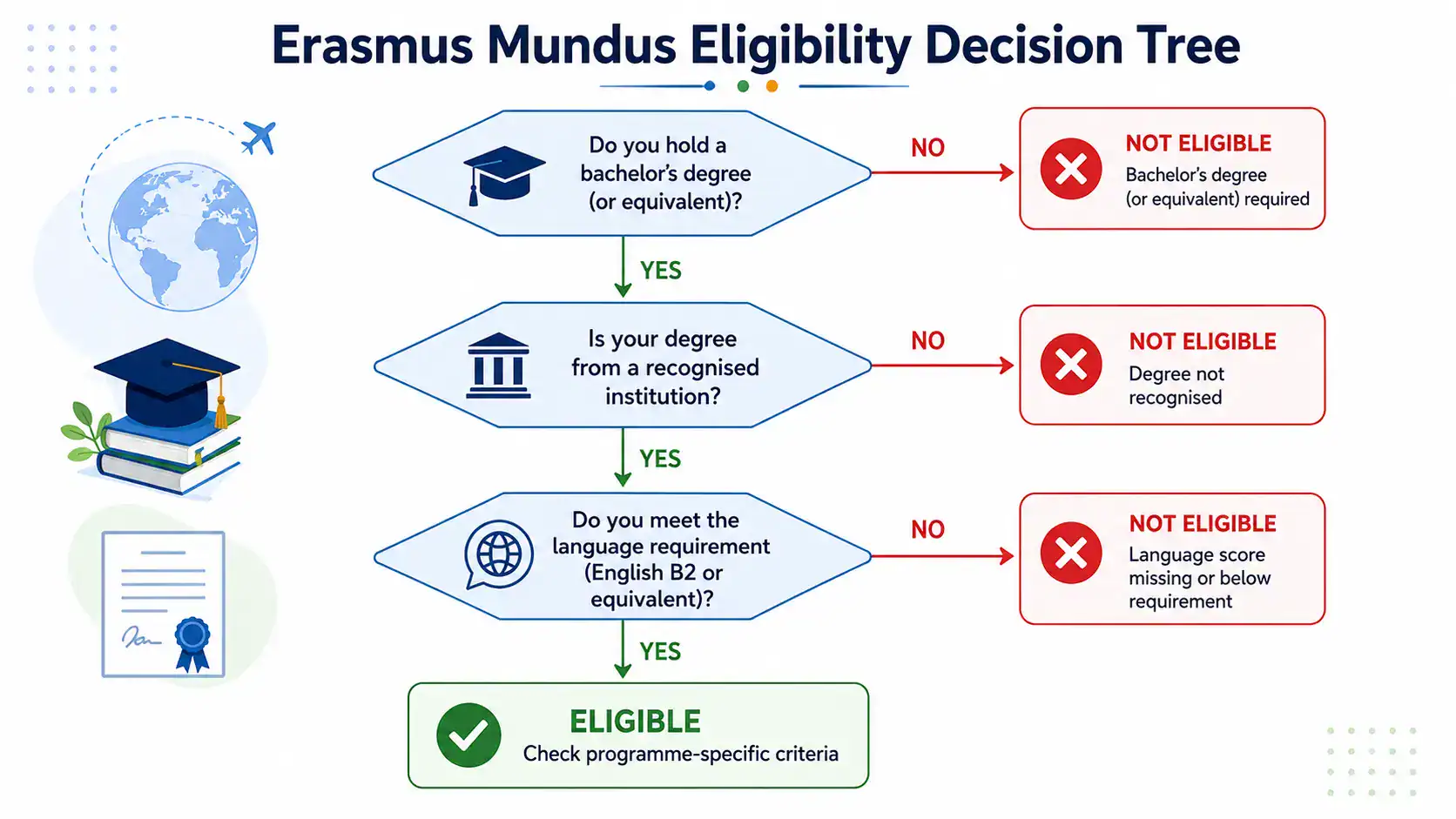
Figure: Erasmus Mundus Joint Master’s Degree eligibility decision tree illustrating the key questions prospective applicants should answer before beginning an application, from confirming academic qualifications and English language proficiency to preparing the required documents and reviewing programme-specific admission requirements.
Academic Requirements for Erasmus Mundus Joint Master’s Degree Programmes Explained
One of the most common questions prospective applicants ask is whether their academic qualifications are sufficient for admission to an Erasmus Mundus Joint Master’s Degree (EMJM). Although every consortium sets its own admission criteria, most programmes evaluate applicants using similar academic standards.
Understanding these requirements before applying can help you determine whether you are eligible, avoid applying to unsuitable programmes, and identify any additional documents or qualifications you may need.
Academic Requirements at a Glance
- A recognized bachelor’s degree (or equivalent).
- An academic background relevant to the chosen master’s programme.
- Sufficient university credits where required.
- Final-year undergraduate students may be eligible under certain conditions.
- Competitive academic performance.
- Recognition of professional qualifications where accepted by the consortium.
1. Bachelor’s Degree Requirement
Nearly all Erasmus Mundus Joint Master’s Degree programmes require applicants to hold a recognized bachelor’s degree before enrolment begins.
Your degree does not necessarily need to come from a European university. Degrees awarded by accredited universities around the world are commonly accepted, provided they are recognized within the educational system of the country where they were earned.
Some programmes also accept applicants who are in the final year of their bachelor’s degree, provided they successfully graduate before the programme starts. The exact deadline for submitting proof of graduation varies by consortium.
Important
Holding a bachelor’s degree alone does not guarantee admission. Your degree must also satisfy the academic requirements of the specific Erasmus Mundus programme you apply for.
2. Degree Equivalency
Applicants often wonder whether degrees earned outside Europe are accepted.
In most cases, the answer is yes. Erasmus Mundus programmes evaluate whether your qualification is academically equivalent to the bachelor’s degree normally required for admission.
Programme coordinators may review factors such as:
- The accreditation status of your university.
- The duration of your degree programme.
- The level of qualification awarded.
- The subjects you studied.
- Your official academic transcripts.
Some universities may request additional documentation if they need to verify your qualification or compare it with their national education system.
3. Academic Credits
Certain Erasmus Mundus programmes specify a minimum number of academic credits in particular subject areas.
For example, a data science programme may expect applicants to have completed university-level coursework in mathematics, statistics, or computer science, while an engineering programme may require previous engineering or technical credits.
These subject-specific requirements help ensure applicants possess the academic foundation needed to succeed in a demanding international master’s programme.
Always review the official programme description carefully to determine whether your previous coursework satisfies any credit requirements.
4. Can Final-Year Students Apply?
Yes. Many Erasmus Mundus Joint Master’s Degree programmes allow students who are completing the final year of their bachelor’s degree to submit an application.
However, applicants are usually expected to:
- Complete all graduation requirements before enrolment.
- Provide updated academic transcripts when requested.
- Submit official proof of graduation before the consortium’s deadline.
If you fail to graduate within the required timeframe, your admission or scholarship offer may be withdrawn.
Tip for Final-Year Students
If you are still studying, prepare provisional transcripts and monitor your university’s graduation schedule so you can submit your final documents as soon as they become available.
5. Minimum Grades and Academic Performance
Unlike many scholarship programmes, Erasmus Mundus does not publish one universal minimum GPA or class of degree that applies to every programme.
Instead, each consortium determines its own academic expectations. Some programmes simply require applicants to have successfully completed a bachelor’s degree, while others are highly competitive and favour candidates with outstanding academic records.
Selection committees often consider:
- Your cumulative GPA or degree classification.
- Your performance in relevant subjects.
- The difficulty of your previous academic programme.
- Academic awards or distinctions.
- Your overall application alongside your grades.
A lower GPA does not automatically prevent admission if other parts of your application—such as motivation, research experience, professional achievements, or recommendation letters—are particularly strong.
6. Professional Qualifications
Some Erasmus Mundus programmes recognise professional qualifications or industry experience as part of their holistic admissions process.
For example, applicants may strengthen their application by demonstrating:
- Relevant professional certifications.
- Industry experience.
- Research publications.
- Internships.
- Professional licences where applicable.
- Significant practical achievements related to the programme.
Professional qualifications rarely replace the bachelor’s degree requirement, but they can make an application more competitive when evaluated alongside academic achievements.
Key Takeaway
Most Erasmus Mundus Joint Master’s Degree programmes require applicants to hold a recognized bachelor’s degree, demonstrate an academic background relevant to their chosen field, and satisfy any programme-specific credit requirements. Final-year undergraduate students are often eligible to apply, while strong academic performance and relevant professional experience can strengthen an application even further. Because admission criteria vary between consortia, applicants should always verify the latest academic requirements on the official webpage of each Erasmus Mundus programme before submitting an application.

Figure: Erasmus Mundus Joint Master’s Degree academic requirements checklist summarizing the key academic qualifications applicants should review before applying, including degree recognition, relevant academic background, required credits, final-year student eligibility, minimum academic performance, and professional qualifications where applicable.
English Language Requirements for Erasmus Mundus Joint Master’s Degree Programmes
Since Erasmus Mundus Joint Master’s Degree (EMJM) programmes are delivered by international university consortia and bring together students from around the world, applicants are generally expected to demonstrate sufficient English language proficiency before admission.
However, there is no single English language requirement that applies to every Erasmus Mundus programme. Each consortium establishes its own language policy, accepted tests, minimum scores, and exemption rules.
Understanding these requirements early allows you to choose the appropriate language test, determine whether you qualify for an exemption, and avoid delays during the application process.
Quick Answer
Most Erasmus Mundus programmes require proof of English language proficiency, but the accepted tests, minimum scores, and exemption policies vary by programme. Always review the official admission requirements published by the specific Erasmus Mundus consortium before applying.
1. Is Proof of English Language Proficiency Required?
In many cases, yes.
Because coursework is commonly taught in English, universities need assurance that students can successfully participate in lectures, complete assignments, conduct research, and communicate effectively throughout the programme.
Some programmes require every applicant to submit an English language test, while others waive this requirement for eligible candidates.
2. Accepted English Language Tests
The accepted language tests differ between Erasmus Mundus programmes. Commonly accepted examinations include:
- IELTS Academic
- TOEFL iBT
- PTE Academic
- Cambridge English Qualifications (accepted by some programmes)
- Other recognised English proficiency certificates specified by the consortium
Always verify which examinations are accepted before registering for a test, as some universities accept only specific qualifications.
3. Minimum English Test Scores
There is no universal minimum score for Erasmus Mundus admissions.
Instead, each consortium sets its own language requirements based on the academic demands of the programme.
For example, one programme may require a higher IELTS or TOEFL score than another, while some programmes specify minimum scores for each language skill, including reading, writing, listening, and speaking.
The official programme webpage always provides the most accurate and up-to-date score requirements.
4. Who May Qualify for an English Language Waiver?
Some Erasmus Mundus programmes exempt applicants from submitting English test results under specific circumstances.
Common waiver situations may include applicants who:
- Completed a bachelor’s degree taught entirely in English.
- Graduated from a university located in an English-speaking country.
- Can provide an official Medium of Instruction (MOI) certificate if accepted by the consortium.
- Meet other programme-specific exemption criteria.
Not every consortium accepts language waivers or Medium of Instruction certificates. Even among those that do, the conditions can vary significantly.
Important
Never assume that a Medium of Instruction certificate automatically replaces IELTS or TOEFL. Always confirm the consortium’s official policy before relying on an exemption.
5. Can I Apply Before Receiving My Test Results?
Some Erasmus Mundus programmes allow applicants to submit an application while awaiting language test results, provided the official score is submitted before a specified deadline.
Others require applicants to upload valid English test results during the initial application process.
Because application procedures differ between programmes, applicants should carefully review the instructions on the official programme webpage.
6. Tips for Meeting the English Language Requirement
If you need to demonstrate English proficiency, these steps can improve your preparation:
- Register for your language test several months before the application deadline.
- Choose a test accepted by your selected Erasmus Mundus programme.
- Allow time to retake the examination if necessary.
- Ensure your score report remains valid throughout the application period.
- Keep electronic copies of your results ready for upload.
English Language Requirement Checklist
Before submitting your application, make sure you can answer Yes to the following questions:
- ✅ Have I confirmed the accepted English language tests for my chosen programme?
- ✅ Do I meet the required minimum score?
- ✅ If claiming a waiver, have I confirmed that my programme accepts it?
- ✅ Are my language test results still valid?
- ✅ Have I uploaded the correct supporting documents?
Information Verified Using Official Programme Guidance
English language requirements vary across Erasmus Mundus Joint Master’s Degree programmes. Applicants should always consult the official webpage of their chosen programme to verify accepted English language tests, minimum scores, exemption policies, and document requirements before submitting an application.

Figure: Erasmus Mundus Joint Master’s Degree English language requirements guide summarizing accepted English proficiency tests, minimum score expectations, waiver options, application timing, test validity, and practical tips to help applicants meet programme-specific language requirements.
Required Documents for Erasmus Mundus Joint Master’s Degree Applications
Preparing your application documents well before the deadline is one of the most important steps in the Erasmus Mundus Joint Master’s Degree (EMJM) application process. Since each programme is managed by a consortium of universities, the exact document requirements may vary slightly. However, most programmes request a similar set of academic and supporting documents to assess applicants fairly.
Submitting complete, accurate, and high-quality documents not only helps your application meet the eligibility requirements but also demonstrates professionalism and attention to detail.
Quick Answer
Most Erasmus Mundus programmes require applicants to submit academic transcripts, a bachelor’s degree certificate (or proof of expected graduation), a curriculum vitae (CV), a motivation letter, recommendation letters, proof of English language proficiency where applicable, and other programme-specific supporting documents.
Estimated Preparation Time
| Document | Estimated Time |
|---|---|
| Academic transcripts | 1–3 weeks |
| Degree certificate | Immediately available or 1–2 weeks |
| Recommendation letters | 2–4 weeks |
| Motivation letter | 1–2 weeks |
| CV preparation | 1–3 days |
| Final review | 1–2 days |
1. Bachelor’s Degree Certificate
Applicants are generally expected to provide proof that they have completed, or will complete before enrolment, a recognised bachelor’s degree or an equivalent qualification.
If you are still in your final year of study, many programmes allow you to submit an official statement confirming your expected graduation date.
2. Official Academic Transcripts
Official transcripts allow the admissions committee to evaluate your academic performance, completed courses, and overall suitability for the programme.
Where required, transcripts should be issued by your university and translated into English if the originals are in another language.
3. Curriculum Vitae (CV)
Most Erasmus Mundus programmes request an up-to-date CV outlining your educational background, work experience, research activities, internships, volunteer work, publications, awards, language skills, and other relevant achievements.
Many programmes recommend using the Europass CV format, although applicants should always confirm the preferred format in the programme guidelines.
4. Motivation Letter
The motivation letter is one of the most important documents in your application.
It gives you an opportunity to explain why you selected the programme, how it aligns with your academic interests and career goals, and how you intend to contribute to the Erasmus Mundus community.
Strong motivation letters are specific, well-structured, and supported by genuine experiences rather than generic statements.
5. Letters of Recommendation
Most programmes require two recommendation letters from academic lecturers, research supervisors, employers, or other professionals who can evaluate your academic ability, professional experience, and potential for postgraduate study.
Choose referees who know your work well and can provide detailed, personalised recommendations.
6. Proof of English Language Proficiency
Where required, applicants should upload valid English language test results or other approved evidence of language proficiency.
Accepted examinations, minimum scores, and waiver policies differ between programmes, so applicants should carefully review the official language requirements before submitting their application.
7. Additional Supporting Documents
Depending on the Erasmus Mundus programme, applicants may also be asked to provide additional documentation such as:
- Passport or national identity document.
- Research proposal (where applicable).
- Portfolio for creative programmes.
- Professional licences or certifications.
- Publications or research papers.
- Proof of residence where required.
Important
Do not assume every Erasmus Mundus programme requires the same documents. Always use the official checklist published by your chosen consortium and upload documents exactly as instructed.
Before You Submit
Before clicking the submit button, confirm that you have:
- ✅ Uploaded every required document.
- ✅ Used the correct file formats.
- ✅ Named your files appropriately.
- ✅ Checked that every document is readable.
- ✅ Confirmed translations where required.
- ✅ Reviewed all uploaded files one final time.
Information Verified Using Official Programme Guidance
Required documents vary between Erasmus Mundus Joint Master’s Degree programmes. Applicants should always consult the official webpage of their selected programme to verify document requirements, accepted file formats, translation policies, and submission instructions before applying.

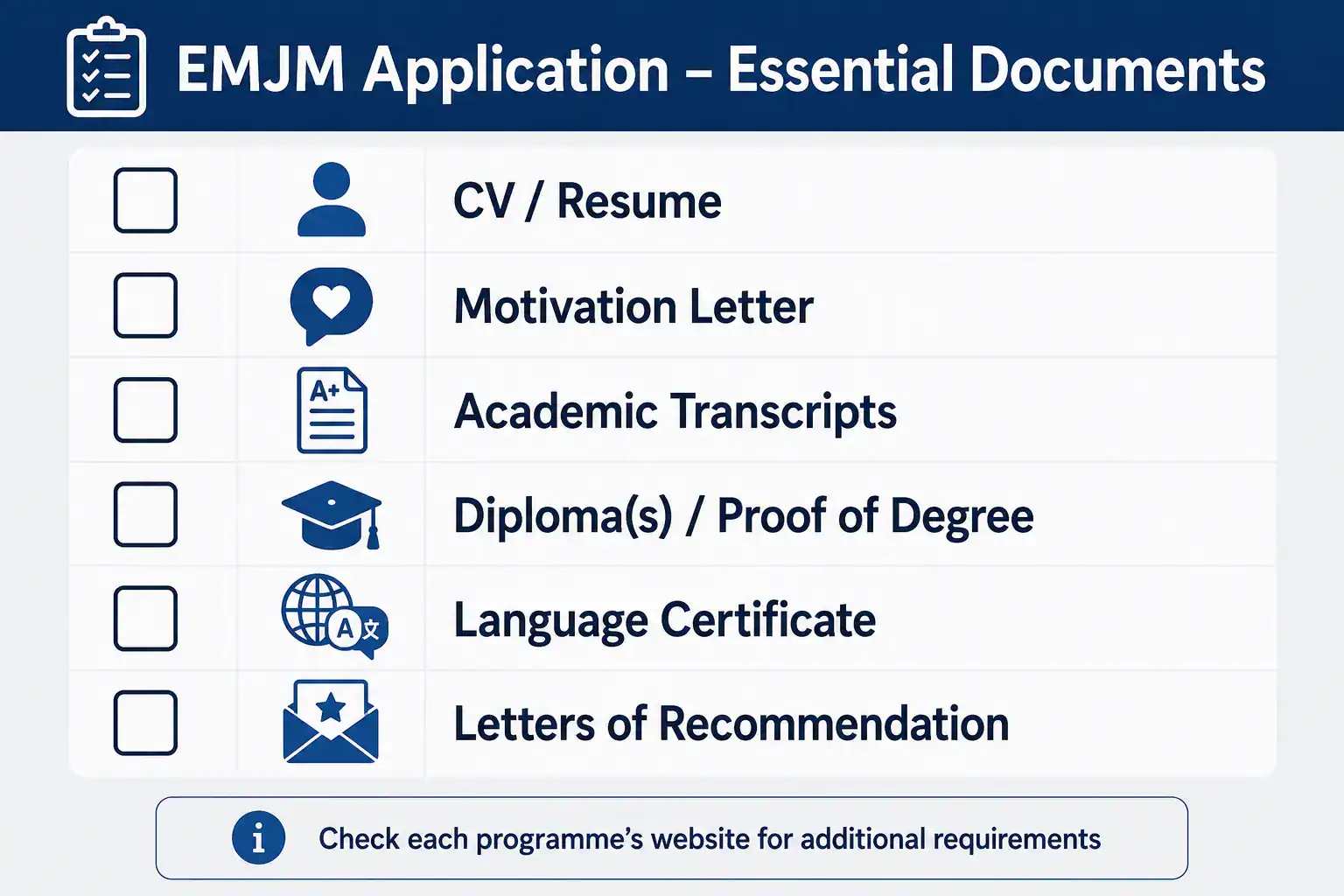
Figure: Erasmus Mundus Joint Master’s Degree document checklist summarizing the key documents applicants should prepare before submitting their application, including academic qualifications, supporting documents, proof of English proficiency, identification, and programme-specific requirements.
Required Documents Checklist for Erasmus Mundus Joint Master’s Degree Applications
Before submitting your Erasmus Mundus Joint Master’s Degree (EMJM) application, ensure every required document has been prepared, reviewed, and uploaded according to the programme’s official instructions. Although document requirements vary slightly between consortia, most programmes request the same core application materials.
Preparing these documents well in advance can help you avoid last-minute problems, missing files, or incomplete submissions that may affect your application’s competitiveness.
Quick Answer
Most Erasmus Mundus programmes require a valid passport, bachelor’s degree certificate (or proof of expected graduation), official academic transcripts, a curriculum vitae (CV), a motivation letter, recommendation letters, proof of English language proficiency where applicable, and additional documents such as a portfolio or research proposal for specific programmes.
1. Valid Passport or National Identity Document
Applicants are generally required to upload a clear copy of a valid passport or another accepted identification document. Ensure that your passport remains valid throughout the application process and, ideally, until your expected enrolment date.
2. Bachelor’s Degree Certificate
Provide proof that you have completed a recognised bachelor’s degree or an equivalent qualification. If you are still completing your undergraduate studies, many programmes allow you to submit an official statement confirming your expected graduation before enrolment.
3. Official Academic Transcripts
Official transcripts should list all completed courses, grades, and credits earned. If your transcripts are not issued in English, certified translations may also be required depending on the programme.
4. Curriculum Vitae (CV)
Your CV should present your academic background, research experience, internships, employment history, volunteer work, awards, publications, technical skills, and language abilities. Many Erasmus Mundus programmes recommend using the Europass CV format.
5. Motivation Letter
The motivation letter explains why you are applying for the programme, how it supports your academic and professional goals, and why you are a strong candidate. A well-written motivation letter is often one of the most influential parts of the application.
6. Recommendation Letters
Most programmes require two recommendation letters from lecturers, academic supervisors, employers, or other professionals who know your qualifications well. Strong recommendations should provide specific examples of your academic ability, research potential, leadership, or professional achievements.
7. English Language Certificate
Where required, applicants must upload valid results from an accepted English language test such as IELTS, TOEFL iBT, PTE Academic, or another approved qualification. Some programmes may grant waivers under specific circumstances, so always review the official language policy.
8. Portfolio (If Required)
Applicants applying to architecture, design, arts, media, or other creative programmes may need to submit a portfolio showcasing previous academic or professional work. Portfolio requirements vary considerably between programmes.
9. Research Proposal (If Required)
Some research-oriented or specialised Erasmus Mundus programmes ask applicants to submit a research proposal outlining their intended area of study, research interests, objectives, methodology, and expected contribution to the field.
Important Reminder
Every Erasmus Mundus Joint Master’s Degree programme publishes its own official document checklist. Always verify the required documents, accepted file formats, translation requirements, certification rules, and submission instructions on your chosen programme’s official webpage before submitting your application.
Final Document Checklist
Before submitting your application, confirm that you have:
- ✅ Valid passport or accepted identification document.
- ✅ Bachelor’s degree certificate or proof of expected graduation.
- ✅ Official academic transcripts.
- ✅ Updated Curriculum Vitae (CV).
- ✅ Well-written motivation letter.
- ✅ Required recommendation letters.
- ✅ English language certificate (where applicable).
- ✅ Portfolio (if required).
- ✅ Research proposal (if required).
- ✅ Verified that every uploaded file meets the programme’s official requirements.
Verified Against Official Programme Guidance
Although this checklist reflects the documents commonly requested by Erasmus Mundus Joint Master’s Degree programmes, applicants should always consult the official webpage of their selected programme for the latest document requirements, file specifications, deadlines, and application instructions.

Figure: Erasmus Mundus Joint Master’s Degree required documents checklist summarizing the key documents applicants should prepare before submitting their application, along with important reminders to verify file formats, translations, and programme-specific requirements.
Before You Start Your Erasmus Mundus Joint Master’s Degree Application
A successful Erasmus Mundus Joint Master’s Degree (EMJM) application begins long before the application portal opens. The strongest applicants usually spend several weeks—or even months—preparing their documents, researching programmes, refining their motivation letter, and confirming that they meet every eligibility requirement.
Starting early not only reduces stress but also gives you enough time to request recommendation letters, complete language tests if necessary, obtain certified translations, and carefully review your application before submission.
Quick Answer
Before beginning your Erasmus Mundus application, make sure you have researched suitable programmes, confirmed your eligibility, prepared your passport, academic documents, CV, motivation letter, recommendation letters, English language evidence (where required), and created a shortlist of programmes that align with your academic and career goals.
1. Create Your Programme Shortlist
Not every Erasmus Mundus programme has the same admission criteria, curriculum, or career focus. Before applying, carefully compare programmes based on your academic background, research interests, language requirements, participating universities, and long-term career objectives.
Review each consortium’s official webpage to understand eligibility requirements, application deadlines, scholarship availability, and any programme-specific conditions.
2. Prepare an Updated Curriculum Vitae (CV)
Your CV should present your education, work experience, internships, volunteer activities, research projects, publications, technical skills, language abilities, awards, and leadership experience in a clear and professional format.
Many Erasmus Mundus programmes recommend or accept the Europass CV, although some may allow other professional CV formats.
3. Confirm Your Passport Is Valid
Check that your passport remains valid for the entire application process and, where possible, beyond your expected enrolment period. If your passport is close to expiration, consider renewing it before submitting your application to avoid future administrative issues.
4. Gather Your Degree Certificate
Locate your bachelor’s degree certificate or obtain official proof of expected graduation if you are currently in your final year of study. If your documents are not issued in English, determine whether certified translations are required by your chosen programme.
5. Obtain Official Academic Transcripts
Request official academic transcripts early, especially if your university requires several days or weeks to process transcript requests. Make sure the transcript clearly lists your completed courses, grades, and credits.
6. Draft Your Motivation Letter Early
Your motivation letter is often one of the most important components of your application. Instead of writing it at the last minute, prepare multiple drafts and refine your arguments carefully.
Explain why you selected the programme, how it aligns with your academic interests, and how it will contribute to your future career and long-term goals.
7. Contact Your Referees in Advance
Choose referees who know your academic performance, research abilities, or professional experience well. Contact them early enough to give them sufficient time to prepare thoughtful recommendation letters before the application deadline.
Providing your referees with your CV and career goals can help them write stronger and more personalised recommendations.
8. Confirm Your English Language Requirements
If your programme requires proof of English proficiency, register for an accepted language test early enough to receive your results before the application deadline.
If you believe you may qualify for a language requirement waiver, review the official programme policy carefully and prepare any supporting evidence requested by the consortium.
Pre-Application Checklist
Before opening the online application portal, confirm that you have completed the following:
- ✅ Shortlisted suitable Erasmus Mundus programmes.
- ✅ Updated your Curriculum Vitae (CV).
- ✅ Confirmed your passport is valid.
- ✅ Prepared your bachelor’s degree certificate or proof of expected graduation.
- ✅ Obtained official academic transcripts.
- ✅ Drafted and reviewed your motivation letter.
- ✅ Contacted your referees.
- ✅ Completed or scheduled your English language test (if required).
- ✅ Read the official application guidance for your chosen programme.
- ✅ Recorded the application deadline in your personal calendar.
LearnViaHub Tip
Create a dedicated folder for each Erasmus Mundus programme you plan to apply for. Store your documents, programme requirements, application deadlines, essay drafts, recommendation letters, and correspondence in one place. Staying organised reduces mistakes and makes it much easier to manage multiple applications.
Important Reminder
Application requirements can vary between Erasmus Mundus Joint Master’s Degree programmes. Always verify the latest eligibility criteria, required documents, language requirements, and deadlines on the official webpage of each programme before submitting your application.
How to Apply for an Erasmus Mundus Joint Master’s Degree: Step-by-Step Application Process
Once you have confirmed your eligibility, prepared your documents, and selected suitable programmes, you can begin the Erasmus Mundus Joint Master’s Degree (EMJM) application process. Although each consortium manages its own admissions portal and procedures, the overall application journey follows a similar sequence.
Understanding each step beforehand helps you avoid common mistakes, submit a complete application, and stay on schedule throughout the admission process.
Quick Answer
Applying for an Erasmus Mundus Joint Master’s Degree typically involves selecting an eligible programme, reviewing the admission requirements, preparing the required documents, completing the online application form, uploading supporting documents, submitting the application before the deadline, and waiting for the evaluation and scholarship decision.
Estimated Time to Complete the Online Application
Most applicants spend approximately 3–8 hours completing the online application itself, excluding the time needed to prepare supporting documents such as the motivation letter, recommendation letters, language test results, and academic transcripts.
| Task | Estimated Time |
|---|---|
| Review programme instructions | 20–40 minutes |
| Complete personal information | 20–30 minutes |
| Upload supporting documents | 45–90 minutes |
| Review every section | 30–60 minutes |
| Final submission | 10–20 minutes |
Step 1. Choose Your Erasmus Mundus Programme
Begin by selecting one or more Erasmus Mundus Joint Master’s Degree programmes that match your academic background, career objectives, and research interests.
Read the official programme webpage carefully to understand the admission requirements, scholarship opportunities, application deadline, participating universities, language requirements, and required documents.
Step 2. Create Your Applicant Account
Most Erasmus Mundus consortia require applicants to create an online account through their admissions portal before completing the application.
Use an email address that you check regularly, as all application updates and communications are normally sent electronically.
Step 3. Complete the Online Application Form
Provide accurate information about your personal details, educational background, employment history, language proficiency, and other information requested by the consortium.
Always ensure the information entered matches your official documents.
Step 4. Upload the Required Documents
Upload every required document in the format specified by the programme. Before submitting, check that each file is complete, readable, and correctly labelled.
If translations or certified copies are required, ensure they are included with the original documents where instructed.
Step 5. Review Your Application Carefully
Before clicking the final submit button, review every section of your application for spelling mistakes, missing documents, incorrect dates, or incomplete answers.
Many application systems do not allow major changes after submission, making this review stage particularly important.
Step 6. Submit Before the Deadline
Avoid waiting until the final hours before the application deadline. High website traffic, internet interruptions, or technical issues could prevent a successful submission.
Submitting early also provides time to resolve unexpected problems if the consortium contacts you about missing information.
Step 7. Monitor Your Email and Applicant Portal
After submitting your application, monitor both your email inbox and the programme’s application portal regularly. The consortium may request additional documents, clarification, or notify you about the next stage of the selection process.
Application Submission Checklist
Before submitting, make sure you can answer Yes to every question:
- ✅ Have I completed every section of the application?
- ✅ Have I uploaded all required documents?
- ✅ Are all uploaded files readable and correctly named?
- ✅ Have I reviewed my motivation letter?
- ✅ Have I confirmed my referees have completed their part (if required)?
- ✅ Have I checked the application deadline?
- ✅ Have I saved a copy of my application confirmation?

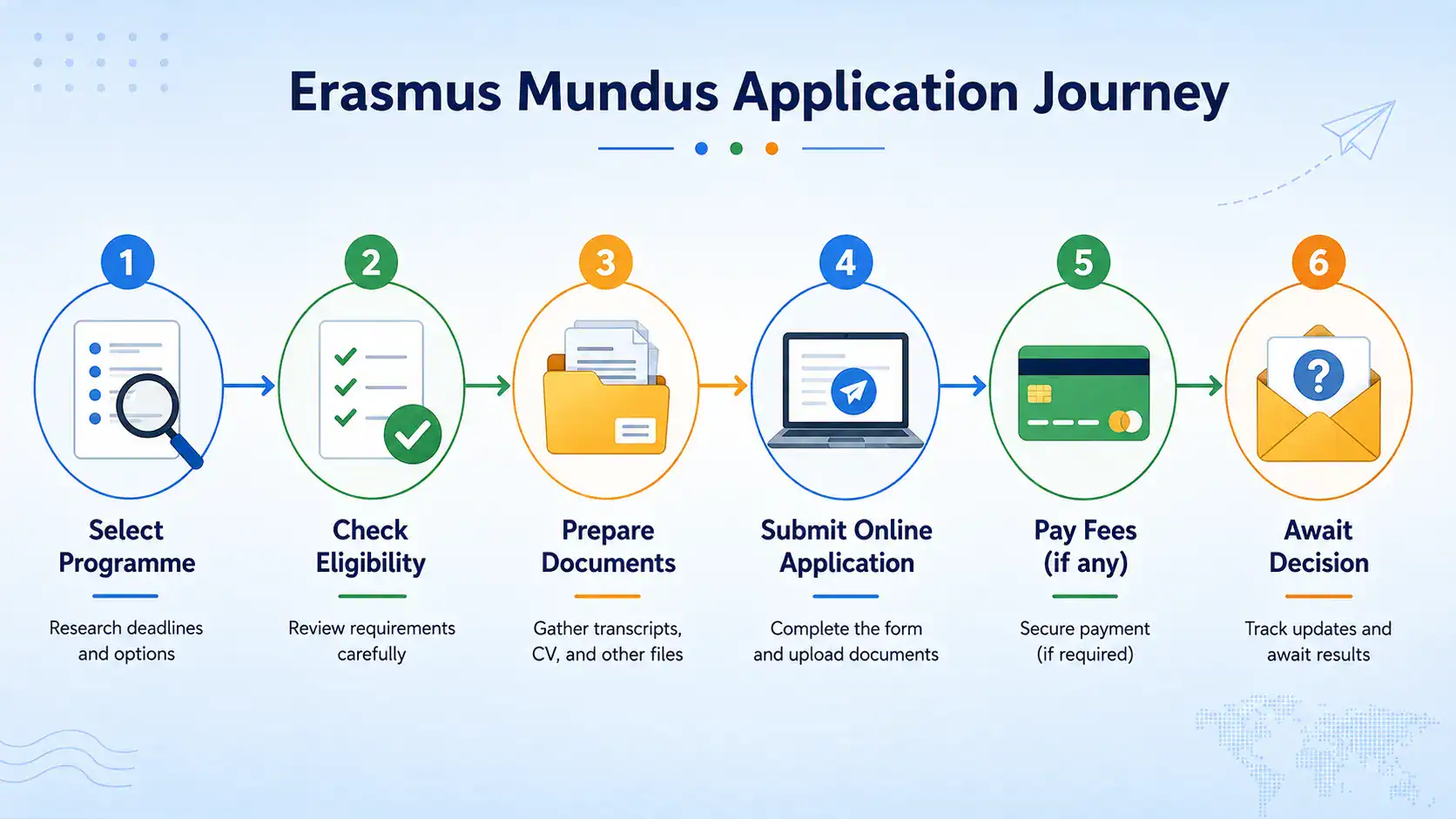
Figure: Erasmus Mundus Joint Master’s Degree application process infographic illustrating the complete application journey, from selecting a suitable programme and preparing the online application to submitting supporting documents, reviewing the application, meeting the deadline, and monitoring admission updates from the programme consortium.
Important Reminder
Application procedures differ between Erasmus Mundus Joint Master’s Degree programmes. Always follow the instructions provided by the official consortium managing your chosen programme and submit your application before the published deadline.
What Happens After You Submit Your Erasmus Mundus Application?
Submitting your Erasmus Mundus Joint Master’s Degree (EMJM) application is an important milestone, but it is not the end of the admission process. After the application deadline passes, each programme consortium begins reviewing applications according to its published selection criteria.
Although timelines differ between programmes, applicants generally progress through several stages before receiving a final admission or scholarship decision. Understanding what happens next can help you stay prepared and respond promptly if additional information is requested.
Quick Answer
After submitting your Erasmus Mundus application, the consortium reviews your eligibility, evaluates your academic qualifications and supporting documents, ranks applicants, selects scholarship recipients where applicable, and notifies candidates of the admission decision. Successful applicants then complete enrolment, visa, and pre-departure requirements before beginning their studies.
1. Application Completeness Check
The admissions team first verifies that your application has been submitted correctly and includes all required documents. Applications that are incomplete or submitted after the deadline may not proceed to the next stage.
2. Eligibility Verification
Programme coordinators confirm that applicants satisfy the published eligibility requirements, including academic qualifications, degree equivalency, language requirements (where applicable), and any programme-specific conditions.
3. Academic Evaluation
Eligible applications are reviewed by academic experts. Selection committees assess factors such as academic performance, motivation, relevant experience, recommendation letters, research potential (where applicable), and the overall strength of the application.
4. Scholarship Selection
For programmes offering Erasmus Mundus scholarships, eligible applicants are ranked according to the consortium’s selection criteria. Because funding is limited, receiving admission does not always guarantee that a scholarship will be awarded.
5. Admission Decision
Applicants are informed of the outcome through the official application portal or by email. Depending on the programme, you may receive an admission offer, be placed on a reserve list, or be informed that your application was unsuccessful.
6. Accepting Your Offer
If you receive an offer of admission, carefully read all instructions and respond before the stated deadline. Some programmes require applicants to formally accept their place before enrolment can begin.
7. Preparing for Enrolment
Successful applicants typically complete several additional steps before travelling to Europe. These may include submitting final academic documents, applying for a student visa, arranging accommodation, purchasing travel insurance where required, and participating in pre-arrival orientation activities.
What You Should Do While Waiting
- ✅ Check your email regularly for updates from the programme consortium.
- ✅ Monitor your applicant portal if one is provided.
- ✅ Keep copies of all submitted documents.
- ✅ Prepare for possible visa requirements.
- ✅ Continue researching accommodation and living costs.
- ✅ Avoid making non-refundable travel bookings until your admission and visa are confirmed.
LearnViaHub Tip
If you are placed on a reserve or waiting list, remain patient and continue monitoring your email. Some applicants receive admission or scholarship offers later if selected candidates decline their places.
Important Reminder
Admission timelines, scholarship decisions, enrolment procedures, and visa requirements vary between Erasmus Mundus Joint Master’s Degree programmes. Always follow the official instructions provided by your programme consortium and respond promptly to any requests for additional information.
Erasmus Mundus Scholarship Selection Criteria vs Admission Requirements
One of the biggest misconceptions among Erasmus Mundus applicants is assuming that meeting the admission requirements automatically makes them competitive for an Erasmus Mundus scholarship. In reality, admission eligibility and scholarship selection are related but distinct processes.
Admission requirements determine whether you are eligible to apply for a programme. Scholarship selection, however, is a competitive evaluation used to identify the strongest applicants from the eligible pool. Understanding this difference can help you prepare a stronger application and set realistic expectations.
Quick Answer
Admission requirements determine whether you qualify to apply for an Erasmus Mundus Joint Master’s Degree programme. Scholarship selection criteria are used after eligibility has been confirmed to rank applicants and identify those who will receive Erasmus Mundus funding.
Admission Requirements vs Scholarship Selection
| Admission Requirements | Scholarship Selection Criteria |
|---|---|
| Confirm whether you are eligible to apply. | Determine which eligible applicants receive Erasmus Mundus scholarships. |
| Focus on minimum academic and language requirements. | Evaluate the overall quality and competitiveness of your application. |
| Usually objective and published on the programme website. | May include holistic assessment by the selection committee. |
| Meeting the requirements allows your application to be considered. | Meeting the requirements does not guarantee funding. |
| Applies to every applicant. | Used to rank eligible applicants when scholarships are limited. |
What Do Selection Committees Usually Evaluate?
Although each Erasmus Mundus consortium uses its own assessment process, scholarship committees commonly evaluate the complete application rather than focusing on one document alone.
- Academic performance and subject knowledge.
- The quality of the motivation letter.
- Relevant work or research experience.
- Leadership, initiative, and extracurricular involvement.
- Recommendation letters.
- How well your background matches the programme.
- Your future academic and career objectives.
- The overall consistency of your application.
Why Two Applicants With Similar Grades May Receive Different Outcomes
Academic performance is important, but it is rarely the only factor considered. Two applicants with similar grades may receive different decisions because one demonstrates stronger motivation, more relevant experience, better recommendation letters, or a clearer connection between their background and the programme.
Selection committees typically assess the application as a whole, looking for evidence that the applicant is well prepared to succeed in the programme and make meaningful contributions during and after graduation.
How to Become a More Competitive Scholarship Applicant
After confirming that you meet the admission requirements, focus on strengthening the areas that scholarship committees often consider when comparing eligible candidates.
- Prepare a personalised motivation letter for each programme.
- Highlight relevant academic, research, and professional achievements.
- Request recommendation letters from referees who know your work well.
- Explain how the programme aligns with your long-term career goals.
- Demonstrate leadership, initiative, and international engagement where applicable.
- Submit a complete and carefully reviewed application before the deadline.
Important Reminder
Meeting the published admission requirements does not guarantee admission or an Erasmus Mundus scholarship. Scholarship decisions are competitive and depend on the overall quality of the applicant pool and the selection criteria established by each programme consortium.
LearnViaHub Insight
Many applicants spend most of their time trying to satisfy the minimum requirements. However, successful scholarship applicants usually go further by submitting compelling motivation letters, strong recommendation letters, relevant achievements, and a well-structured application that clearly demonstrates why they are an excellent fit for the programme.
Country-Specific Erasmus Mundus Joint Master’s Degree Requirements
Although Erasmus Mundus Joint Master’s Degree (EMJM) programmes operate under the Erasmus+ framework, there is no single set of admission requirements that applies to every programme. Each programme consortium establishes its own eligibility criteria, required documents, language policies, and application procedures based on its academic objectives and participating universities.
As a result, applicants should never assume that requirements for one Erasmus Mundus programme are identical to those of another. Even programmes within the same academic field may have different admission standards, document requirements, and scholarship selection processes.
Quick Answer
Erasmus Mundus Joint Master’s Degree requirements vary by programme because each consortium of partner universities sets its own admission criteria. Differences may include academic qualifications, English language requirements, required documents, application deadlines, and scholarship selection procedures. Always verify the latest information on the official programme website before applying.
Why Requirements Differ Between Erasmus Mundus Programmes
Every Erasmus Mundus Joint Master’s Degree is designed and delivered by a consortium of higher education institutions from different countries. Because each consortium manages its own admissions process, the eligibility requirements are tailored to the academic goals of that specific programme.
For example, an engineering programme may require applicants to have completed specific mathematics or technical courses, while a public health or social sciences programme may place greater emphasis on relevant academic background, professional experience, or research interests.
The Role of Partner Universities
One of the defining features of Erasmus Mundus is that students study at multiple partner universities during the programme. These universities work together to develop the curriculum, manage admissions, award degrees, and oversee scholarship selection.
Since every consortium is different, admission policies may also differ. One programme may require two recommendation letters, while another requests three. Some programmes may accept alternative English language evidence, whereas others require specific language tests and minimum scores.
Programme-Specific Admission Rules
Before applying, carefully review the admission guidance published by your chosen programme. Pay particular attention to information such as:
- Accepted academic qualifications.
- Required bachelor’s degree discipline.
- Minimum academic performance or grade expectations.
- English language requirements.
- Required application documents.
- Application deadlines.
- Scholarship eligibility requirements.
- Additional requirements such as portfolios or research proposals.
Ignoring programme-specific instructions can result in an incomplete or ineligible application, even if you satisfy the general Erasmus Mundus eligibility requirements.
Examples of Requirements That May Vary
| Requirement | May Vary Between Programmes |
|---|---|
| Bachelor’s Degree Subject | Some programmes accept applicants from multiple disciplines, while others require a specific academic background. |
| English Language Requirement | Accepted tests, minimum scores, and waiver policies differ by consortium. |
| Recommendation Letters | The required number and type of referees may vary. |
| Motivation Letter | Some programmes provide specific questions or word limits. |
| Supporting Documents | Certain programmes require portfolios, research proposals, or additional certifications. |
| Application Deadline | Opening and closing dates vary between programmes and admission cycles. |
Why the Official Programme Website Matters
The official website of each Erasmus Mundus Joint Master’s Degree programme is the most reliable source of application information. It contains the latest eligibility requirements, application instructions, scholarship details, deadlines, required documents, and contact information for the admissions team.
Avoid relying solely on blogs, forums, or social media posts, as admission requirements may change from one application cycle to another.
Before Applying to Any Programme
- ✅ Read the official programme webpage from beginning to end.
- ✅ Download the latest application guide if available.
- ✅ Verify the application deadline.
- ✅ Confirm the required supporting documents.
- ✅ Check the accepted English language qualifications.
- ✅ Review scholarship eligibility requirements.
- ✅ Contact the programme coordinator if any requirement is unclear.
LearnViaHub Recommendation
Create a separate checklist for every Erasmus Mundus programme you intend to apply for. Comparing admission requirements side by side helps you identify differences in eligibility, required documents, language policies, and deadlines, reducing the risk of missing important programme-specific requirements.
Important Reminder
There is no universal admission checklist that applies to every Erasmus Mundus Joint Master’s Degree programme. Always follow the official guidance published by your chosen programme consortium, as it takes precedence over general application advice.
Erasmus Mundus Joint Master’s Degree Application Timeline
Preparing a successful Erasmus Mundus Joint Master’s Degree (EMJM) application takes several months. Rather than waiting for the application portal to open, competitive applicants usually begin researching programmes, preparing documents, and requesting recommendation letters well in advance.
Although each programme consortium publishes its own application schedule, the overall timeline follows a similar pattern—from preparation and application submission to evaluation, admission decisions, visa processing, and travelling to Europe. Understanding these stages can help you stay organised and avoid last-minute mistakes.
Quick Answer
The Erasmus Mundus application timeline generally includes programme research, document preparation, online application submission, application evaluation, admission and scholarship decisions, visa processing, and travel preparations before the start of the academic year. Exact dates vary between programmes and should always be confirmed on the official programme website.
Stage 1. Preparation
Preparation is the most important stage of the application process. Applicants should begin researching suitable Erasmus Mundus programmes, reviewing eligibility requirements, preparing academic documents, improving their motivation letter, and contacting potential referees several months before applications open.
- Research eligible programmes.
- Review admission requirements.
- Prepare academic transcripts and certificates.
- Draft your motivation letter.
- Contact referees early.
- Take an English language test if required.
Stage 2. Application Submission
Once the application portal opens, applicants complete the online application form, upload all required supporting documents, and submit their application before the published deadline.
Submitting early allows time to resolve technical issues and reduces the risk of missing the deadline.
Stage 3. Evaluation
After the application deadline, programme coordinators verify eligibility before academic reviewers assess each application. The evaluation process may consider academic performance, motivation, recommendation letters, relevant experience, and overall programme fit.
Some programmes may also create reserve lists if the number of qualified applicants exceeds the available places or scholarships.
Stage 4. Admission and Scholarship Results
Applicants are informed of the admission outcome through the programme’s official portal or by email. Depending on the programme, applicants may receive an admission offer, a scholarship offer, placement on a reserve list, or an unsuccessful application notification.
Applicants should carefully review any instructions included with their admission offer and respond before the specified deadline.
Stage 5. Acceptance and Enrolment
Successful applicants normally confirm their acceptance, submit any outstanding documents, and complete the enrolment procedures required by the consortium and partner universities.
Failure to complete these steps within the required timeframe could result in the offer being withdrawn.
Stage 6. Student Visa Preparation
International students who require a visa should begin the visa application process as soon as they receive the necessary admission documents from their programme.
Visa processing times vary by country, so applicants should consult the embassy or consulate responsible for their destination country well in advance.
Stage 7. Travel and Arrival
Before travelling to Europe, students should arrange accommodation, purchase travel insurance if required, prepare essential documents, and attend any pre-arrival or orientation sessions organised by the programme consortium.
Most Erasmus Mundus programmes provide information about arrival dates, orientation activities, and the first semester schedule before classes begin.
Typical Application Journey
| Stage | What Happens |
|---|---|
| Preparation | Research programmes, confirm eligibility, prepare documents. |
| Application | Complete and submit the online application. |
| Evaluation | Applications are reviewed by the consortium. |
| Results | Admission and scholarship decisions are released. |
| Admission | Accept your offer and complete enrolment. |
| Visa | Apply for a student visa if required. |
| Travel | Prepare for departure and begin your studies in Europe. |

Figure: Erasmus Mundus Joint Master’s Degree application timeline illustrating the typical journey from programme research and document preparation through online application, evaluation, scholarship decisions, admission, visa processing, and travelling to Europe. Application dates and procedures vary by programme consortium, so applicants should always verify the latest schedule on the official programme website.
Planning Tip
Create your own application calendar with personal deadlines for requesting recommendation letters, completing language tests, writing your motivation letter, gathering documents, and reviewing your application. Finishing each task early reduces stress and gives you time to correct any issues before the official deadline.
Important Reminder
Application opening dates, deadlines, scholarship announcements, enrolment procedures, and visa requirements differ between Erasmus Mundus Joint Master’s Degree programmes. Always rely on the official programme website for the latest schedule and instructions.
Common Erasmus Mundus Joint Master’s Degree Application Mistakes (and How to Avoid Them)
Every year, thousands of highly qualified applicants apply for Erasmus Mundus Joint Master’s Degree (EMJM) programmes. While competition is strong, many unsuccessful applications are affected by avoidable mistakes rather than a lack of academic ability.
Understanding these common errors can help you submit a stronger, more complete application and improve your chances of both admission and scholarship selection.
Remember
Meeting the minimum admission requirements does not guarantee admission or an Erasmus Mundus scholarship. Selection committees evaluate the overall quality of your application, including your academic background, motivation, recommendation letters, supporting documents, and programme fit.
1. Applying for the Wrong Programme
Some applicants choose programmes based solely on the scholarship rather than their academic background or career goals.
Selection committees expect applicants to demonstrate a genuine connection between their previous studies, professional experience, and the master’s programme they are applying for. Applying for an unrelated programme without a convincing explanation can weaken your application.
2. Writing a Generic Motivation Letter
The motivation letter is one of the most important parts of your application.
Many applicants submit the same letter to multiple programmes without tailoring it to each consortium. Generic statements that fail to explain why you chose the programme or how it supports your future goals are unlikely to stand out.
Instead, personalise your motivation letter by demonstrating your understanding of the programme and explaining how it aligns with your academic interests and long-term career objectives.
3. Requesting Recommendation Letters Too Late
Strong recommendation letters require time to prepare.
Waiting until a few days before the application deadline may result in rushed references or missed submission deadlines. Contact your referees early and provide them with sufficient information about the programme and application requirements.
4. Submitting Incomplete or Missing Academic Documents
Missing transcripts, degree certificates, certified translations, or other required documents may result in an incomplete application.
Before submitting, carefully review the programme’s document checklist to ensure every required file has been uploaded in the correct format.
5. Ignoring Programme-Specific Requirements
Every Erasmus Mundus consortium sets its own admission requirements.
Some programmes require additional essays, portfolios, research proposals, prerequisite courses, or specific recommendation formats. Failing to follow these programme-specific instructions can reduce your chances of being considered.
6. Taking the Wrong English Language Test
Not every programme accepts the same English language qualifications.
Before booking a language test, confirm which qualifications and minimum scores are accepted by your chosen programme. Taking a test that is not recognised may delay or prevent your application.
7. Submitting a Poorly Prepared CV
Your curriculum vitae should clearly present your academic achievements, work experience, research activities, internships, volunteering, language skills, and relevant accomplishments.
Avoid unnecessary information, formatting inconsistencies, and spelling mistakes. A well-structured CV helps reviewers quickly understand your qualifications.
8. Missing the Application Deadline
One of the most common and avoidable mistakes is waiting until the final day to submit an application.
Technical issues, internet problems, missing documents, or delays from referees can prevent timely submission. Aim to complete your application several days before the official deadline whenever possible.
Quick Self-Assessment Before You Submit
Ask yourself the following questions before submitting your application:
- ✅ Have I selected a programme that matches my academic background?
- ✅ Is my motivation letter tailored to this specific programme?
- ✅ Have my referees submitted or prepared their recommendation letters?
- ✅ Have I uploaded every required document?
- ✅ Have I reviewed the programme-specific admission requirements?
- ✅ Does my English language qualification meet the programme’s requirements?
- ✅ Is my CV up to date and professionally formatted?
- ✅ Am I submitting well before the official deadline?
LearnViaHub Tip
Many successful Erasmus Mundus applicants begin preparing their applications several months before the deadline. Creating a personal application schedule, gathering documents early, and reviewing every section carefully can significantly improve the quality of your submission while reducing unnecessary stress.
Important Reminder
Before clicking “Submit,” review your entire application one final time. Check that every document is uploaded correctly, every question has been answered completely, and all information matches your supporting documents. A careful final review can prevent small errors that might otherwise affect your application.
FAQs About Erasmus Mundus Joint Master’s Degree Programme Requirements
1. What GPA is required for Erasmus Mundus?
There is no universal GPA requirement for all Erasmus Mundus programmes. Each consortium establishes its own academic standards. While many successful applicants have strong academic records, selection committees also evaluate your motivation letter, recommendation letters, relevant experience, and overall suitability for the programme.
2. Can I apply without IELTS?
Possibly. Some Erasmus Mundus programmes accept alternatives such as TOEFL, PTE Academic, Cambridge English qualifications, or official English proficiency certificates issued by your university. Others may grant language waivers under specific conditions. Always check the accepted language qualifications listed by your chosen programme.
3. Can I apply before graduating from my bachelor’s degree?
Yes. Many programmes allow final-year undergraduate students to apply, provided they complete their degree before enrolment and submit proof of graduation within the required timeframe. Admission policies differ by programme.
4. Can HND holders apply?
It depends on the programme and whether your qualification is considered equivalent to the required bachelor’s degree. Some programmes may accept applicants with an HND combined with additional qualifications or professional experience, while others require a recognised bachelor’s degree. Always consult the official admissions guidance.
5. Can I apply with work experience only?
No. Relevant work experience may strengthen your application, but it does not replace the requirement for a recognised bachelor’s degree or equivalent qualification where one is required.
6. How competitive is Erasmus Mundus?
Erasmus Mundus Joint Master’s Degree programmes are highly competitive because they attract applicants from around the world. Admission and scholarship decisions are based on academic performance, motivation, recommendation letters, programme fit, and other selection criteria established by each consortium.
7. Can I apply to more than one Erasmus Mundus programme?
Yes. Applicants are generally permitted to apply to multiple Erasmus Mundus programmes, provided they submit separate applications and meet the admission requirements for each programme.
8. How many recommendation letters are usually required?
Most programmes request two recommendation letters, although the exact number and format vary by consortium. Your referees should be able to provide detailed information about your academic or professional abilities.
9. Can I apply every year?
Yes. If you are not admitted during one application cycle, you may apply again in a future cycle, provided you continue to meet the programme’s eligibility requirements and submit a new application.
10. Who funds Erasmus Mundus scholarships?
Erasmus Mundus scholarships are funded through the Erasmus+ programme of the European Union. Funding arrangements may vary depending on the programme and the specific scholarship scheme available during each application cycle.
11. Is Erasmus Mundus fully funded?
Many Erasmus Mundus scholarships are fully funded and may cover tuition fees, travel costs, installation support, and living expenses. However, scholarship availability and funding packages differ between programmes and admission cycles.
12. Do I need work experience to apply?
Not necessarily. Some programmes welcome recent graduates, while others prefer applicants with relevant professional or research experience. Check the admission requirements of your chosen programme.
13. Can I apply if my degree is from a non-European university?
Yes. Erasmus Mundus programmes accept applicants from universities worldwide, provided their qualifications satisfy the programme’s admission requirements and are recognised as equivalent to the required academic level.
14. Are there age limits for Erasmus Mundus applicants?
Generally, no. Most Erasmus Mundus programmes do not impose an upper age limit. Applicants are assessed based on their qualifications and the programme’s admission criteria rather than their age.
15. Can I submit documents after the application deadline?
In most cases, no. Required documents must usually be submitted before the published deadline. Some programmes may request additional documents later in the admissions process, but applicants should not rely on this possibility.
16. What happens if my English test results are not available before the deadline?
This depends on the programme. Some may allow applicants to submit results later, while others require all language qualifications before the application deadline. Always follow the official programme instructions.
17. Can I change my chosen programme after submitting my application?
Policies vary between programmes. Some application portals allow limited changes before the deadline, while others do not permit changes once an application has been submitted.
18. How long does the application review process take?
Review timelines differ between programmes. After the application deadline, eligible applications are evaluated by the consortium before admission and scholarship decisions are announced according to the published schedule.
19. Where can I find the official Erasmus Mundus programme requirements?
The most reliable source is the official webpage of your chosen Erasmus Mundus Joint Master’s Degree programme. It contains the latest information on eligibility, required documents, deadlines, scholarships, language requirements, and application procedures.
20. Does meeting the minimum requirements guarantee admission or a scholarship?
No. Meeting the published admission requirements allows your application to be considered, but admission and scholarship awards remain competitive. Selection committees evaluate the complete application and rank candidates according to the programme’s published selection criteria.
Quick Recap
Before applying to an Erasmus Mundus Joint Master’s Degree programme, remember to:
- ✅ Confirm you meet the academic requirements.
- ✅ Verify the accepted English language qualifications.
- ✅ Prepare every required supporting document.
- ✅ Read the official programme webpage carefully.
- ✅ Submit your application before the deadline.
- ✅ Understand that meeting the minimum requirements does not guarantee admission or scholarship funding.
LearnViaHub Advice
If you’re planning to apply to multiple Erasmus Mundus programmes, create a comparison spreadsheet listing each programme’s eligibility requirements, required documents, language policies, deadlines, and scholarship information. This simple step can help you stay organized and avoid missing important programme-specific requirements.
Official Erasmus Mundus Resources & Your Next Steps
You should now have a clear understanding of the main Erasmus Mundus Joint Master’s Degree programme requirements, including eligibility criteria, academic qualifications, English language requirements, required documents, scholarship selection criteria, application timelines, and common mistakes to avoid.
Your next step is to identify the Erasmus Mundus programmes that best match your academic background and career goals. Before preparing your application, carefully review the latest admission guidance published by each programme consortium, as requirements, deadlines, and scholarship policies may change from one application cycle to another.
Official Resources to Use
For the most accurate and up-to-date information, rely on these official resources throughout your application journey:
- ✓ Erasmus Mundus Catalogue
- Search available Erasmus Mundus Joint Master’s Degree programmes.
- Compare participating universities.
- Access official programme websites.
- Review current admission requirements.
- Check scholarship information.
- ✓ European Commission – Erasmus+The European Commission manages the Erasmus+ programme and publishes official information about Erasmus Mundus scholarships, programme policies, funding opportunities, and higher education initiatives across Europe.
- ✓ Official Programme Websites
- Review programme-specific eligibility requirements.
- Confirm required documents.
- Check accepted English language qualifications.
- Verify application deadlines.
- Read detailed admission instructions.
- Contact programme coordinators if clarification is needed.
- ✓ Partner University Websites Partner universities may publish additional information about course structures, mobility pathways, accommodation, student services, and enrolment procedures that can help you prepare before arriving in Europe.
Continue Your Scholarship Journey with LearnViaHub
If you found this Erasmus Mundus guide helpful, explore these additional LearnViaHub resources to discover more international scholarships and improve your scholarship application strategy.
Related Scholarship Guides
- Scholarship Opportunities: 100+ Fully Funded Scholarships for International Students
Explore one of LearnViaHub’s largest scholarship collections, featuring government-funded, university-funded, and private scholarships across multiple countries and study levels. - Fully Funded Scholarships for International Students
Compare scholarships that cover tuition fees, living expenses, travel costs, health insurance, and other study-related expenses around the world. - How to Apply for the Chevening Scholarship
Read our comprehensive guide covering eligibility requirements, application timelines, required documents, scholarship essays, interviews, and selection tips for one of the UK’s most prestigious scholarship programmes. - How to Apply for the Fulbright Scholarship
Explore our complete Fulbright application guide, including eligibility requirements, required documents, scholarship benefits, interviews, and application strategies.
Editorial Disclaimer
This guide is published by LearnViaHub for educational and informational purposes only.
Although every effort has been made to ensure the information is accurate at the time of publication, Erasmus Mundus programme requirements, eligibility criteria, scholarship funding, participating universities, application deadlines, and admission procedures may change without notice.
Always verify the latest information through the official Erasmus Mundus Joint Master’s Degree programme website, the Erasmus Mundus Catalogue, the European Commission, and other official programme sources before making application decisions.
LearnViaHub is not affiliated with, endorsed by, or officially connected to the European Commission, the Erasmus+ Programme, any Erasmus Mundus Joint Master’s Degree consortium, or any participating university mentioned in this guide.