
Quick Answer
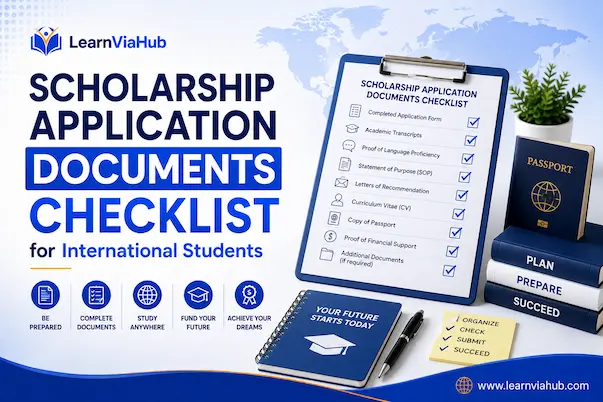
Fully funded international scholarships require documents most domestic scholarship checklists never mention — certified translations, apostille degree certificates, English test scores, and country-specific visa-related paperwork. This checklist covers what you actually need for programmes like Fulbright, Chevening, Erasmus Mundus, and DAAD, organized by how far in advance you should start each one.
Core Documents Every Application Needs
| Document | Notes |
|---|---|
| Valid passport | Must remain valid through the entire programme duration, not just the application date. Renew early if it’s close to expiry. |
| Official academic transcripts | From every post-secondary institution attended, showing grades and degree conferral — not just your most recent degree. |
| Degree certificate(s) | Separate from your transcript. Final-year students typically submit a proof-of-enrollment or expected-graduation letter instead, with the actual certificate to follow. |
| Curriculum Vitae (CV) | European and EU-funded programmes commonly request the Europass format specifically — check before submitting a standard resume. |
| Personal statement / Statement of Purpose | Typically 500–1,000 words, but word counts vary by programme. Must be written fresh for each application — see our essay guide. |
| Letters of Recommendation (2–3) | Request these well in advance — see the timeline below. A mix of academic and professional referees is standard. |
| Research proposal (if required) | Common for PhD, research-track, and some science/law programmes. Follow the exact template your programme provides. |
Language & Test Documents
This is where international applications diverge most sharply from domestic ones:
| Document | Notes |
|---|---|
| IELTS / TOEFL / PTE score report | Score validity is typically two years — check that yours won’t expire before your programme start date, not just before the application deadline. |
| Medium of Instruction (MOI) certificate | If your prior degree was taught entirely in English, some programmes will waive the standardized test in favor of a signed MOI letter from your university — this can save you significant time and cost if your programme accepts it. |
| GRE / GMAT scores (if required) | Not universal — mainly requested by some business, economics, and quantitative programmes. Confirm before assuming you need one. |
| Portfolio (creative fields) | Relevant for journalism, film, design, and architecture programmes specifically. |
Translation & Certification Requirements
This step trips up more international applicants than any single document on the list above — mostly because it takes far longer than expected.
- Certified translations: any document not originally in English needs a certified translation, not just a personal or informal one. Certification requirements (sworn translator, notarized, or institution-issued) vary by destination country — check the specific requirement rather than assuming any translation will do.
- Apostille or legalization: some countries require an apostille stamp (under the Hague Convention) or embassy legalization on official documents like degree certificates. This is a separate process from translation and can take several weeks depending on your country’s issuing authority.
- Notarized copies: some programmes want notarized copies of originals rather than the originals themselves — confirm which is expected before you have documents notarized unnecessarily.
Preparation Timeline
| Timing Before Deadline | What to Start |
|---|---|
| 3+ months | English test booking (if needed), apostille/legalization requests, passport renewal if close to expiry |
| 2 months | Request letters of recommendation, order official transcripts, begin certified translations |
| 1 month | Draft and revise personal statement/SOP, finalize CV, confirm all document formats match programme requirements |
| 1–2 weeks | Final proofread, confirm recommenders have submitted, upload and review the complete application before the deadline |
Frequently Asked Questions
Do all international scholarships require certified translations? ▼
What’s the difference between an apostille and a certified translation? ▼
Can I use the same recommendation letters for multiple scholarships? ▼
How long does an English test exemption (MOI certificate) take to get? ▼
Next steps in your scholarship strategy:
Christian Chinonso is the founder of LearnViaHub, with 6+ years of research experience in international education, GPA systems, and study-abroad guidance for international students.Christian Chinonso is the founder of LearnViaHub, with 6+ years of research experience in international education — including GPA systems, scholarships, student financing, and study-abroad guidance — for students worldwide.