
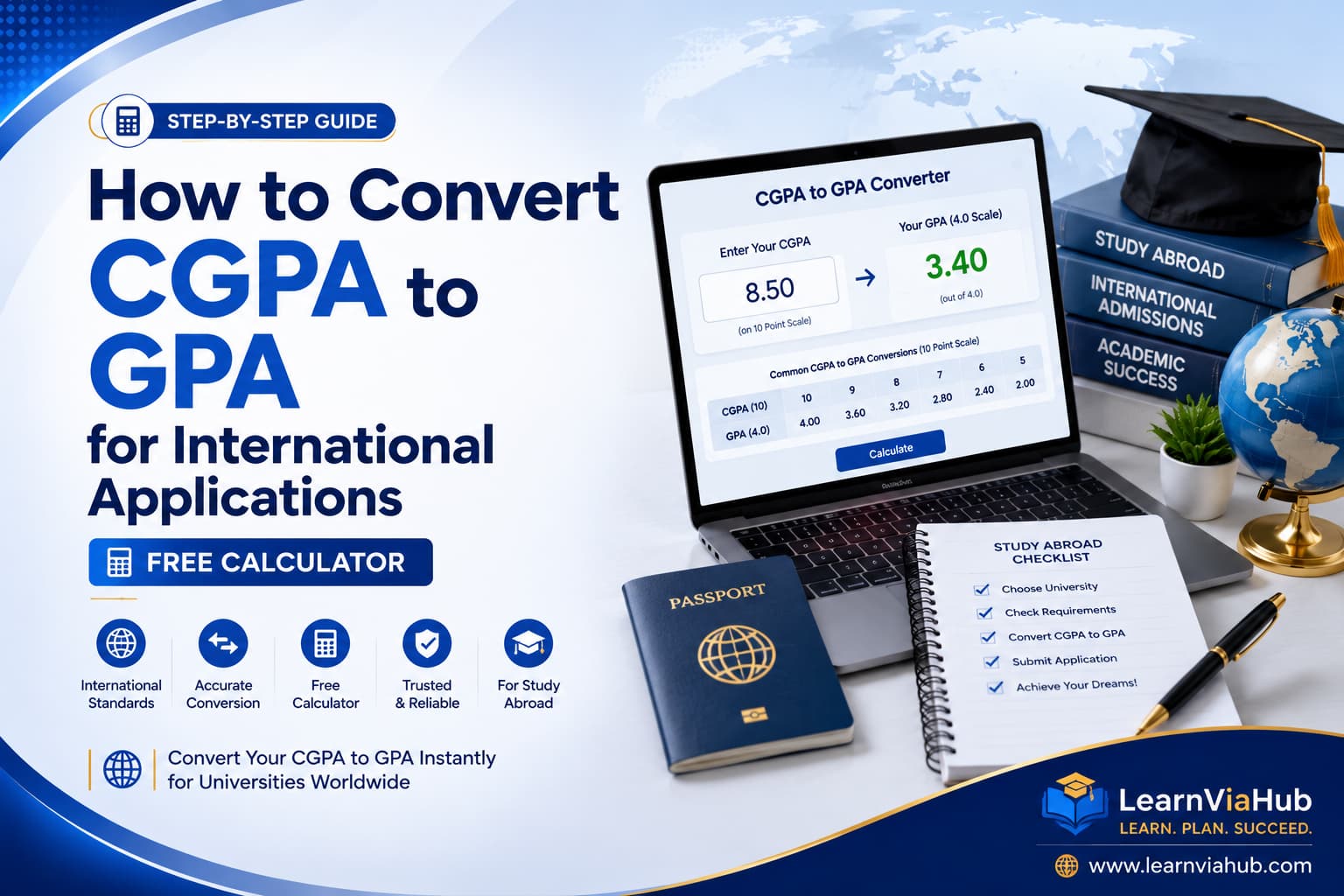
Short answer: divide your CGPA by the top of your grading scale, then multiply by 4. An 8.2 on a 10-point scale is 8.2 ÷ 10 × 4 = 3.28.
That is a straight-line estimate. A credential evaluator such as WES converts your grades course by course, and a university may apply its own rules, so the number on an official report can differ from this one.
CGPA to GPA calculator
Enter your CGPA and the maximum of your scale (10, 5 or 7 for most readers) to get the 4.0 equivalent.
🌍 CGPA to GPA Converter for International Applications
Convert your CGPA on any common scale to an estimated US 4.0 GPA. Includes linear conversion and WES‑style estimates where available.
📋 Linear conversion provides a rough estimate. WES and ECE use course‑by‑course evaluation for official reports.
Need the reverse? Use our percentage to GPA converter.
The calculator applies the straight-line formula below. If it does not load on your device, the formula and tables on this page give the same result.
The formula and worked examples
A CGPA is the cumulative average of your semester results on your home scale (commonly 10-point in India, 5-point in Nigeria, 7-point in Australia). The US GPA is almost always reported on a 4.0 scale. To compare them, rescale the CGPA:
US GPA = (CGPA ÷ maximum of your scale) × 4
Three worked examples
- 10-point scale, CGPA 8.2: 8.2 ÷ 10 = 0.82, and 0.82 × 4 = 3.28.
- 5-point scale, CGPA 4.2: 4.2 ÷ 5 = 0.84, and 0.84 × 4 = 3.36.
- 7-point scale, CGPA 5.5: 5.5 ÷ 7 = 0.7857, and 0.7857 × 4 = 3.14 (rounded to two decimals).
Keep the maximum of your scale in the formula. Some institutions on a 10-point scale cap at 10, others grade out of 4 or 5, so check the grading key printed on your transcript before dividing.
Lookup tables for 10-, 5- and 7-point scales
These tables apply the formula above and round to two decimals. They are arithmetic conversions, not official equivalencies published by any university or evaluator.
10-point scale (for example, India)
| CGPA (out of 10) | Straight-line GPA (out of 4.0) |
|---|---|
| 6.0 | 2.40 |
| 6.5 | 2.60 |
| 7.0 | 2.80 |
| 7.5 | 3.00 |
| 8.0 | 3.20 |
| 8.2 | 3.28 |
| 8.4 | 3.36 |
| 8.5 | 3.40 |
| 9.0 | 3.60 |
| 9.5 | 3.80 |
| 10.0 | 4.00 |
5-point scale (for example, Nigeria)
| CGPA (out of 5.0) | Straight-line GPA (out of 4.0) |
|---|---|
| 2.0 | 1.60 |
| 2.5 | 2.00 |
| 3.0 | 2.40 |
| 3.5 | 2.80 |
| 4.0 | 3.20 |
| 4.5 | 3.60 |
| 5.0 | 4.00 |
7-point scale (for example, Australia)
| CGPA (out of 7.0) | Straight-line GPA (out of 4.0) |
|---|---|
| 4.0 | 2.29 |
| 4.5 | 2.57 |
| 5.0 | 2.86 |
| 5.5 | 3.14 |
| 6.0 | 3.43 |
| 6.5 | 3.71 |
| 7.0 | 4.00 |
Why an official evaluation can differ
The straight-line formula uses one number, your overall CGPA. A WES course-by-course evaluation works from the individual courses and grades on your transcript and reports a US GPA equivalent on the 4.0 scale. WES states that the result depends on factors such as the grading culture and practices of the country where you studied.
WES also states that the quality or rank of your institution does not factor into the GPA on its evaluation. A well-known university does not, by itself, raise the converted figure.
WES offers a free iGPA calculator that estimates a GPA on a 4.0 scale. According to WES support, the calculator is for informational purposes only and is not available for all countries. If you need an official calculated GPA, WES points applicants to its Course-by-Course evaluation. WES reports are recognised by more than 2,500 institutions in the US and Canada, according to WES, but each program decides what it accepts, so confirm on the program’s admissions page before you order a report.
Processing times vary by evaluation type and workload. WES publishes its current average processing times on the page linked above, so check it when you plan your timeline.
Worked example: credit-weighted GPA
Once each course has a US grade and a credit value, the GPA is a credit-weighted average: GPA = Σ(grade points × credits) ÷ Σ(credits). The example below uses four hypothetical courses to show the arithmetic.
| Course | Credits | Grade points | Credits × points |
|---|---|---|---|
| Mathematics | 4 | 3.7 | 14.8 |
| Physics | 3 | 3.3 | 9.9 |
| Chemistry | 3 | 4.0 | 12.0 |
| English | 2 | 3.0 | 6.0 |
| Total | 12 | 42.7 |
42.7 ÷ 12 = 3.56. Deciding which US grade each of your home grades earns is the evaluator’s or the university’s call, which is why the same CGPA can map to different GPAs in different hands.
GPA to CGPA (reverse conversion)
To express a US GPA on a 10-, 5- or 7-point scale, reverse the formula: CGPA = (GPA ÷ 4) × maximum of the target scale. A 3.4 GPA on a 10-point scale is 3.4 ÷ 4 × 10 = 8.5. On a 5-point scale it is 3.4 ÷ 4 × 5 = 4.25. Treat this as a rough comparison only, because institutions set their own grade bands.
Email to request your grading details
Many applications need a transcript that shows the grading scale and how your CGPA was calculated. You can copy and adapt this message to your registrar or examinations office.
Subject: Request for official transcript and grading scale details

Dear Registrar,

I am applying to universities abroad and need the following for my records:

1. An official transcript showing all courses, credits and grades.
2. The official grading scale used by the university, including the maximum CGPA and the grade bands.
3. A short note, or a page in the handbook, explaining how the CGPA is calculated (for example, whether it is credit-weighted).
4. Confirmation of the degree classification that matches my final CGPA.

My details:
Full name: [your name]
Student ID: [your ID]
Programme: [your programme]
Year of graduation: [year]

Please let me know the fee and the expected delivery time, and whether the documents can be sent directly to the receiving institution.

Thank you for your help.

Kind regards,
[your name]
[your phone number and email]
Frequently asked questions
How do I convert a 10-point CGPA to a 4.0 GPA?
Divide the CGPA by 10 and multiply by 4. For example, 8.0 ÷ 10 × 4 = 3.20. This is an estimate, and a university or evaluator may report a different figure.
Does WES use this formula?
No. A WES course-by-course evaluation assesses the courses and grades on your transcript and reports US equivalents, rather than rescaling your overall CGPA. See the section on official evaluations above.
Will a top-ranked university give me a higher converted GPA?
Not on a WES evaluation. WES states that the quality or rank of your institution does not factor into the GPA it reports.
Can I put my calculated GPA on an application?
Use the figure the program asks for. Some programs accept your home CGPA with the grading scale, others ask for an official evaluation. The program’s admissions page or admissions office is the source to follow.
How do I convert GPA back to CGPA?
Divide the GPA by 4 and multiply by the maximum of your target scale. A 3.4 GPA is 8.5 on a 10-point scale.
Related guides
- How to Calculate GPA: the step-by-step guide for any scale
- GPA Calculator: semester and cumulative GPA
- Percentage to GPA Converter: if your transcript uses percentages
- GPA Formula: the maths behind credit-weighted averages
How we researched this
We checked WES’s published statements on how its evaluation GPA is determined, on its free iGPA calculator and its availability, on how many institutions recognise WES reports, and on processing times. The formulas, lookup tables and worked examples on this page are our own arithmetic, calculated from the formulas shown, and are not official equivalencies. Sources: WES Advisor Blog on evaluation GPA, WES support on cumulative GPA, and WES on what to expect after your evaluation.
Last Checked: October 13, 2026. Policies and processing times can change, so confirm with WES and your target university before you act.

Christian Chinonso is the founder of LearnViaHub, with 6+ years of research experience in international education — including GPA systems, scholarships, student financing, and study-abroad guidance — for students worldwide.