
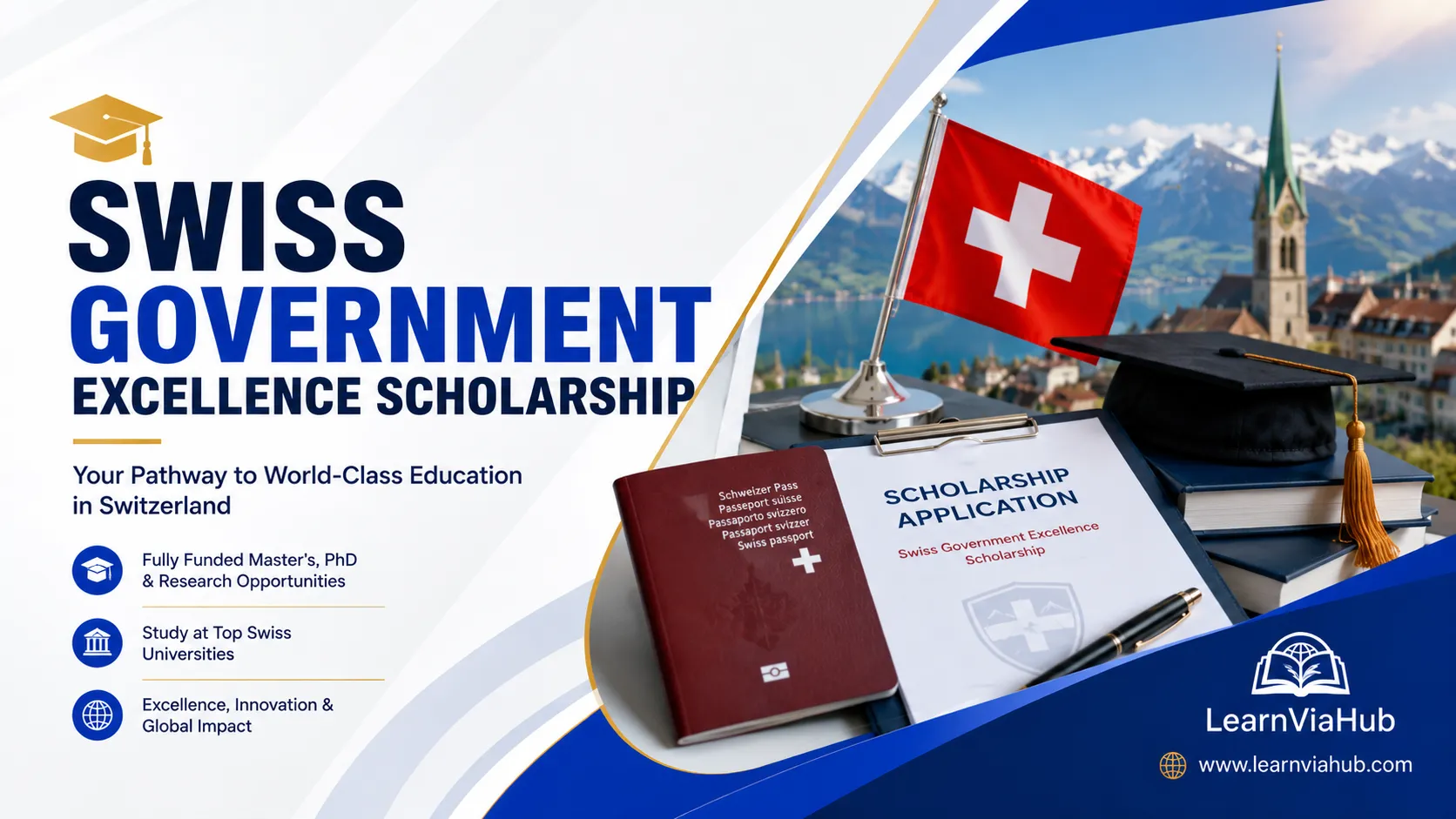
QUICK ANSWER
The Swiss Government Excellence Scholarship is a fully funded research scholarship—traditional MBA programmes are largely not covered. However, research‑oriented management master’s at Swiss public universities can be funded. The scholarship provides a CHF 1,920 monthly stipend, full tuition exemption, health insurance, and a travel allowance. Applications are submitted through the Swiss embassy in your home country.
⚠️ MBA? Read This First
The Swiss Government Excellence Scholarship funds research‑focused master’s, not professional MBAs. Private Swiss business schools (IMD, St. Gallen MBA) are not covered. This guide explains which management master’s at public universities can be funded—and how to write a research proposal that qualifies.
Swiss Government Excellence Scholarship Snapshot
| Host Country | Switzerland |
| Funding Type | Fully Funded (research) |
| Monthly Stipend | CHF 1,920 for master’s students |
| Tuition | Full exemption at public universities |
| Other Benefits | Health insurance, travel allowance, housing allowance (possible), free public transport in many cities |
| MBA Eligibility | Very limited; research master’s in management may qualify |
| Work Experience | None required (research experience preferred) |
| Application Route | Swiss embassy in your home country |
| Typical Deadlines | August – November 2027 (varies by country) |
| Post‑Study Obligation | None formal (job‑seeking visa available after graduation) |
| Official Link | sbfi.admin.ch/scholarships |
🔗 Sources: SERI & Swiss Embassies
LearnViaHub is an independent educational guide, not affiliated with the Swiss Government or SERI. Always verify details on the official website.
What Is the Swiss Government Excellence Scholarship?
The Swiss Government Excellence Scholarship is the flagship fully funded scholarship programme of the Swiss Confederation, managed by the State Secretariat for Education, Research and Innovation (SERI). It is designed for research‑focused master’s, PhD, and postdoctoral studies at Swiss public universities, federal institutes of technology, and universities of applied sciences. The goal is to promote international exchange and research collaboration between Switzerland and partner countries.
This is not a general study scholarship—it’s a research scholarship. That means even at the master’s level, you must submit a research proposal and show how your work connects to Swiss academic expertise. For MBA applicants, this is the single most important fact: traditional, course‑based MBA programmes are largely not covered. However, research‑oriented master’s in management, business, or economics at public Swiss universities can qualify, and this guide shows you exactly how.
Swiss Government Excellence Scholarship Benefits: CHF 1,920 Stipend, Tuition Exemption, and More
The Swiss Government Excellence Scholarship is one of the most generous in Europe. It covers all major expenses and provides a monthly stipend that is among the highest of any government scholarship. Here is the full package for the 2027‑2028 academic year.
| Benefit | Details |
|---|---|
| Monthly Stipend | CHF 1,920 per month for master’s students. This is roughly $2,100 USD and is designed to cover accommodation, food, health insurance, and daily living costs comfortably. |
| Full Tuition Exemption | 100% tuition fee waiver at Swiss public universities. No tuition cap. |
| Health Insurance | Swiss and international health insurance coverage is provided (part of the stipend can be used for the premium). |
| Travel Allowance | A one‑time lump sum for travel from your home country to Switzerland at the beginning and end of the scholarship. |
| Housing Allowance | In some cantons, a supplementary housing allowance is provided. This varies by location. |
| Free Public Transport | Many Swiss cities offer scholars a free or heavily discounted public transport pass. |
💰 One of the highest stipends in Europe. At CHF 1,920/month, the Swiss Government Excellence Scholarship offers a higher monthly living allowance than DAAD EPOS (€1,200), CSC (3,000 RMB), or even Chevening (which does not publish a fixed amount). Switzerland is expensive, but this stipend covers a comfortable student lifestyle.
Swiss Government Excellence Scholarship Eligibility: Research Focus, Academic Excellence, and Country‑Specific Rules
The eligibility criteria for this scholarship are unique because the programme is fundamentally a research scholarship, not a general academic award. Here’s what you need to qualify for a master’s-level scholarship, including a business/management degree, in the 2027‑2028 cycle.
- Country of origin: You must be a citizen of a country that has a bilateral agreement with Switzerland for this scholarship. The list is maintained by SERI and varies by year; it typically includes many countries in Asia, Africa, Latin America, and Eastern Europe. Some developed nations are not eligible. Check the official SERI country list before applying.
- Academic excellence: You must hold a bachelor’s degree (or equivalent) with a very strong academic record—typically a first‑class or upper second‑class equivalent. The scholarship is merit‑based and highly competitive.
- Research proposal: You must submit a detailed research proposal (2‑3 pages) that aligns with the expertise of a Swiss university. Even for a management master’s, you cannot simply apply to a programme; you need a specific research topic and a potential supervisor. This is the single most important document in your application.
- Language proficiency: You must meet the language requirements of your chosen programme. Many Swiss master’s in business/management are taught in English, requiring IELTS (6.5+) or TOEFL (90+). Some programmes are in French, German, or Italian, and require corresponding certificates.
- Age: No strict age limit for master’s, but candidates are typically under 35 at the time of application.
- Work experience: None required. However, relevant research experience (e.g., a strong bachelor’s thesis, research assistantship) significantly strengthens your application.
🔬 Remember: This is a research scholarship. The Swiss Federal Commission for Scholarships (FCS) evaluates you primarily on your research proposal. Even if you are applying for a master’s in management, your proposal must demonstrate academic rigor and a clear connection to Swiss research strengths.
Can You Get an MBA with the Swiss Government Excellence Scholarship?
The honest answer: a traditional MBA is largely not eligible. The Swiss Government Excellence Scholarship funds research‑focused master’s programmes at public Swiss universities. Most MBA programmes in Switzerland are offered by private institutions (e.g., IMD, University of St. Gallen MBA) or are professional, course‑based degrees without a required research thesis. These are not covered by the scholarship.
However, if your goal is to study business, management, or economics at a world‑class Swiss university with a strong research component, there are excellent alternatives that can be fully funded. The key is to target research‑oriented master’s programmes (MSc, MA, or equivalent) at Swiss public universities, where your thesis and research proposal fit the scholarship’s requirements. Below are the most promising options.
MBA vs. Research Master’s: What’s Eligible?
| Feature | Traditional MBA | Research Master’s in Management (Eligible) |
|---|---|---|
| Institution Type | Often private | Swiss public university |
| Focus | Professional, course‑based | Academic, research‑based |
| Research Thesis | Not always required | Required (core component) |
| Scholarship Eligibility | No | Yes |
| Career Outcome | Consulting, finance, leadership | Research, policy, consulting, PhD path |
Swiss Public Universities with Eligible Management/Business Master’s
Below are Swiss public universities that offer research‑oriented master’s in business, management, or economics. These programmes may be eligible under the Swiss Government Excellence Scholarship, provided your research proposal fits their expertise and you secure a supervisor.
| University | Programme Name | Language | Research Focus |
|---|---|---|---|
| University of Zurich | MSc in Business and Economics | English / German | Management, finance, innovation |
| University of Geneva | MSc in Management | English / French | Strategy, organisational behaviour, sustainability |
| ETH Zurich | MTEC (Management, Technology, and Economics) | English | Technology management, entrepreneurship, supply chain |
| University of Lausanne (HEC Lausanne) | MSc in Management | English / French | Marketing, strategy, corporate finance |
| University of Bern | MSc in Business Administration | English / German | Accounting, finance, public management |
These programmes are not MBAs, but they provide a rigorous academic foundation in business and management, often with opportunities for industry placements. Crucially, they require a master’s thesis—which satisfies the Swiss Government Excellence Scholarship’s research requirement. If your ultimate goal is an international business career in Europe, a research master’s from a Swiss public university combined with the scholarship’s generous stipend is a powerful alternative.
💡 Expert Tip
Before applying, contact the programme coordinator at your target university. Ask explicitly: “Does your master’s programme qualify for the Swiss Government Excellence Scholarship?” and “Can you help me identify a potential supervisor for my research proposal?” A positive response from the university can significantly strengthen your application.
How to Apply for the Swiss Government Excellence Scholarship – Step‑by‑Step via Swiss Embassy
The Swiss Government Excellence Scholarship uses a decentralized application process. There is no single online portal. Instead, you must submit your application through the Swiss embassy or consulate in your home country. Each embassy sets its own internal deadline, so the timeline varies. Below is the typical process for the 2027‑2028 academic year, assuming your programme starts in September 2028.
- Check your country’s eligibility (March–June 2027): Visit the SERI website and confirm that your country is on the list of eligible nations. Note the contact details of your local Swiss embassy.
- Contact the Swiss embassy (June–August 2027): Send a polite email or call to request the application package and confirm the exact deadline. Most embassies have deadlines between August and November 2027. Do not skip this step—some embassies require you to register interest before they release the forms.
- Prepare your research proposal and documents (June–October 2027): Draft a 2‑3 page research proposal (see next section), collect academic transcripts, CV, two academic references, language certificates, and a copy of your passport. All documents must be in English, German, French, or Italian (or officially translated).
- Submit your application to the embassy (by the embassy’s deadline): Send or hand‑deliver your completed application package. The embassy will conduct an initial review and, if suitable, forward it to the Federal Commission for Scholarships for Foreign Students (FCS) in Switzerland.
- Wait for the FCS evaluation (November 2027 – April 2028): The FCS reviews all applications, often in consultation with the proposed Swiss university. You may be contacted for additional information or an interview (rare).
- Receive the result (May 2028): Successful candidates are notified through the Swiss embassy. You will receive an award letter and instructions for the visa and enrolment.
- Prepare for departure (June–August 2028): Apply for your Swiss student visa (D visa), arrange accommodation, and book your travel. The scholarship provides a travel allowance.
⚠️ The embassy is the gatekeeper. You cannot apply directly to SERI or to a Swiss university for this scholarship. If your application does not go through the Swiss embassy in your home country, it will not be considered. Always start by contacting the embassy.
💡 Expert Tip
Reach out to your target Swiss university before submitting your application to the embassy. A letter from a professor expressing interest in supervising your research can dramatically improve your chances. Even a short email exchange printed and included in your application package shows initiative and academic alignment.
Swiss Government Excellence Scholarship Required Documents & Research Proposal
The document list is standard, but the research proposal is what makes or breaks your application. This is not a simple personal statement—it is a miniature research plan that must demonstrate academic rigor, feasibility, and a clear connection to Swiss research expertise.
Required Documents Checklist
- Application form – obtained from the Swiss embassy (not available online in most countries).
- Research proposal – 2‑3 pages, structured as described below.
- Curriculum Vitae (CV) – academic format, highlighting research experience, publications, and relevant coursework.
- Two academic references – from professors or research supervisors. They must comment on your research potential.
- Bachelor’s degree certificate and transcripts – certified copies, translated into English, German, French, or Italian.
- Language proficiency certificates – IELTS, TOEFL, or French/German/Italian certificates as required by the programme.
- Copy of passport – bio‑data page.
- Letter of motivation – a brief statement (1 page) explaining why you chose Switzerland and your chosen university.
How to Write a Research Proposal for a Business/Management Master’s
Even if you are applying for a master’s in management, your proposal must follow an academic structure. Below is a framework tailored to business and management topics.
Suggested Structure (2‑3 pages)
- Title: A concise, descriptive title (e.g., “Digital Transformation in Swiss SMEs: Adoption Barriers and Success Factors”).
- Introduction & Background (½ page): State the business problem or research question. Explain why it matters, citing relevant academic literature or industry reports.
- Research Objectives (¼ page): List 2‑3 clear objectives. What do you aim to investigate or demonstrate?
- Methodology (½ page): Describe how you will conduct the research—qualitative interviews, quantitative surveys, case study analysis, data modelling. Show that the approach is feasible within a master’s programme.
- Connection to Switzerland (¼ page): Explain why this research should be done in Switzerland. Mention specific Swiss companies, research centres, or professors whose work aligns with your proposal. This is critical.
- Timeline (¼ page): Provide a brief semester‑by‑semester plan: literature review, data collection, analysis, thesis writing.
- Expected Outcomes & Contribution (¼ page): What do you expect to find? How will this research contribute to academic knowledge or practical business applications?
💡 Expert Tip for Business Research Proposals
Use the research proposal to show you’ve done your homework on Switzerland. For example, if you’re interested in sustainable finance, mention the University of Zurich’s Center for Sustainable Finance or ETH’s research on green fintech. If you’re exploring supply chain resilience, reference Swiss pharmaceutical or watchmaking industries. The more specific your Switzerland connection, the stronger your application.
Swiss Public Universities with Management/Business Master’s Eligible for the Scholarship
We introduced the key Swiss public universities with eligible management and business master’s in the section above. Below is the consolidated list for easy reference. These are not MBAs, but they are fully funded research‑oriented alternatives that can lead to similar career paths in consulting, international business, policy, or academia.
| University | Programme Name | Language | Research Area | Link |
|---|---|---|---|---|
| University of Zurich | MSc in Business and Economics | English / German | Management, finance, innovation | Programme → |
| University of Geneva | MSc in Management | English / French | Strategy, organisational behaviour, sustainability | Programme → |
| ETH Zurich | MTEC (Management, Technology, and Economics) | English | Technology management, entrepreneurship, supply chain | Programme → |
| HEC Lausanne (UNIL) | MSc in Management | English / French | Marketing, strategy, corporate finance | Programme → |
| University of Bern | MSc in Business Administration | English / German | Accounting, finance, public management | Programme → |
Always confirm with the university that the programme qualifies under the Swiss Government Excellence Scholarship. Some programmes may have specific tracks that are more research‑intensive than others. A quick email to the international office or programme coordinator will save you time and ensure your application is targeted correctly.
After Winning the Swiss Government Excellence Scholarship: Visa, Life in Switzerland, and Post‑Study Options
If you are selected, you will be notified through the Swiss embassy by May 2028. Here is what happens next—from the student visa to settling into Swiss life, and the attractive post‑study opportunities available to graduates.
1. Swiss Student Visa (D Visa)
Use your scholarship award letter to apply for a national D visa at the Swiss embassy. The process is straightforward: the scholarship proves financial support, and the university admission letter provides the study purpose. Upon arrival, you will register at the local commune and receive a residence permit (B permit) valid for the duration of your master’s programme.
2. Cost of Living and the Stipend
Switzerland is one of the most expensive countries in the world, but the CHF 1,920 monthly stipend is designed to cover a comfortable student lifestyle. Here is a rough budget breakdown for a single student in a Swiss city:
- Accommodation: CHF 600–900 (shared flat or student residence).
- Food: CHF 400–500 (cooking at home; eating out is expensive).
- Health insurance: CHF 100–150 (the stipend can cover the premium).
- Transport: Often free or heavily discounted with a student pass.
- Miscellaneous: CHF 300–400 (phone, leisure, books).
The stipend is sufficient, but budgeting is essential—especially in cities like Zurich or Geneva. The tuition exemption saves you several thousand francs per year.
3. Post‑Study Options: Job‑Seeking Visa and Work Permit
One of the most attractive features of studying in Switzerland under this scholarship is the absence of a formal return obligation. After completing your master’s, you can apply for a 6‑month job‑seeking visa to look for qualified employment. If you find a job that matches your degree, you can convert to a work permit (B permit). Switzerland actively retains skilled international graduates, and the scholarship’s prestige helps open doors with Swiss employers.
🇨🇭 No return obligation – build your career in Switzerland. Unlike many government scholarships, the Swiss Government Excellence Scholarship does not require you to leave after graduation. You have a clear pathway to stay and work in one of the world’s most prosperous economies.
Swiss Government Excellence Scholarship vs Other Government MBA Scholarships
If you are looking for a fully funded MBA or business master’s, how does the Swiss Government Excellence Scholarship compare to other top government‑funded options? Here is a side‑by‑side look, keeping in mind that the Swiss scholarship is research‑focused, not a professional MBA.
| Feature | Swiss Govt Excellence (Switzerland) | Chevening (UK) | Fulbright (USA) | DAAD EPOS (Germany) |
|---|---|---|---|---|
| Funding | CHF 1,920/month + tuition exemption + insurance + travel | Fully funded (£22K tuition cap, stipend, flights) | Fully funded (no cap, stipend, flights, insurance) | €1,200+/month + insurance + travel + tuition |
| MBA Coverage | Very limited (research master’s in management may qualify) | Yes (one‑year MBA at UK universities) | Yes (two‑year MBA at US universities) | Yes (selected MBA and business master’s programmes) |
| Application Route | Swiss embassy | Direct online application (OAS) | Country Fulbright commission | University nomination → DAAD |
| Return Obligation | None (job‑seeking visa available) | 2‑year return to home country | 2‑year home residency (J‑1 visa) | None formal |
| Key Advantage | High stipend, tuition exemption, no return obligation | Strong leadership network | Full US MBA, no tuition cap | Development focus, tuition‑free |
| Official Link | sbfi.admin.ch | chevening.org | foreign.fulbrightonline.org | daad.de/epos |
The Swiss Government Excellence Scholarship is ideal if you are academically inclined, want a research‑based business master’s at a Swiss public university, and value a high monthly stipend, no return obligation, and the opportunity to work in Switzerland after graduation. If you specifically need a professional MBA with a course‑based curriculum, Chevening, Fulbright, or DAAD EPOS are better fits.
🔗 Explore the full list of 12 government‑funded MBA scholarships → | Chevening MBA guide → | Fulbright MBA guide → | DAAD EPOS guide →
Common Mistakes to Avoid
The Swiss Government Excellence Scholarship is highly competitive, and its unique research focus catches many applicants off guard. Here are the most frequent errors—and how to avoid them.
❌ Mistake 1: Applying for a Traditional MBA
The scholarship does not fund professional, course‑based MBAs. How to avoid: Target research‑oriented master’s in management at Swiss public universities. Use the curated list in this guide as a starting point.
❌ Mistake 2: Bypassing the Swiss Embassy
You cannot apply directly to SERI or the university. How to avoid: Contact your local Swiss embassy at least 3‑4 months before the deadline to request the application package and confirm the submission date.
❌ Mistake 3: Submitting a Weak Research Proposal
A generic proposal with no connection to Swiss research strengths will be rejected. How to avoid: Follow the framework in this guide. Mention specific professors, research centres, or Swiss companies relevant to your topic.
❌ Mistake 4: Missing the Embassy Deadline
Deadlines vary by country (usually August–November) and are strict. How to avoid: Mark the embassy’s deadline on your calendar and submit at least two weeks early.
❌ Mistake 5: Assuming All Public Universities Are Eligible
Not every Swiss public university participates in the scholarship programme each year. How to avoid: Check the SERI website for the current list of participating institutions before finalising your choice.
❌ Mistake 6: Ignoring Language Requirements
Even if your programme is in English, some Swiss universities require proof of basic German or French. How to avoid: Read the programme’s admission requirements carefully. Take a language test if needed.
Frequently Asked Questions
▸ Can I bring my family on the Swiss Government Excellence Scholarship?
The scholarship does not provide additional funding for dependants. You may bring your family, but you are responsible for their visa fees, health insurance, and all living costs. The CHF 1,920 stipend is calculated for a single person.
▸ Is there an age limit?
No strict age limit for master’s applicants, though candidates are typically under 35 at the time of application. The scholarship prioritizes academic excellence and research potential over age.
▸ Do I need to speak German or French?
It depends on your programme. Many Swiss master’s in business/management are taught in English, and you only need IELTS/TOEFL. However, programmes taught in German, French, or Italian require corresponding certificates. Even for English‑taught courses, basic local language skills help with daily life.
▸ Can I work while studying?
Yes—international students in Switzerland can work part‑time up to 15 hours per week during term time, and full‑time during holidays. However, you need permission from the cantonal migration office, and your employer must confirm the work does not interfere with your studies.
▸ How competitive is the Swiss Government Excellence Scholarship?
It is extremely competitive. Only a few hundred scholarships are awarded globally each year across all disciplines and degree levels. A strong research proposal, excellent academic record, and a clear connection to Swiss research expertise are essential to stand out.
▸ Is the scholarship renewable for a second year?
The scholarship is initially awarded for one academic year (9‑12 months). It can be renewed for a second year, provided you demonstrate satisfactory academic progress and your research timeline supports the extension. Renewal is not automatic and must be requested through your host university.
Official Resources & Swiss Embassy Finder
Use these official channels to start your Swiss Government Excellence Scholarship application. Always verify the latest country‑specific deadlines on the SERI website and contact your local Swiss embassy for the application package.
| Resource | Link |
|---|---|
| SERI – Swiss Government Excellence Scholarships | sbfi.admin.ch/scholarships_eng |
| Swiss Embassies – Global Directory | eda.admin.ch/countries |
| LearnViaHub – Full MBA Scholarships Hub | 12 Government‑Funded MBA Scholarships |
LearnViaHub is an independent educational platform, not affiliated with the Swiss Government or SERI. Always verify information on official websites.
Christian Chinonso is the founder of LearnViaHub, with 6+ years of research experience in international education — including GPA systems, scholarships, student financing, and study-abroad guidance — for students worldwide.