
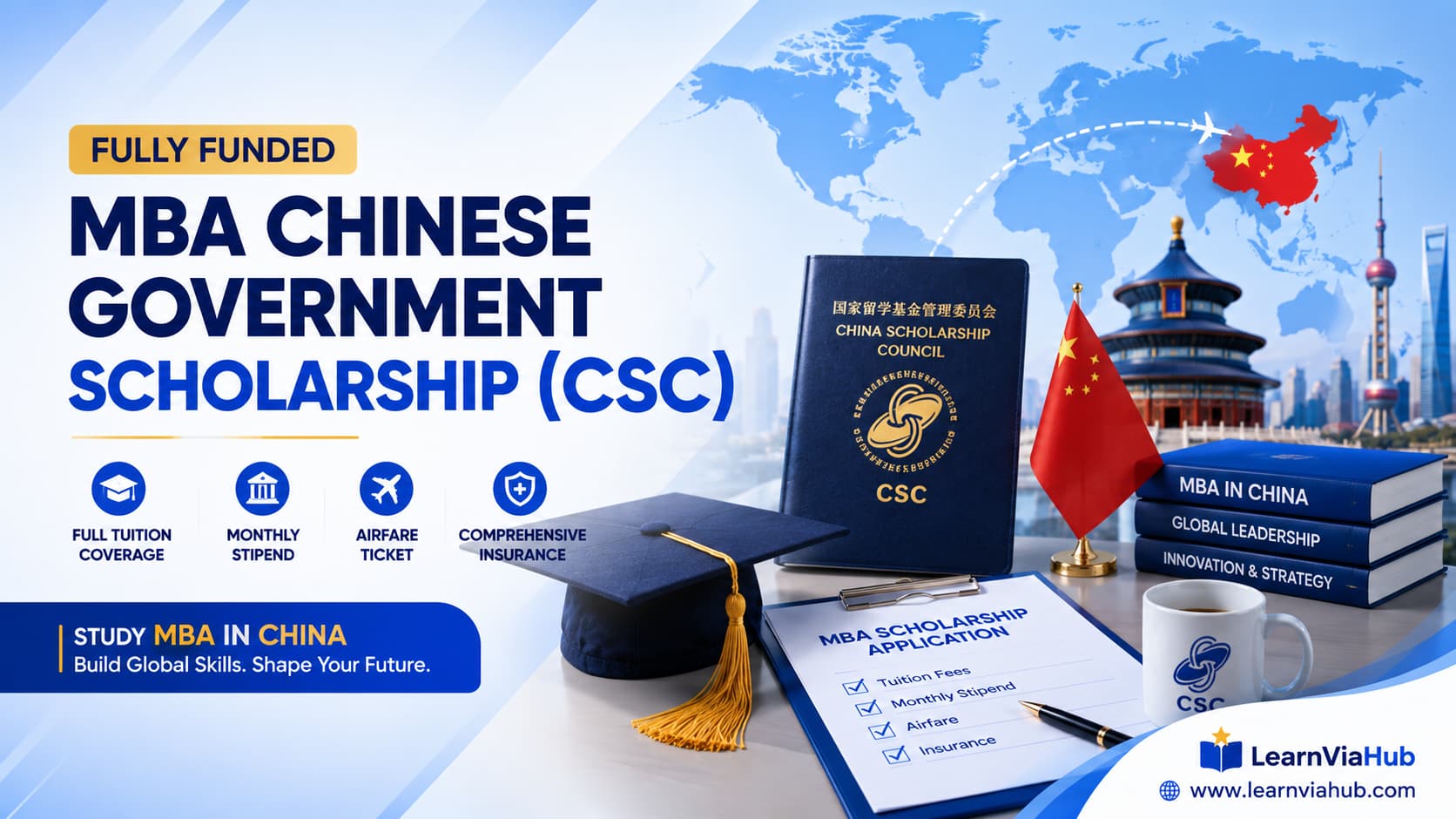
QUICK ANSWER
The Chinese Government Scholarship (CSC) can fully fund an MBA at some Chinese universities — but not all. Coverage varies by school: Tsinghua requires pre-admission to the MBA before CSC, Tongji requires tuition to still be paid (RMB 129,000/year), and PHBS states a CSC grant “will not fully cover the tuition cost.” A small number of universities (e.g., Chongqing’s Youth of Excellence MBA) offer it as a full-scholarship programme.
Two application channels exist: Type A (through the Chinese embassy) and Type B (direct to a university). Age limit: under 35 for master’s. CSC itself does not require work experience; most top MBA programmes do (2–3+ years).
Jump to a section
CSC MBA snapshot
| Host country | China |
| Funding type | Fully funded at some universities; partial at others (see below) |
| Monthly stipend | RMB 3,000 for master’s students |
| Accommodation | Free university dormitory (or a housing subsidy if the dorm is full — amount varies by university) |
| Health insurance | Comprehensive coverage for the scholarship period |
| Airfare | Type A (Embassy) scholars are eligible for reimbursement. Type B (University) routes typically do not include it. |
| Work experience | Not required by CSC. Most top MBA programmes require 2–3+ years. |
| Application channels | Type A (Embassy) or Type B (University) |
| Typical deadlines | January – April 2027 (varies by channel and university) |
| Age limit | Under 35 for master’s programmes (34 or younger on the deadline) |
| Post-study obligation | None for international students |
| Official link | campuschina.org |
What CSC covers — and where it doesn’t
The standard package is tuition waiver, free dormitory, RMB 3,000/month stipend, health insurance, and (for Type A) airfare reimbursement. But tuition coverage specifically varies by university. Three verified examples:
Tongji University — tuition still payable
Tongji’s Full-Time MBA programme page states that even with a CSC or Shanghai Municipal scholarship, admitted students must still pay the programme tuition of RMB 129,000 per academic year.
Peking University HSBC Business School — partial coverage
PHBS’s own admissions page states that a CSC grant “will not fully cover the tuition cost” at PHBS.
Chongqing University — full scholarship
Chongqing’s International MBA is offered as a full-scholarship programme under the CSC Youth of Excellence Scheme.
What to do with this: Before you commit to a university, email its international MBA office and ask directly: “For CSC scholars admitted to the MBA, is tuition fully waived, or is any part payable by the student?” Get the answer in writing. The answer determines whether CSC is a full ride or a partial one for your target programme.
Eligibility
- Nationality: Non-Chinese citizen in good health. All countries are eligible.
- Education: Completed bachelor’s degree (or equivalent) with a strong academic record.
- Age: Under 35 at application — meaning 34 or younger on the deadline. This is strictly enforced with no flexibility.
- Work experience: Not required by CSC. Most top MBA programmes set their own 2–3+ year requirement.
- Language: For English-taught MBAs, typically IELTS 6.0+ or TOEFL 80+ — but check your target programme’s specific requirement (some ask for IELTS 6.5+). For Chinese-taught programmes, HSK 4 or 5.
- Physical exam: A Foreigner Physical Examination Form is mandatory.
The work-experience trap
CSC’s funding rules don’t mention work experience. But Tsinghua’s Global MBA, Peking University’s Guanghua MBA, Fudan’s School of Management MBA, and Shanghai Jiao Tong’s Antai MBA all require 2–3+ years of professional experience for admission. Meeting CSC’s criteria does not mean you meet the MBA’s criteria. Confirm the MBA programme’s own requirement before you invest in the CSC application.
Type A vs Type B — how they differ
Two channels, same benefits, different process. You can apply through both at the same time to increase your chances.
| Feature | Type A (Embassy) | Type B (University) |
|---|---|---|
| How it works | Apply through the Chinese embassy in your country. Embassy reviews and forwards applications. | Apply directly to a Chinese university that nominates you. You must meet the university’s admission requirements first. |
| Agency number | Your local embassy’s number | The university’s number (see table below) |
| Typical deadline | January – March 2027 (varies by country) | December 2026 – April 2027 (varies by university) |
| Airfare | Eligible for reimbursement (process varies by embassy) | Typically not included |
| Best for | Applicants without a specific university in mind; those applying to multiple universities at once | Applicants with a clear MBA programme preference; those who already have a pre-admission letter |
Strategy: apply through both channels simultaneously. Use Type A for a broad reach and Type B for your top-choice MBA. CSC allows applications through multiple channels as long as you use the correct agency numbers.
MBA-eligible universities — with agency numbers and tuition coverage
You need each university’s CSC agency number to complete the application at campuschina.org. Confirm the number on the university’s own admissions page before submitting.
| University | Agency № | MBA programme | Language | CSC tuition coverage |
|---|---|---|---|---|
| Tsinghua University | 10003 | Tsinghua SEM MBA | English / Chinese | Pre-admission required: must pass MBA interview first; CSC application alone is not accepted |
| Peking University | 10001 | Guanghua School of Management MBA | English / Chinese | Check programme page; PHBS states CSC will not fully cover tuition |
| Fudan University | 10246 | School of Management MBA | English / Chinese | Confirm with Fudan’s international office |
| Shanghai Jiao Tong University | 10248 | Antai College MBA | English / Chinese | Confirm with SJTU’s international office |
| Tongji University | 10247 | Full-Time MBA | Chinese / English tracks | Tuition still payable — RMB 129,000/year even with CSC |
| Chongqing University | 10611 | International MBA (Youth of Excellence) | English | Full scholarship under CSC Youth of Excellence Scheme |
Note: agency numbers are set by CSC and can occasionally be updated. Always cross-check on the university’s own admissions page or campuschina.org.
How to apply — both channels
All applications are submitted online at campuschina.org. You can apply through both Type A and Type B at the same time.
Type A (Embassy)
- Check your local Chinese embassy website for the CSC call — usually announced November–December 2026. Note the agency number and exact deadline (typically January–March 2027).
- Create an account at campuschina.org. Select “Type A” and enter the embassy’s agency number.
- Fill in the online form: personal details, education, and up to three university/programme preferences. Confirm each MBA’s own work-experience requirement first.
- Upload required documents (see checklist below). The study plan is the most important written component.
- Submit online, download the completed form, print, and sign it.
- Send the physical package to your embassy if required. Some embassies now accept fully digital submissions.
- Results typically announced July–August 2027.
Type B (University)
- Contact your target university by October 2026. Confirm the MBA accepts CSC scholars, check its work-experience requirement, and get the university’s agency number.
- Apply for MBA admission through the university’s application system. Meet all admission requirements — transcripts, language scores, references, work experience.
- Once you have a pre-admission letter, go to campuschina.org, create an account, select “Type B”, and enter the university’s agency number.
- Complete the CSC application and upload all documents, including the acceptance letter.
- Submit before the university’s CSC deadline — usually December 2026 to April 2027.
- The university nominates you to CSC. Results typically announced June–August 2027.
Required documents
Missing or incorrectly formatted files are a common reason for rejection. Prepare these 2–3 months before the deadline.
- CSC online application form (printed and signed)
- Highest degree certificate and transcripts, certified and translated into Chinese or English
- Study plan / research proposal — typically 800–1,000 words for MBA applicants
- Two letters of recommendation, in Chinese or English, on official letterhead
- Foreigner Physical Examination Form — mandatory, must use the official CSC template
- Valid passport bio-data page
- Language proficiency certificate (IELTS/TOEFL for English-taught; HSK for Chinese-taught)
- Acceptance letter from a Chinese university (required for Type B, optional but helpful for Type A)
- Non-criminal record certificate (if required by your embassy)
Study plan — the four things reviewers look for
- A specific business or management problem your MBA will help you solve — not a general “I want to grow my career”
- Why China specifically — name Chinese companies, industries, or policies relevant to your goal (e.g., Belt and Road, digital economy, green energy)
- 2–3 realistic objectives for what you want to learn
- Home-country impact — how you’ll apply the knowledge after graduation
Common mistakes
Frequently asked questions
Do I need work experience for a CSC MBA?
Is there an age limit?
Does the CSC scholarship cover airfare to China?
How competitive is the CSC MBA?
How does CSC MBA compare with other government schemes?
Official resources
| CSC official website | campuschina.org |
| CSC application system | studyinchina.csc.edu.cn |
| LearnViaHub MBA scholarships hub | Compare all 8 government schemes |
LearnViaHub is an independent educational platform, not affiliated with the Chinese Government or the CSC. Always verify information on official websites before applying.
Christian Chinonso is the founder of LearnViaHub, with 6+ years of research experience in international education — including GPA systems, scholarships, student financing, and study-abroad guidance — for students worldwide.