
Quick Answer
Most scholarship interview questions fall into four categories regardless of programme: motivation, leadership, academic direction, and long-term impact. What changes between scholarships isn’t the question categories — it’s which one gets the most weight. Chevening leans hardest on leadership and UK connection; Fulbright leans on cultural exchange in both directions; DAAD leans on development relevance; Erasmus Mundus leans on fit with the specific consortium. Answering with the right emphasis for your target scholarship, using structured examples rather than vague claims, is what separates a strong interview from a rehearsed one.
Core Questions Every Panel Asks
What Each Panel Is Really Testing
Virtual Interview Logistics
FAQs
Structure Your Answers With the STAR Method
Panels are trained to spot rehearsed, generic answers. The fix isn’t to sound less prepared — it’s to ground every answer in a real example instead of an abstract claim. The STAR method structures that:
- Situation — the specific context. Keep this brief; it should never dominate the answer.
- Task — what you were responsible for or trying to achieve.
- Action — what you specifically did. This should be the bulk of your answer.
- Result — the measurable or observable outcome, and what you learned.
A useful discipline: no more than about 20% of your answer should be spent setting up the Situation. Spend most of your time on the Action — that’s the part that actually demonstrates capability.
Core Questions Almost Every Panel Asks
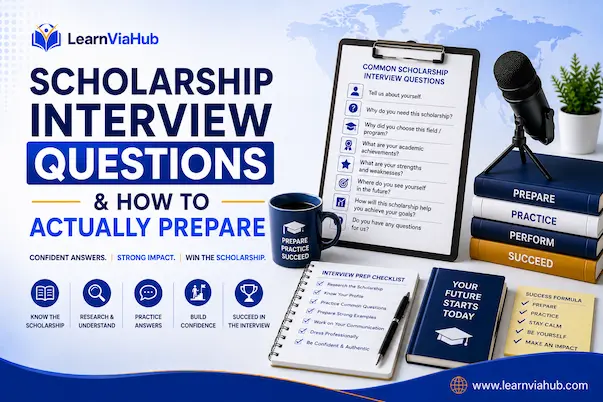
- “Tell me about yourself.” Not an invitation to recite your CV — the panel has already read your application. Give a concise narrative connecting your background, your field, and your direction, in under 90 seconds.
- “Why this scholarship, specifically?” The most important question in the room for government scholarships, and the one most applicants answer too generically. “It’s a world-class programme” signals you picked from a ranking. Naming a specific module, professor, or the exact gap this programme fills in your experience signals you did the work.
- “Why do you need this scholarship, and not just funding in general?” They already know you need funding — everyone applying does. What’s being tested is whether you understand what the scholarship is actually for. Answer with the programme’s mission, then connect your plans to it.
- “What will you do after the programme ends?” For any scholarship with a mission-driven funder (government or foundation), a vague or evasive answer here is a common rejection point, even after a strong interview otherwise.
- “Tell me about a time you showed leadership / overcame a setback.” This is where STAR structure matters most — use a real, specific example, not a general claim about your character.
What Each Panel Is Really Testing
Same question categories, different emphasis. Calibrate your preparation accordingly — this mirrors the same mission-fit framing covered in our personal statement guide, since a consistent story across your written application and interview matters.
| Scholarship | What the Panel Weighs Most |
|---|---|
| Fulbright | Academic exchange and bidirectional cultural contribution — clarity on study objectives and how you’ll represent your country, plus a credible return-and-impact plan. |
| Chevening | Leadership potential and long-term UK network value — expect direct questions about your leadership examples and post-award influence. |
| DAAD | Development relevance — how your field connects to your home region’s development needs. |
| Erasmus Mundus | Consortium fit and mobility readiness — interviews are typically run by the specific consortium, not a central EU panel, so expect programme-specific and sometimes subject-matter questions. |
| Gates Cambridge | Academic depth alongside social impact — expect more rigorous subject-matter questions than other programmes typically ask. |
Note: not every scholarship interviews. Erasmus Mundus consortia mostly rank on written applications and only some conduct interviews; government scholarships like Chevening and Fulbright treat the interview as a standard stage — assume one from the day you apply if a government scholarship is your target.
Virtual Interview Logistics
- Time zones: double-check the stated time against your own zone — this is a common, avoidable error when interviews are scheduled across countries.
- Platform check: confirm which platform will be used and install/test it at least a day beforehand.
- Tech check: test lighting and audio ahead of time — poor audio quality can undercut a strong answer.
- If you don’t know an answer: for subject-matter or technical questions (more common in research-oriented programmes), say so honestly rather than guessing — panels are generally more interested in how you think through a problem than whether you have a memorized correct answer.
Frequently Asked Questions
How many questions are usually asked in a scholarship interview? ▼
Does Erasmus Mundus always require an interview? ▼
Should I memorize my answers word-for-word? ▼
What’s the biggest interview mistake candidates make? ▼
Complete your scholarship preparation:

Christian Chinonso is the founder of LearnViaHub, with 6+ years of research experience in international education, GPA systems, and study-abroad guidance for international students.Christian Chinonso is the founder of LearnViaHub, with 6+ years of research experience in international education — including GPA systems, scholarships, student financing, and study-abroad guidance — for students worldwide.