
Quick Answer
A scholarship personal statement (also called a Statement of Purpose, or SOP) for a fully funded international scholarship is not primarily about proving financial need — it’s about proving mission fit. Fulbright, Chevening, Erasmus Mundus, DAAD, and Gates Cambridge each fund a specific kind of impact, and the strongest statements show reviewers exactly how you’ll deliver on that mission, not just why you deserve support. This guide covers the structure, the framing mistake most guides get wrong, and what to emphasize for each major scholarship.
Why “Explain Your Financial Need” Is the Wrong Starting Point
A lot of scholarship-writing advice online tells you to center your financial need — why you can’t otherwise afford this degree. That framing comes from domestic, need-based scholarships, and it’s the wrong lens for most fully funded international scholarships.
Government-funded programmes like Fulbright aren’t primarily solving a financial problem — they’re funding a specific outcome. Fulbright explicitly frames itself around mutual cultural understanding: you’re a “cultural ambassador,” not just a funding recipient. Chevening funds future leaders with a UK-alumni network effect in mind. Erasmus Mundus and DAAD both look for evidence you’ll use a multi-country or development-focused education to create impact in a specific direction. None of these are asking “why do you need this money” — they’re asking “what will you do with this opportunity, and does it match what we’re trying to achieve.”
The practical shift: instead of “I come from a background with limited resources and this scholarship would change my life,” aim for “here’s the specific problem I plan to work on, here’s the evidence I can do it, and here’s exactly why this programme’s approach gets me there.” Need can appear as context — it should not be the argument.
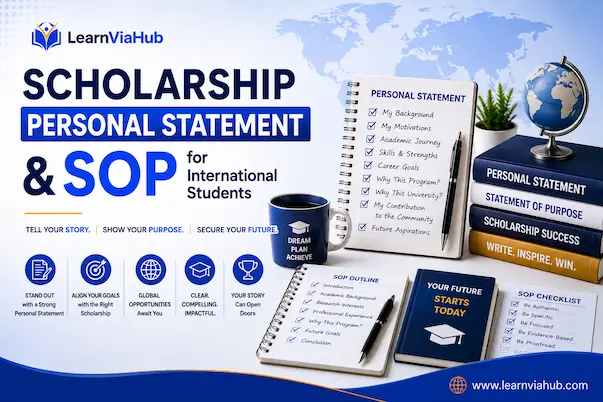
Core Structure
- Opening — a specific moment, not a summary. Skip “Since I was young, I have always been passionate about…” Start with a concrete moment, project, or turning point that sets up what you’re about to argue.
- Academic and professional foundation. What you’ve done that makes you credible — but framed as evidence for your goal, not a standalone list of achievements.
- The specific goal. Not “I want to make a difference” — the actual problem, field, or outcome you’re aiming at.
- Why this programme, specifically. Name modules, faculty, consortium partners, or the country’s specific relevance to your field. This is the single most common weak point — see the framing note below.
- What happens after. Your plan to apply what you learn — this matters more for mission-driven scholarships than for a generic master’s application.
- Closing. Return to your opening image or moment, now reframed by everything you’ve argued.
What Each Major Scholarship Actually Wants
| Scholarship | Core Framing to Emphasize |
|---|---|
| Fulbright | Cultural exchange and mutual understanding — how you’ll represent your country in the US and bring value back home. Address the “why return home” question directly. |
| Chevening | Leadership and future influence — Chevening explicitly wants people who will hold influential positions and maintain a long-term UK connection. |
| Erasmus Mundus | Fit with the specific consortium — name at least two partner universities and explain why studying across multiple countries specifically serves your goal, not just the subject matter. |
| DAAD | Development relevance — how your work connects to your home country or region’s development priorities, since DAAD EPOS programmes are oriented around development-relevant fields. |
| Gates Cambridge | Academic excellence and a commitment to improving the lives of others — Gates Cambridge weighs intellectual ability alongside a clear social-impact dimension. |
Frequently Asked Questions
Is a personal statement the same as a Statement of Purpose (SOP)? ▼
Should I mention financial need at all? ▼
Can I reuse the same statement for multiple scholarships? ▼
How long should a scholarship personal statement be? ▼
Next steps in your scholarship strategy:
Christian Chinonso is the founder of LearnViaHub, with 6+ years of research experience in international education, GPA systems, and study-abroad guidance for international students.Christian Chinonso is the founder of LearnViaHub, with 6+ years of research experience in international education — including GPA systems, scholarships, student financing, and study-abroad guidance — for students worldwide.