
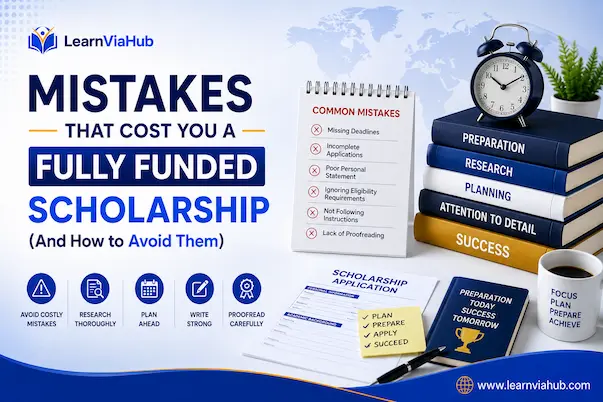
Quick Answer
Most guides on scholarship mistakes are written for small domestic awards — missed deadlines, typos, forgetting a transcript. Fully funded international scholarships like Fulbright, Chevening, Erasmus Mundus, DAAD, and Gates Cambridge fail applicants in different, more specific ways: technical disqualifications buried in eligibility rules, essays that miss what the programme is actually funding you to do, and administrative slip-ups unique to multi-country or government-run competitions. This guide covers the mistakes specific to that category — the ones a generic scholarship-tips article won’t warn you about.
Eligibility Trap Mistakes
These are the mistakes that end an application before it’s even properly reviewed — often buried in fine print applicants skim past.
Not opting in to scholarship consideration
Erasmus Mundus applications ask, separately from the programme application itself, whether you want to be considered for the EU scholarship. Miss or skip this checkbox and your application may be processed as self-funded — meaning you were never in the scholarship pool at all, regardless of how strong your file was.
Exceeding the programme application limit
Erasmus Mundus caps applicants at three programmes per year, and consortia share applicant data — applying to a fourth risks automatic disqualification from all of them, not just the extra one. Always confirm the exact limit and stay under it.
Misreading dual-citizenship or residency rules
Government-funded scholarships often have citizenship rules that aren’t obvious. Chevening, for example, disqualifies applicants who hold dual UK citizenship — a detail easy to miss if you assume “international applicant” rules apply uniformly. Read the specific disqualification clauses for your target scholarship, not just the general eligibility summary.
Failing a pre-screen question you didn’t take seriously
Several scholarships use a short eligibility pre-screen before you even reach the full application. An incorrect answer — sometimes on a detail applicants assume doesn’t matter, like exact work-experience hours — can fail you out at that stage. Chevening’s 2,800-hour work experience threshold is a documented example: falling short, even by a little, disqualifies the application before review begins.
Essay & Statement Mistakes
Writing a “need” essay instead of an “impact” essay
Domestic scholarship essays often center financial need. Government-funded international scholarships fund a mission, not a need — Fulbright is explicitly built around mutual cultural understanding, and reviewers are looking for what you’ll do with the opportunity and how you’ll apply it back home, not primarily why you can’t otherwise afford it.
Reusing one generic essay across every application
This is the single most repeated failure point across Fulbright, Chevening, and Erasmus Mundus alumni accounts. An essay that lists achievements with no specific reason for that programme, that country, or that consortium reads as generic — and selection committees process thousands of these. Naming specific modules, professors, or a consortium’s mission by name is what separates a tailored statement from a template.
Achievements with no personal story
An essay that’s a list of accomplishments and nothing else tends to underperform against one that includes a genuine narrative — including setbacks. Applicants who’ve rewritten “achievements-only” essays into something that shows a real turning point or motivation have reported markedly better results across multiple programmes.
Not addressing the “why return home” question
For J-1 visa-based or bilateral government scholarships, a vague or evasive answer about your post-programme plans can cost the award even when every other part of the application was strong — this question exists specifically because these programmes are built around a return-of-service expectation.
Administrative Mistakes
Treating every programme’s format as the same
Unlike Fulbright or DAAD, which run through a more centralized process, Erasmus Mundus has no central application system — each of its 160+ consortia has its own portal, word count, and deadline. Applicants who assume one format applies across programmes often submit essays that are the wrong length or miss a consortium-specific requirement entirely.
Underestimating document translation and certification lead time
Certified translations of transcripts and degree certificates can take weeks, not days, especially during peak application season when translation services are backed up. Starting this process the same week as your deadline is a common, entirely avoidable failure point.
Strategy Mistakes
Applying only to the most prestigious option
Betting everything on one highly competitive scholarship — with acceptance rates as low as 2–5% for programmes like Erasmus Mundus or Chevening — without a backup plan leaves no room for the reality that even excellent applicants are frequently not selected. Building a shortlist across a few genuinely well-matched programmes changes the odds without diluting effort. See our guide to choosing the right scholarship for a filtering framework.
Ignoring your country’s specific competition
Fulbright and Chevening are both administered on a per-country basis with country-specific deadlines, quotas, and — for Fulbright — wildly different award rates (from roughly 3% to 100% depending on the country). Applying based on the “global” version of a scholarship’s requirements instead of your specific country’s competition page is a common and costly oversight.
Frequently Asked Questions
What’s the single most common reason strong applicants get rejected? ▼
Can I fix an eligibility mistake after submitting? ▼
How early should I start document translations? ▼
Is it a mistake to only apply to one scholarship? ▼
Next steps in your scholarship strategy:
Christian Chinonso is the founder of LearnViaHub, with 6+ years of research experience in international education, GPA systems, and study-abroad guidance for international students.Christian Chinonso is the founder of LearnViaHub, with 6+ years of research experience in international education — including GPA systems, scholarships, student financing, and study-abroad guidance — for students worldwide.